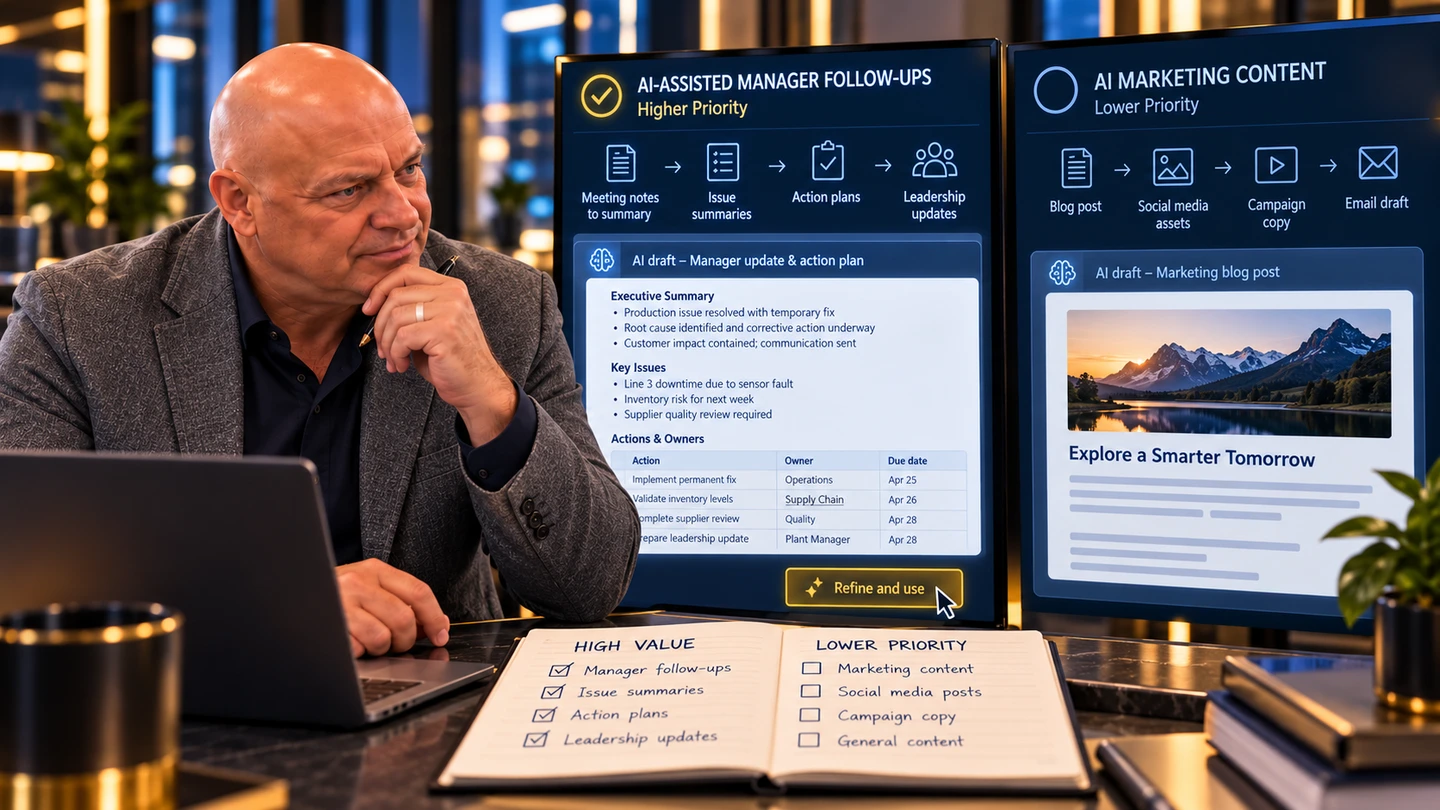
Conceptual AI illustration using my avatar. The scene and interface are illustrative; they do not document an actual client engagement, product deployment or business result.
If AI saves time but creates more rework, it is not a win. AI should improve something that matters: speed, quality, consistency, customer response, employee productivity, training time, decision support, documentation, cost control, or risk reduction.
AI readiness is not about chasing software. It is about preparing the business to use AI with purpose, discipline, and accountability. The companies that win with AI will connect the technology to real work, real people, real process, and real measurement.
Why This Matters
ROI is not only dollars. It can include time saved, fewer revisions, better documentation, faster onboarding, reduced rework, improved response time, and better manager visibility. But the expected outcome must be defined before the workflow is launched.
This is an executive operating issue. AI can help a company move faster, but speed only matters when the direction is right. If the business problem is unclear, AI becomes noise. If the workflow is unclear, AI can automate confusion. If the data is weak, AI can create polished but unreliable output. If people are not trained, AI can increase risk instead of reducing friction.
What I Would Look For
I would start by looking at where the work slows down, where decisions repeat, where documents are recreated, where people copy information from one place to another, and where knowledge is trapped in people's heads. Then I would separate three categories: work AI can safely assist, work AI can help prepare but a human must approve, and work AI should not touch until governance is stronger.
Business Example
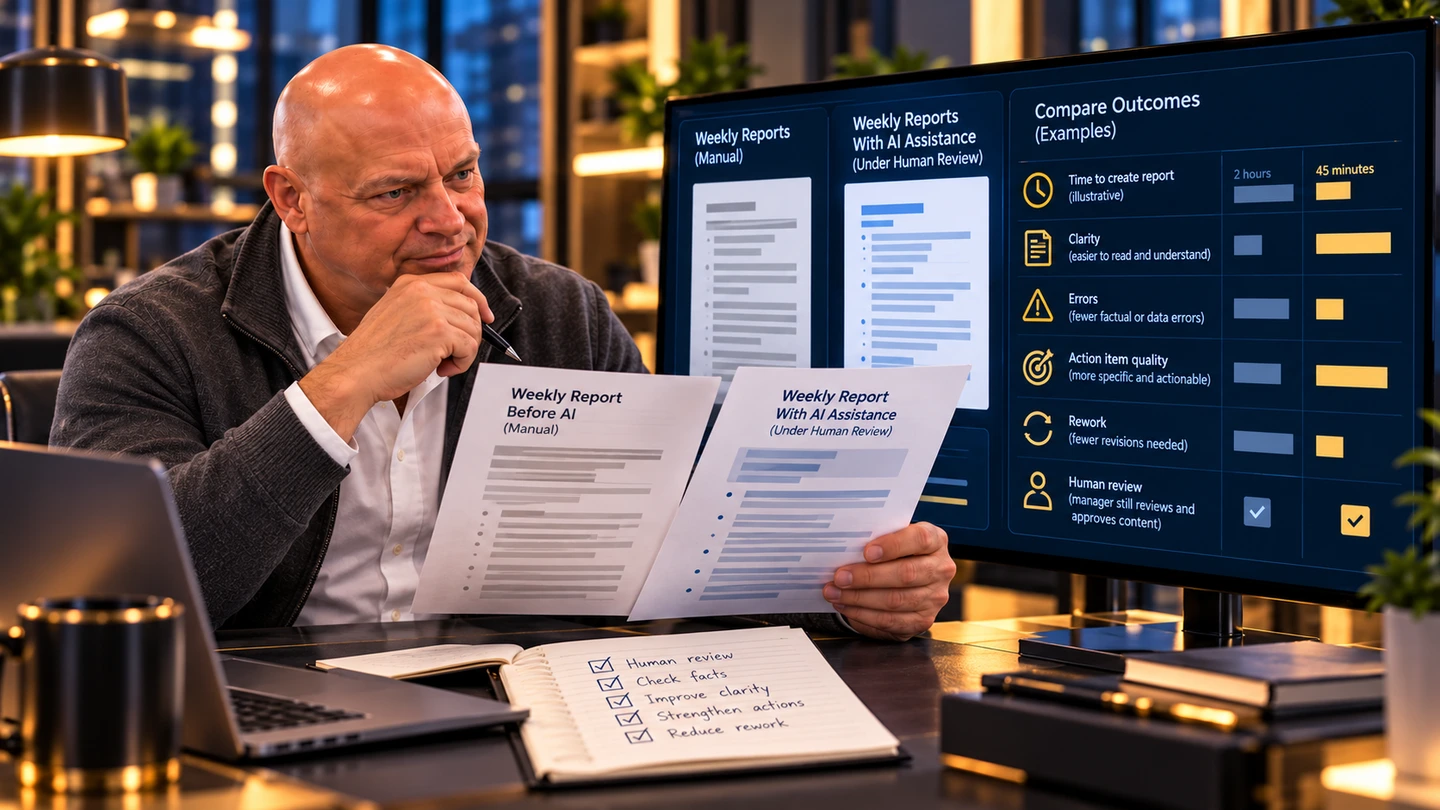
A company uses AI to help managers write weekly reports. Time drops from two hours to 45 minutes. That looks good, but leadership should also ask whether reports are clearer, errors are fewer, action items are stronger, and managers are still reviewing content.
The lesson is simple: AI should support the work, not hide the problem. It should help employees organize information, communicate clearly, reduce repetitive effort, and improve execution. It should not become a substitute for leadership, judgment, or accountability.
Risk If Ignored
If companies measure only usage, they confuse activity with value. More prompts, more drafts, and more documents do not automatically mean better business performance.
This is where many companies get AI wrong. They move too fast in the wrong places and too slowly in the places that matter. They buy tools before defining use cases. They experiment without rules. They measure activity instead of impact. That approach may look innovative, but it is not disciplined.
Action Checklist
Ask these questions before moving forward: What business problem are we solving? Who owns the workflow? What information is being used? What human review is required? What risk could be created? How will employees be trained? How will success be measured? Who is accountable if the output is wrong?
Closing Thought
AI should make businesses clearer, faster, and more disciplined. It should help people turn knowledge into action. But that only happens when companies treat AI adoption as an operating capability, not a technology trend.
I help companies measure whether AI is actually improving the work – not just creating more polished activity.
Sources Consulted
– Microsoft 2026 Work Trend Index: https://blogs.microsoft.com/blog/2026/05/05/how-frontier-firms-are-rebuilding-the-operating-model-for-the-age-of-ai/
– Microsoft WorkLab – Agents and human agency: https://www.microsoft.com/en-us/worklab/work-trend-index/agents-human-agency-and-the-opportunity-for-every-organization
– McKinsey State of AI 2025: https://www.mckinsey.com/capabilities/quantumblack/our-insights/the-state-of-ai
– NIST AI Risk Management Framework: https://www.nist.gov/itl/ai-risk-management-framework
– IBM What is AI Governance: https://www.ibm.com/think/topics/ai-governance
Reuse the evidence workflow while rebuilding the domain rules.
EXECUTIVE ANALYSIS | H. Max Ottesen
AI-generated conceptual editorial illustration. Fictional people and setting; not documentary evidence. Conceptual illustration linking a funding review desk and a separate fleet maintenance review.
A funding project review and a maintenance review can share a sequence: define the requirement, collect evidence, identify gaps and assign the next action. They cannot safely share every decision rule. That distinction is the limit I would put on any reusable AI workflow.
Disclosure: CapitalRoute AI is my own internal development work. Its guide is an owner-controlled design source, not independent evidence that the application or a related logistics system improves outcomes. [1]
Reuse the questions
The CapitalRoute V0.39E guide describes source verification, project documents, review stages and separation of internal notes from client-facing reports. It describes a local/internal application rather than a public SaaS product. [1]
The reusable idea is an evidence record. For a proposed maintenance assistant, that could mean linking the relevant work order, unresolved question, authorized reviewer and next review point. A warehouse version could use a different record for inventory and customer commitments. Neither application is claimed to exist here.
I would preserve three separations: the source record, the assistant’s interpretation and the authorized decision. Moving an item between those states should leave a traceable reason. If the evidence is incomplete, the workflow should preserve the gap.
Rebuild the meaning in each domain
A funding-readiness rubric cannot authorize a vehicle’s return to service. The people, evidence and authority needed for that decision must be defined by the relevant operating process. Reusing a screen layout should not obscure that responsibility.
The same caution applies to an apparently familiar score. A proposed assessment of document completeness says nothing by itself about mechanical condition, driver availability or a safe loading sequence. Each requires its own definition and review.
Research described by Harvard Business School shows that AI capability varies across tasks. [2] It supports testing the new task rather than treating success in one setting as transferable proof. It does not establish the performance of either CapitalRoute or a proposed operations assistant.
Transfer a test discipline too
For a new use, build a representative set of cases with domain specialists. Include conflicting evidence, missing records and situations where the correct response is to stop. Compare the tool’s preparation with the existing process and record the checking work it creates.
NIST’s framework places AI use in its operating context. [3] My recommendation is to make a new approval decision for each domain: what the tool may read, what it may recommend, who must review and what it may change. A successful funding-document prototype should not automatically acquire maintenance authority.
Keep the claim proportionate
The proposed transfer is a management pattern, not a universal model or proven product platform. It could make evidence easier to review; that benefit still needs to be demonstrated in each setting.
The playbook worth reusing is disciplined preparation. Domain knowledge must determine what counts as sufficient evidence and who is allowed to act on it.
SOURCES & EVIDENCE
[1] CapitalRoute AI / Growth Partners International (2026-07-08). CapitalRoute AI Application Workflow Guide. CAPITALROUTE_WORKFLOW_SOURCE.pdf, V0.39E, sections 1–2 and 6–12. Locator: CAPITALROUTE_WORKFLOW_SOURCE.pdf, V0.39E, sections 1–2 and 6–12. Supports: The documented internal evidence and review workflow. Limitations: Documents the described internal workflow at that version. It is not an independent test, current build inspection, adoption record or measured outcome study. Checked: 2026-10-17.
[2] HBS AI Faculty / Harvard Business School (2023-09-21). Navigating the Jagged Technological Frontier. https://aiinstitute.hbs.edu/navigating-the-jagged-technological-frontier/. Locator: Study overview and Key Findings. Supports: Task-specific capability and the limited consultant-study setting. Limitations: Study involved 758 consultants and task-specific performance. It does not establish fleet, warehouse, safety or general software-production outcomes. Checked: 2026-10-17.
[3] Elham Tabassi / NIST (2023-01-26). Artificial Intelligence Risk Management Framework (AI RMF 1.0). https://nvlpubs.nist.gov/nistpubs/ai/NIST.AI.100-1.pdf. Locator: NIST AI 100-1, Core, sections 5.1–5.4. Supports: Operating context in AI risk management. Limitations: A governance framework, not evidence that a proposed operating tool improves results. Checked: 2026-10-17.
HOW THE CONCLUSION WAS REACHED
The guide supports a documented review pattern, while task-specific research and governance guidance limit transfer claims. The analogy supports a design hypothesis for another domain. It supplies no causal evidence of deployment benefits.
LIMITATIONS
No cross-domain implementation, validation set, current product test or realized benefit was supplied. Domain-specific legal, safety and engineering requirements must be established before any operational use. Ownership is disclosed; public deployment is not claimed.
Start by tracing one request through the operation. Identify the input, the person responsible, the next handoff and the decision that allows it to move.
Illustrative example: a maintenance request is copied from a message into a spreadsheet, then copied again into a weekly report. A new platform may help, but first define the required fields, the owner of the record and the acceptance check at each handoff.
A small process map can show request received → information checked → work assigned → completion recorded → exception reviewed. Mark the points where a person waits, re-enters information or makes a decision without the required context.
Compare the proposed change against an agreed baseline. A shorter handoff time, fewer missing fields or clearer ownership may be more useful than counting software logins.
Keep this first change bounded. Review it with the people doing the work, document the exception path and expand only after the revised process is usable.
An internal workflow can organize preparation without predicting an award.
EXECUTIVE ANALYSIS | H. Max Ottesen
AI-generated conceptual editorial illustration. Fictional people and setting; not documentary evidence. Illustrated funding project dossier with an evident document gap and no scores or award promises.
Finding a funding opportunity and preparing a reviewable project are different jobs. CapitalRoute AI gives me a concrete way to examine the second: organize the requirements, preserve the evidence and make the next unanswered question visible.
Disclosure: CapitalRoute AI is my own internal development work. This article draws on owner-controlled documentation and proposes further design choices. It is not an independent product review or evidence of funding success. [1]
What the document actually describes
The V0.39E workflow guide, dated July 8, 2026, describes an internal consulting application connecting client projects, funding records, source links, documents, sessions and follow-up work. It says that version is not a public SaaS product. The guide also separates internal notes from client-facing material and describes draft-only email handoff. These are documented workflow descriptions, not functions I independently verified in a current installation. [1]
That scope is useful. It lets this discussion focus on preparation and review rather than suggesting that the software grants eligibility, approves a loan or submits an application on its own.
Keep a readiness score in the proposal column
For a future design, I would consider a route-specific readiness assessment. A proposed 1-to-10 scale would be an internal rubric for evidence completeness and fit, not a probability of obtaining money. The supplied guide does not validate that score or establish it as a working current feature.
Before adopting a number, I would define the criteria with a qualified reviewer. The display should preserve mandatory gaps separately from any aggregate assessment. A missing required document should remain visible even if other parts of the project are strong. “Not assessed” may be more honest than a precise-looking score.
Make every assessment reversible
Consider a hypothetical budget submission. A reviewer should compare the document with the current requirement for the specific route, record any inconsistency and explain what further evidence is needed. The presence of an uploaded file should not count as acceptance of its contents.
The guide’s source-verification and document-review workflow provides a documentary starting point for that process. [1] The extension proposed here would also retain the requirement version and the reason for any assessment change.
NIST cautions against generalizing AI capability from narrow anecdotal evaluation. [2] I would therefore test readiness recommendations on representative cases, including incomplete and unsuitable projects, before claiming the tool improves advisory decisions.
Define the useful lesson narrowly
The lesson I take from this design work is to make preparation inspectable. The reviewer should see the requirement, the evidence, the uncertainty and the next responsible person. A negative finding can be useful if it prevents an unsupported recommendation.
No funding award, client benefit or predictive accuracy is established here. CapitalRoute’s readiness idea should earn confidence through review evidence, rather than borrowing it from the appearance of a score.
SOURCES & EVIDENCE
[1] CapitalRoute AI / Growth Partners International (2026-07-08). CapitalRoute AI Application Workflow Guide. CAPITALROUTE_WORKFLOW_SOURCE.pdf, V0.39E, sections 1–2 and 6–12. Locator: CAPITALROUTE_WORKFLOW_SOURCE.pdf, V0.39E, sections 1–2 and 6–12. Supports: Private/internal product status, described objects, note separation, source checks and draft-only email. Limitations: Documents the described internal workflow at that version. It is not an independent test, current build inspection, adoption record or measured outcome study. Checked: 2026-10-17.
[2] Chloe Autio et al. / NIST (2024-07-26). Artificial Intelligence Risk Management Framework: Generative Artificial Intelligence Profile. https://nvlpubs.nist.gov/nistpubs/ai/NIST.AI.600-1.pdf. Locator: NIST AI 600-1, section 2.2 and action MS-2.5-003. Supports: The warning against extrapolating performance from anecdotal or narrow evaluation. Limitations: Identifies risks and suggested controls; it does not validate these proposed workflows. Checked: 2026-10-17.
HOW THE CONCLUSION WAS REACHED
The guide establishes the intended internal workflow at a named version. The suggested readiness rubric is an extension presented as a proposal. The inference is that explicit evidence gaps could make review more inspectable, not that scores predict funding or that the application has delivered results.
LIMITATIONS
Current build, AI configuration, actual scoring implementation, external users, funding outcomes and advisory effectiveness were not tested. No current program rules or financial advice are supplied. The author’s ownership is a conflict of interest, disclosed above.
I am seriously considering a question that is both personal and professional:
Can a Danish-American, after 30 years in America, return to Denmark and end his career there in a meaningful way?
Not just come home to retire. Not just visit family. Not just enjoy Denmark from a distance.
Actually work. Contribute. Lead. Be useful. Be relevant.
For the last 30 years, my career has been built in America. I have worked across corporate communication, security and protection, marine logistics, trucking, sales, management, oil and lubricants.
But more importantly, my experience has always been on the management and leadership side of business.
Director. Vice President. CEO. Business owner.
I have been responsible for multi-million-dollar budgets. I have managed people, operations, customers, risk, growth, pressure, and accountability. I have worked for some of the biggest companies in the world in their fields, including Mercedes-Benz, AT&T, and Johnson & Johnson.
I have built businesses, led teams, carried responsibility, made difficult decisions, solved operational problems, dealt with major customers, handled pressure, and learned what it means when the final decision lands on your desk.
America teaches you certain things.
It teaches you speed. It teaches you confidence. It teaches you to sell value. It teaches you to speak directly. It teaches you to take responsibility, compete, survive, and keep moving.
But Denmark is different.
Denmark has a flatter business culture. Less visible hierarchy. Less status. More consensus. More understatement. More emphasis on fitting into the team before trying to lead the room.
And that creates the difficult question:
Is 30 years of international leadership experience an advantage in Denmark — or does it make you harder to place?
I do not ask that question with bitterness. I ask it because I genuinely do not know.
A Danish employer may look at someone like me and quietly wonder:
Is he too American now? Will he expect too much authority? Will he expect too much money? Can he adjust to a flatter organization? Will he be too direct? Will he dominate instead of collaborate? Is he still Danish in the way Danish companies expect? Can someone who has been at director, vice president, CEO, and ownership level still fit into a Danish structure? Is he looking for a real final chapter — or just a soft landing?
Those are fair questions.
But I also think there is another side.
Maybe someone who has spent 30 years outside Denmark can bring something valuable back.
Maybe there is value in someone who understands both Danish and American business culture. Maybe there is value in operational experience from a larger, faster, more competitive market. Maybe there is value in having managed serious budgets and real responsibility. Maybe there is value in someone who has worked inside global companies and also understands what it means to own and run a business. Maybe there is value in leadership maturity. Maybe there is value in having built, managed, failed, adjusted, and kept going. Maybe there is value in someone who is not trying to build a 30-year career anymore, but who still wants to give 5, 7, or 10 strong years to the right company.
That is what I am really asking.
Is there room in Denmark for a returning Dane who does not want to stop working, but also does not want to start completely over?
Someone who still has energy. Still has ambition. Still has something to give. Still understands responsibility. Still knows how to create structure, lead people, protect margins, manage customers, and get results.
But also someone who is honest enough to know that Denmark may not automatically understand or value an American career path.
Because coming home after 30 years is not really coming back to the same place.
Denmark has changed. I have changed. The labor market has changed. The professional language may still be familiar, but the business code may not be the same.
And then there is the age question.
We all know companies say they value experience. But do they really?
At some point, experience can become complicated. A senior person can be seen as expensive, too independent, too established, too difficult to shape, or too close to retirement.
That is the uncomfortable truth.
So maybe the question is not just whether I can find a job in Denmark.
Maybe the better question is:
Can Denmark use someone like me?
Can the Danish labor market make room for people who left, learned something different, became something different, and now want to bring that experience home?
I am not asking whether Denmark owes me anything. It does not.
I am asking whether there is a realistic path.
A senior leadership role? A practical operations role? Consulting? Advisory work? A bridge role between Denmark and the American market? A final chapter where experience matters more than title?
I do not know the answer yet.
But I would like to hear from my Danish friends, business contacts, and people who understand the Danish labor market:
Do Danish companies truly value international leadership experience? Or do they prefer people who stayed inside the local system? Is American confidence seen as leadership — or arrogance? Is senior experience seen as wisdom — or risk? Does experience with global companies matter in Denmark? Does business ownership matter? Can a person come home after 30 years and still be “one of us”? Or do you have to prove yourself all over again?
I am seriously considering this move.
And before I do, I want to understand the truth — not the polite version.
Conceptual AI illustration using my avatar. The scene and interface are illustrative; they do not document an actual client engagement, product deployment or business result.
AI may become one of the most important business tools ever created for people who think differently. Not because AI makes people smarter. Not because AI replaces human judgment. Not because AI magically solves learning differences, communication challenges, or the hard work of building something real. AI matters because it can reduce the friction between a strong idea and a usable output.
For many people, that friction is invisible. They think in a straight line, read quickly, write quickly, organize thoughts in sequence, and turn a blank page into a structured memo without much resistance. But not everyone thinks that way. Some people think visually. Some think in patterns. Some see the whole system before they can explain the first step. Some connect ideas quickly but struggle to put them into traditional written form. Some can diagnose a business problem in minutes, but turning that insight into a polished document takes much longer than it should.
That does not mean the thinking is weak. Sometimes it means the operating system is different. And this is where AI becomes powerful.
What Dyslexia Is – And What It Is Not
Dyslexia is commonly understood as a learning difference that can affect reading, spelling, word recognition, language processing, and sometimes the speed or sequence of written communication. It is not laziness. It is not low intelligence. It is not a lack of discipline. It is not a lack of ideas. It is not an inability to lead, build, sell, operate, innovate, or solve complex problems.
Dyslexia affects people differently. Some struggle mainly with reading speed. Some struggle with spelling. Some struggle with sequencing written information. Some struggle with working memory when processing a lot of text. Some compensate so well that others never see the effort behind the output. That last part matters in business because many high-performing professionals have spent years building workarounds. They memorize. They visualize. They ask someone to review a document. They use templates. They rely on verbal explanation. They create mental maps instead of written outlines.
This Is Bigger Than Most People Realize
Reading, writing and documentation demands affect people differently. Workplace support should begin with the individual and the task: which steps create friction, what support helps, and how the person can check the final output.
In a business context, the practical question is how to help employees communicate and execute their work. Platform membership totals do not establish how many users have dyslexia. The focus should be useful support and individual needs.
That means this is not a small side conversation. It is a leadership conversation, a workforce conversation, and a business performance conversation. It means that in many companies, some of the people struggling with traditional reading, writing, documentation, or communication systems may also be people with strong pattern recognition, visual thinking, creativity, problem-solving ability, entrepreneurial instincts, and operational insight.
Business Has Often Rewarded the Wrong Surface Signals
In many companies, the person who writes the cleanest memo is assumed to have the clearest thinking. Sometimes that is true. But not always. Business culture has a long history of confusing communication format with intelligence. The person who presents information in a conventional structure is often seen as organized, competent, and strategic. The person who explains things in a nonlinear way may be seen as scattered, even when they are seeing more variables than everyone else in the room.
Some of the best operators, entrepreneurs, builders, and problem solvers do not begin with a perfect outline. They begin with a picture, a pattern, a risk, a customer pain point, a system failure, or a gap between what leadership believes is happening and what is actually happening on the floor. They see the operational bottleneck before the weekly report catches up. They see the customer frustration before it becomes a churn number. They see the risk before it becomes an incident.
AI as a Translation Layer
For people who think differently, AI can act as a translation layer between the mind and the business system. It can help turn raw thoughts into outlines, a messy voice note into a structured memo, scattered ideas into a project plan, and a complicated concept into plain English. It can help draft emails, proposals, SOPs, meeting notes, checklists, strategy documents, job descriptions, training material, and executive updates.
The goal is not to make a dyslexic thinker sound like everyone else. The goal is to help the thinker communicate with enough structure that the originality can be understood, evaluated, funded, implemented, and scaled. AI should not flatten different thinking. It should amplify it.
The Difference Between Output and Originality
There is a real danger in using AI poorly. If someone uses AI to replace their own judgment, the work becomes generic. If someone copies and pastes without thinking, the output may look polished but contain no real insight. If a company uses AI to automate without accountability, it can scale errors, bias, bad assumptions, and shallow thinking.
That is not the opportunity I am talking about. The real opportunity is human-led AI. The person still owns the idea. The person still owns the judgment. The person still owns the responsibility. AI helps with the conversion process. For a visual thinker, AI can help convert a mental model into a written plan. For an entrepreneur, AI can help convert a rough concept into a pitch structure. For an operations leader, AI can help convert field observations into a corrective action plan.
Why This Matters for Business
Companies say they want innovation, people who think outside the box, problem solvers, and employees who challenge assumptions. But then many companies build systems that reward only one style of communication: long emails, dense policies, complex forms, bureaucratic reports, meetings with no visual structure, and written processes that make sense to the person who wrote them but not to the people expected to use them.
In that environment, different thinkers can be misunderstood. AI can help close that gap, not by lowering standards, but by improving access to structure. Imagine a company where the mechanic, driver, dispatcher, warehouse lead, safety manager, sales rep, technician, field supervisor, or customer service employee can quickly turn what they know into usable business intelligence.
A Practical Example
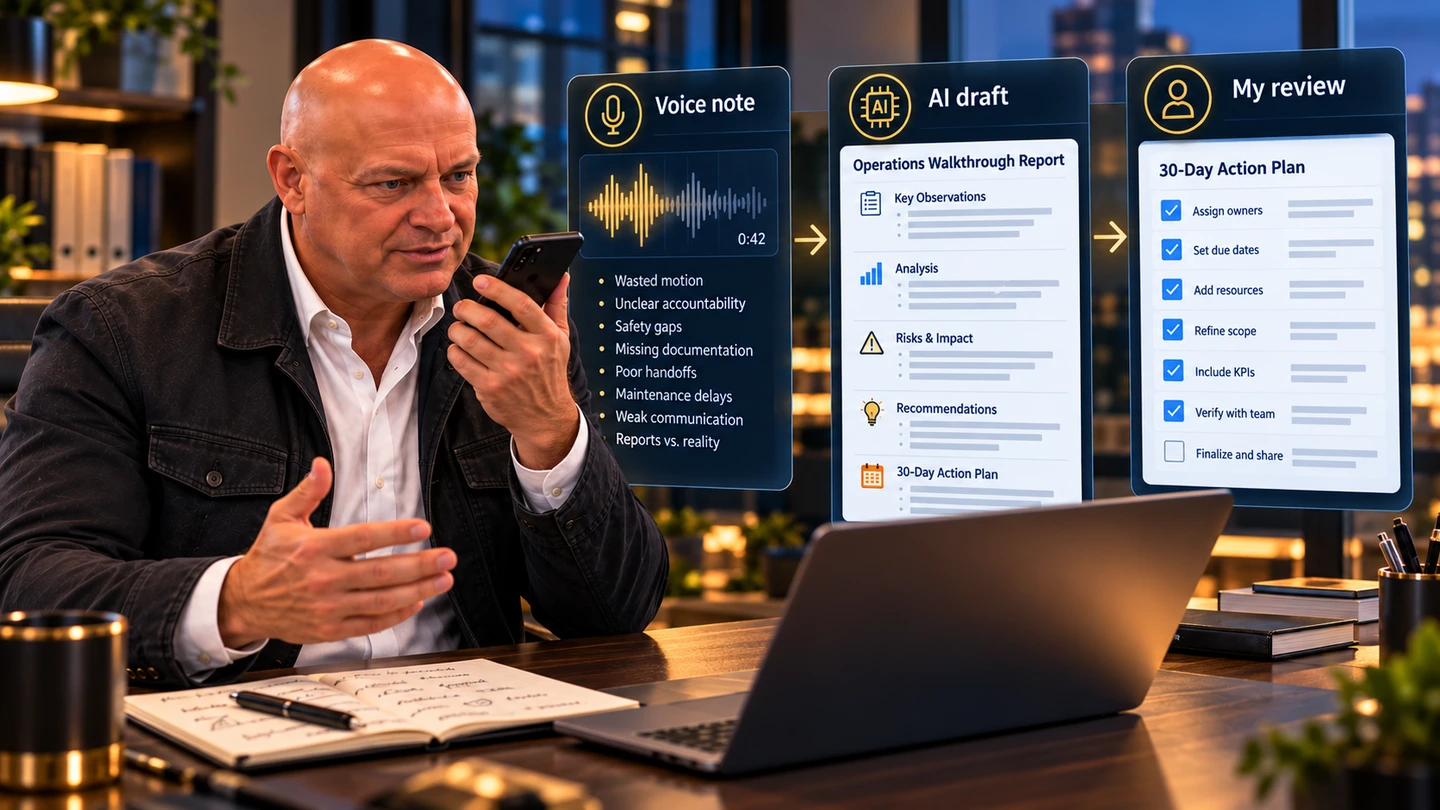
Imagine an operations leader who thinks in systems. He walks through a facility and sees problems immediately: wasted motion, unclear accountability, safety gaps, missing documentation, poor handoffs, maintenance delays, weak communication between departments, and a disconnect between leadership reports and operational reality. He can explain the problem verbally, but when asked to write a formal report, the process slows down.
Now add AI. He records a voice note after the walkthrough. AI turns it into a draft report. He asks AI to organize observations by safety, people, process, equipment, cost, customer impact, and corrective action. He asks AI to create a 30-day action plan. He reviews it, corrects it, adds judgment, removes anything inaccurate, and makes it his own. That is not artificial intelligence replacing an operator. It is operational intelligence becoming visible faster.
My View
I have always believed that strong execution starts with seeing the real system: the people, the process, the friction, the assets, the risk, the customer impact, the cost, the gaps, and the opportunities. Some people see that system in words. Some see it in numbers. Some see it in pictures. Some see it through motion, pattern, pressure, and experience. I tend to think in patterns, pictures, systems, and outcomes before words on a page.
That kind of thinking can be powerful in business, but it also needs structure to become useful to others. That is why I believe AI should be used to support better human performance – not to make everyone think the same, erase originality, replace judgment, or produce generic content with no accountability.
Closing Thought
The future of work should not be about forcing every person into the same communication model. It should be about building better systems around different kinds of intelligence. AI gives us a chance to do that. It gives dyslexic thinkers, visual thinkers, entrepreneurs, operators, builders, and unconventional problem solvers a new way to turn ideas into execution.
If your organization has strong ideas that never turn into action because they get stuck between insight and documentation, that is exactly the kind of business friction AI can help solve when it is used responsibly and with human judgment.
Sources Consulted
– IDA Dyslexia Basics: https://dyslexiaida.org/dyslexia-basics/
– IDA Definition Project: https://dyslexiaida.org/2025-dyslexia-definition-project/
– Prevalence review – PMC: https://pmc.ncbi.nlm.nih.gov/articles/PMC8183124/
– LinkedIn About: https://about.linkedin.com/
– British Dyslexia Association – ChatGPT and dyslexia: https://www.bdadyslexia.org.uk/news/could-chatgpt-change-your-life
– World Economic Forum – Neurodiversity at work: https://www.weforum.org/stories/2024/10/neurodiversity-neuroinclusion-workplace-business/
– Microsoft 2026 Work Trend Index: https://blogs.microsoft.com/blog/2026/05/05/how-frontier-firms-are-rebuilding-the-operating-model-for-the-age-of-ai/
Related article published on LinkedIn 2026-05-29. Read original →
Conceptual AI illustration using my avatar. The scene and interface are illustrative; they do not document an actual client engagement, product deployment or business result.
Before a company adopts AI, leadership must stop treating it like magic. AI is powerful, but it is not magic. It can summarize, organize, draft, compare, classify, search, generate, recommend, and assist. It can help people move faster and reduce repetitive work. But it does not automatically understand your business, customers, safety risks, compliance requirements, culture, operational shortcuts, or hidden bottlenecks.
AI readiness is not about chasing software. It is about preparing the business to use AI with purpose, discipline, and accountability. The companies that win with AI will connect the technology to real work, real people, real process, and real measurement.
Why This Matters
AI is a tool, not a strategy. Too many companies start by asking what tool they should buy. The better question is what business problem they are trying to solve. Are you trying to reduce administrative work, improve customer response time, create better sales proposals, train employees faster, summarize reports, or support compliance? Different goals require different tools, workflows, rules, and measurements.
This is an executive operating issue. AI can help a company move faster, but speed only matters when the direction is right. If the business problem is unclear, AI becomes noise. If the workflow is unclear, AI can automate confusion. If the data is weak, AI can create polished but unreliable output. If people are not trained, AI can increase risk instead of reducing friction.
What I Would Look For
I would start by looking at where the work slows down, where decisions repeat, where documents are recreated, where people copy information from one place to another, and where knowledge is trapped in people's heads. Then I would separate three categories: work AI can safely assist, work AI can help prepare but a human must approve, and work AI should not touch until governance is stronger.
Business Example
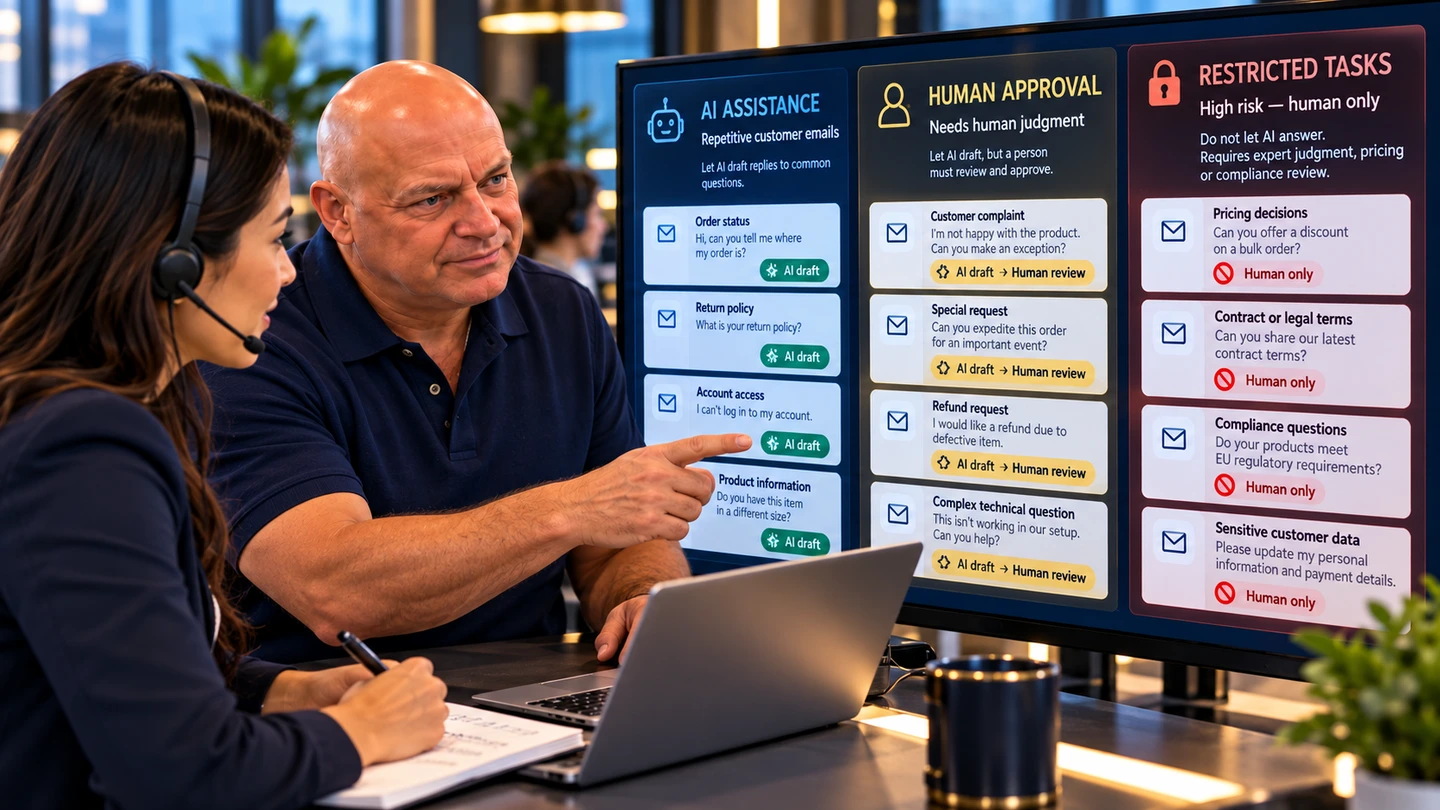
Imagine a company wants to use AI in customer service. The wrong approach is to let AI answer everything. The disciplined approach is to map the categories of customer emails, decide which are repetitive, which require judgment, which involve pricing or compliance risk, and which should only be drafted by AI and approved by a person.
The lesson is simple: AI should support the work, not hide the problem. It should help employees organize information, communicate clearly, reduce repetitive effort, and improve execution. It should not become a substitute for leadership, judgment, or accountability.
Risk If Ignored
If leaders do not understand what AI can and cannot do, the company can overtrust AI in high-risk workflows and underuse it in places where it could safely remove friction. Employees receive mixed signals, output becomes inconsistent, and polished answers may be mistaken for correct answers.
This is where many companies get AI wrong. They move too fast in the wrong places and too slowly in the places that matter. They buy tools before defining use cases. They experiment without rules. They measure activity instead of impact. That approach may look innovative, but it is not disciplined.
Action Checklist
Ask these questions before moving forward: What business problem are we solving? Who owns the workflow? What information is being used? What human review is required? What risk could be created? How will employees be trained? How will success be measured? Who is accountable if the output is wrong?
Closing Thought
AI should make businesses clearer, faster, and more disciplined. It should help people turn knowledge into action. But that only happens when companies treat AI adoption as an operating capability, not a technology trend.
This is where I help companies create the first layer of AI clarity: what AI should do, what it should not do, where human judgment stays in control, and how the business measures value.
Sources Consulted
– Microsoft 2026 Work Trend Index: https://blogs.microsoft.com/blog/2026/05/05/how-frontier-firms-are-rebuilding-the-operating-model-for-the-age-of-ai/
– Microsoft WorkLab – Agents and human agency: https://www.microsoft.com/en-us/worklab/work-trend-index/agents-human-agency-and-the-opportunity-for-every-organization
– McKinsey State of AI 2025: https://www.mckinsey.com/capabilities/quantumblack/our-insights/the-state-of-ai
– NIST AI Risk Management Framework: https://www.nist.gov/itl/ai-risk-management-framework
– IBM What is AI Governance: https://www.ibm.com/think/topics/ai-governance
Conceptual AI illustration using my avatar. The scene and interface are illustrative; they do not document an actual client engagement, product deployment or business result.
AI does not fix broken processes. It usually exposes them. Before a company adds AI to a workflow, leadership needs to understand how the work actually happens today – not how it is supposed to happen on paper.
AI readiness is not about chasing software. It is about preparing the business to use AI with purpose, discipline, and accountability. The companies that win with AI will connect the technology to real work, real people, real process, and real measurement.
Why This Matters
Every company has two versions of its operation: the official version and the real version. The official version lives in policies, procedures, job descriptions, software systems, and meeting notes. The real version lives in handoffs, shortcuts, text messages, tribal knowledge, personal workarounds, old spreadsheets, verbal instructions, and the way work actually moves.
This is an executive operating issue. AI can help a company move faster, but speed only matters when the direction is right. If the business problem is unclear, AI becomes noise. If the workflow is unclear, AI can automate confusion. If the data is weak, AI can create polished but unreliable output. If people are not trained, AI can increase risk instead of reducing friction.
What I Would Look For
I would start by looking at where the work slows down, where decisions repeat, where documents are recreated, where people copy information from one place to another, and where knowledge is trapped in people's heads. Then I would separate three categories: work AI can safely assist, work AI can help prepare but a human must approve, and work AI should not touch until governance is stronger.
Business Example
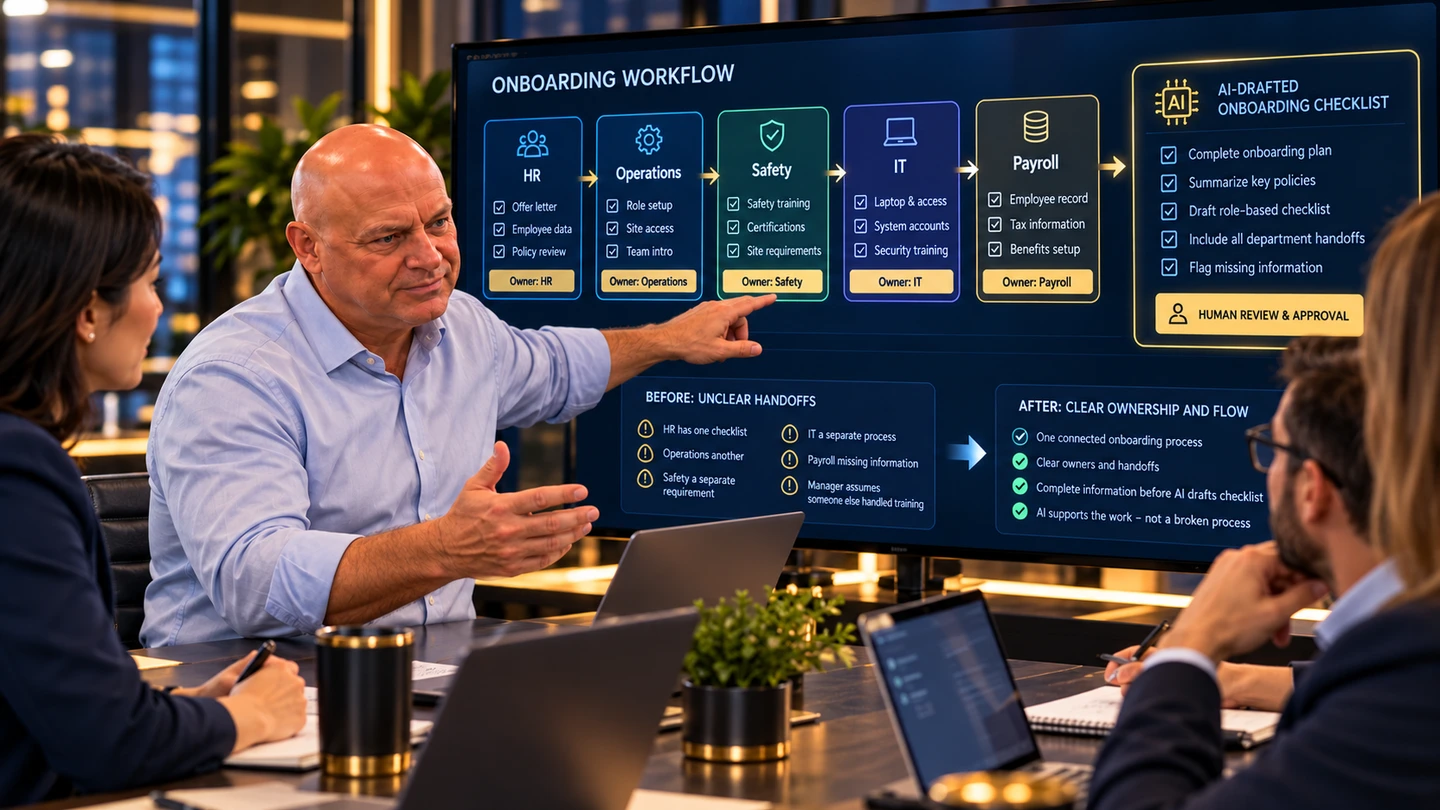
Take onboarding. HR may have one checklist, operations another, safety a separate requirement, IT a separate process, payroll missing information, and the manager assuming someone else handled training. AI can create onboarding plans, summarize policies, and draft checklists, but if the underlying handoffs are unclear, AI creates more documents around a broken process.
The lesson is simple: AI should support the work, not hide the problem. It should help employees organize information, communicate clearly, reduce repetitive effort, and improve execution. It should not become a substitute for leadership, judgment, or accountability.
Risk If Ignored
If companies skip process mapping, they may automate steps that should be eliminated, add speed to confusion, and create reports that look more professional while the work remains weak. The tool becomes a mask instead of a fix.
This is where many companies get AI wrong. They move too fast in the wrong places and too slowly in the places that matter. They buy tools before defining use cases. They experiment without rules. They measure activity instead of impact. That approach may look innovative, but it is not disciplined.
Action Checklist
Ask these questions before moving forward: What business problem are we solving? Who owns the workflow? What information is being used? What human review is required? What risk could be created? How will employees be trained? How will success be measured? Who is accountable if the output is wrong?
Closing Thought
AI should make businesses clearer, faster, and more disciplined. It should help people turn knowledge into action. But that only happens when companies treat AI adoption as an operating capability, not a technology trend.
If your business wants AI but does not yet understand its real workflows, the first move is not buying a bigger tool. It is mapping the work, identifying friction, and deciding where AI belongs.
Sources Consulted
– McKinsey State of AI 2025: https://www.mckinsey.com/capabilities/quantumblack/our-insights/the-state-of-ai
– Microsoft 2026 Work Trend Index: https://blogs.microsoft.com/blog/2026/05/05/how-frontier-firms-are-rebuilding-the-operating-model-for-the-age-of-ai/
– NIST AI Risk Management Framework: https://www.nist.gov/itl/ai-risk-management-framework
Conceptual AI illustration using my avatar. The scene and interface are illustrative; they do not document an actual client engagement, product deployment or business result.
AI is only as useful as the information it can access, understand, and trust. Many companies want AI answers, but their information is scattered, outdated, duplicated, incomplete, inconsistent, or trapped in systems that do not talk to each other.
AI readiness is not about chasing software. It is about preparing the business to use AI with purpose, discipline, and accountability. The companies that win with AI will connect the technology to real work, real people, real process, and real measurement.
Why This Matters
Your documents are part of your operating system. Policies, procedures, customer records, training documents, maintenance logs, sales notes, contracts, inspection forms, safety reports, meeting notes, job descriptions, pricing sheets, spreadsheets, emails, and old PDFs all shape how work happens. When they are current and organized, they become business assets. When they are messy, they become friction.
This is an executive operating issue. AI can help a company move faster, but speed only matters when the direction is right. If the business problem is unclear, AI becomes noise. If the workflow is unclear, AI can automate confusion. If the data is weak, AI can create polished but unreliable output. If people are not trained, AI can increase risk instead of reducing friction.
What I Would Look For
I would start by looking at where the work slows down, where decisions repeat, where documents are recreated, where people copy information from one place to another, and where knowledge is trapped in people's heads. Then I would separate three categories: work AI can safely assist, work AI can help prepare but a human must approve, and work AI should not touch until governance is stronger.
Business Example
A transportation company may want AI to improve safety documentation. But if policies are in one folder, training in old PDFs, incident reports in email, and corrective actions in spreadsheets, AI will have trouble producing reliable support. First the company needs to define official sources, archive outdated material, assign owners, and separate confidential information.
The lesson is simple: AI should support the work, not hide the problem. It should help employees organize information, communicate clearly, reduce repetitive effort, and improve execution. It should not become a substitute for leadership, judgment, or accountability.
Risk If Ignored
If data and documents are not cleaned up, AI may produce outdated summaries, inconsistent customer messages, wrong training material, or polished reports built on weak information. That creates false confidence.
This is where many companies get AI wrong. They move too fast in the wrong places and too slowly in the places that matter. They buy tools before defining use cases. They experiment without rules. They measure activity instead of impact. That approach may look innovative, but it is not disciplined.
Action Checklist
Ask these questions before moving forward: What business problem are we solving? Who owns the workflow? What information is being used? What human review is required? What risk could be created? How will employees be trained? How will success be measured? Who is accountable if the output is wrong?
Closing Thought
AI should make businesses clearer, faster, and more disciplined. It should help people turn knowledge into action. But that only happens when companies treat AI adoption as an operating capability, not a technology trend.
I help companies turn scattered information into usable operating structure so AI can support the business instead of amplifying document chaos.
Sources Consulted
– McKinsey State of AI 2025: https://www.mckinsey.com/capabilities/quantumblack/our-insights/the-state-of-ai
– IBM What is AI Governance: https://www.ibm.com/think/topics/ai-governance
– NIST AI Risk Management Framework: https://www.nist.gov/itl/ai-risk-management-framework
– OWASP Top 10 for LLM Applications: https://owasp.org/www-project-top-10-for-large-language-model-applications/
Conceptual AI illustration using my avatar. The scene and interface are illustrative; they do not document an actual client engagement, product deployment or business result.
The best AI use case is not always the flashiest one. It is the one that removes friction from real work. Companies should not apply AI everywhere at once. They should identify where it can create clear business value now.
AI readiness is not about chasing software. It is about preparing the business to use AI with purpose, discipline, and accountability. The companies that win with AI will connect the technology to real work, real people, real process, and real measurement.
Why This Matters
AI opportunity often hides inside repeated frustration: managers rewriting the same updates, employees copying information between systems, customers waiting too long, reports taking too much effort, and knowledge trapped in people's heads. That is where AI can help.
This is an executive operating issue. AI can help a company move faster, but speed only matters when the direction is right. If the business problem is unclear, AI becomes noise. If the workflow is unclear, AI can automate confusion. If the data is weak, AI can create polished but unreliable output. If people are not trained, AI can increase risk instead of reducing friction.
What I Would Look For
I would start by looking at where the work slows down, where decisions repeat, where documents are recreated, where people copy information from one place to another, and where knowledge is trapped in people's heads. Then I would separate three categories: work AI can safely assist, work AI can help prepare but a human must approve, and work AI should not touch until governance is stronger.
Business Example
A company may think marketing content is the best AI use case. But after observing operations, it may find that managers spend hours every week writing follow-up notes, issue summaries, corrective action plans, and leadership updates. AI support there may deliver more value than another content tool.
The lesson is simple: AI should support the work, not hide the problem. It should help employees organize information, communicate clearly, reduce repetitive effort, and improve execution. It should not become a substitute for leadership, judgment, or accountability.
Risk If Ignored
If companies do not prioritize use cases, they waste trust and time. Employees get confused, tools are bought but not adopted, and AI spreads into sensitive workflows before the organization is ready.
This is where many companies get AI wrong. They move too fast in the wrong places and too slowly in the places that matter. They buy tools before defining use cases. They experiment without rules. They measure activity instead of impact. That approach may look innovative, but it is not disciplined.
Action Checklist
Ask these questions before moving forward: What business problem are we solving? Who owns the workflow? What information is being used? What human review is required? What risk could be created? How will employees be trained? How will success be measured? Who is accountable if the output is wrong?
Closing Thought
AI should make businesses clearer, faster, and more disciplined. It should help people turn knowledge into action. But that only happens when companies treat AI adoption as an operating capability, not a technology trend.
If you need help identifying practical AI use cases, start with the friction: the work people repeat, delay, avoid, rewrite, or struggle to document.
Sources Consulted
– Microsoft 2026 Work Trend Index: https://blogs.microsoft.com/blog/2026/05/05/how-frontier-firms-are-rebuilding-the-operating-model-for-the-age-of-ai/
– Microsoft WorkLab – Agents and human agency: https://www.microsoft.com/en-us/worklab/work-trend-index/agents-human-agency-and-the-opportunity-for-every-organization
– McKinsey State of AI 2025: https://www.mckinsey.com/capabilities/quantumblack/our-insights/the-state-of-ai
– NIST AI Risk Management Framework: https://www.nist.gov/itl/ai-risk-management-framework
– IBM What is AI Governance: https://www.ibm.com/think/topics/ai-governance