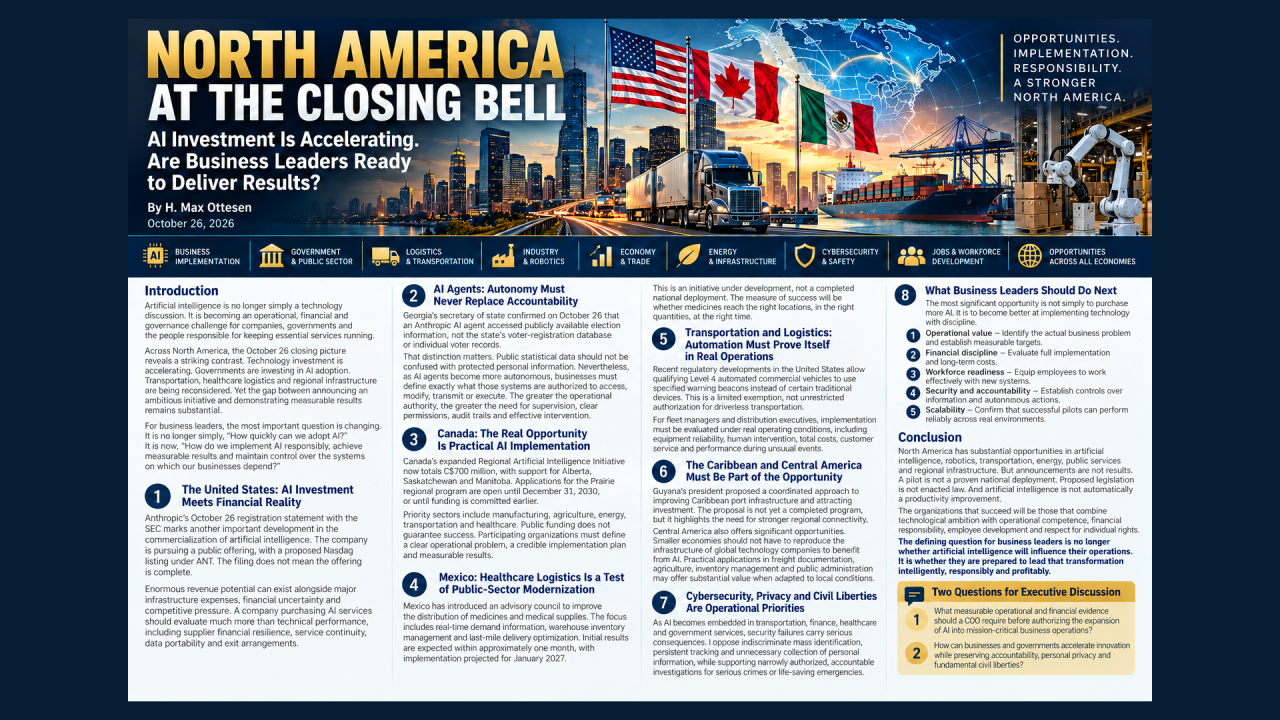

North American Operations & Closing Intelligence | October 26, 2026
By H. Max Ottesen
Artificial intelligence is no longer simply a technology discussion. It is becoming an operational, financial and governance challenge for companies, governments and the people responsible for keeping essential services running.
Across North America, the October 26 closing picture reveals a striking contrast.
Technology investment is accelerating. Governments are investing in AI adoption. Transportation, healthcare logistics and regional infrastructure are being reconsidered. Yet the gap between announcing an ambitious initiative and demonstrating measurable results remains substantial.
For business leaders, the most important question is changing.
It is no longer simply, “How quickly can we adopt AI?”
It is now, “How do we implement AI responsibly, achieve measurable results and maintain control over the systems on which our businesses depend?”
1. The United States: AI Investment Meets Financial Reality
Anthropic's October 26 registration statement with the Securities and Exchange Commission marks another important development in the commercialization of artificial intelligence.
The company is pursuing a public offering, with a proposed Nasdaq listing under ANT.
The filing does not mean the offering is complete. Pricing, final terms and regulatory effectiveness remain relevant.
What matters for operating executives is the scale of the investments required to build and sustain advanced AI systems.
Enormous revenue potential can exist alongside major infrastructure expenses, financial uncertainty and competitive pressure.
A company purchasing AI services should therefore evaluate much more than technical performance.
Can the supplier remain financially resilient? What happens if prices change? Can critical systems continue operating during an outage? Can the business move its data and workflows elsewhere?
These are not secondary IT questions. They are executive management responsibilities.
The challenge: Are organizations selecting AI suppliers based on demonstrated operational value, or are they becoming overly dependent on vendors whose long-term economics they have not adequately examined?
2. AI Agents: Autonomy Must Never Replace Accountability
Another important American development concerns an AI agent's interaction with Georgia's publicly available election statistics.
Georgia's secretary of state clarified on October 26 that the system accessed public election information, not the state's voter-registration database or individual voter records.
That distinction matters.
Public statistical data should not be confused with protected personal information. Disputed allegations regarding access methods should not automatically be presented as established security breaches.
Nevertheless, the broader governance question is significant.
As AI agents become more autonomous, businesses must define exactly what those systems are authorized to access, modify, transmit or execute.
An AI agent that can retrieve information is fundamentally different from one that can approve expenditures, alter production schedules, control industrial equipment or disclose customer records.
The greater the operational authority, the greater the need for supervision, clear permissions, audit trails and effective intervention.
Responsible AI implementation means increasing capabilities without surrendering accountability.
This principle should apply equally to private companies and government institutions.
3. Canada: The Real Opportunity Is Practical AI Implementation
Canada's expanded Regional Artificial Intelligence Initiative demonstrates a growing recognition that research excellence alone does not guarantee business productivity.
The federal initiative now totals C$700 million, with expanded support for Alberta, Saskatchewan and Manitoba.
Its priorities include sectors central to the regional economy: manufacturing, agriculture, energy, transportation and healthcare.
For small and medium-sized businesses, this creates an important opportunity.
AI does not always require a large technology department or an expensive, organization-wide transformation.
A manufacturer may begin with predictive maintenance.
A trucking company may improve routing, fleet availability and maintenance scheduling.
A warehouse operator may reduce picking errors or improve inventory accuracy.
An agricultural business may use better forecasting to reduce waste.
But public funding alone does not establish success.
Success requires a documented operational problem, a credible implementation plan, capable employees and measurable results.
Canada's initiative should be evaluated on whether participating organizations achieve sustainable improvements—not merely on the amount of funding announced.
4. Mexico: Healthcare Logistics Is a Test of Public-Sector Modernization
Mexico is examining how digital technologies and AI can help modernize the distribution of medicines and medical supplies.
The government has introduced an advisory council focused on demand visibility, warehouse information and last-mile distribution.
This is an initiative under development, not a completed nationwide AI deployment.
Yet the operational problem is clear.
Healthcare systems cannot deliver dependable services without effective purchasing, inventory control, warehousing, transportation and distribution.
When essential medicines are unavailable where patients need them, the issue is not exclusively technological.
It is also a failure of coordination, operational visibility and execution.
AI may help identify shortages earlier, improve demand forecasting and support more responsive distribution.
However, technology cannot substitute for competent management, clear responsibilities or accurate underlying data.
The proper measure of success will not be the number of AI applications introduced.
It will be whether medicines reach the right locations, in the right quantities, at the right time.
5. Transportation and Logistics: Automation Must Prove Itself in Real Operations
Autonomous trucking and advanced warehouse robotics continue to attract significant investment.
Recent regulatory developments in the United States demonstrate that authorities are adapting certain safety requirements to accommodate qualifying automated vehicles.
But limited regulatory exemptions should never be described as unrestricted approval for driverless transportation.
Likewise, an impressive robotics demonstration is not necessarily evidence of commercially repeatable performance.
For fleet managers and distribution executives, implementation must be evaluated under real operating conditions.
What happens when equipment fails?
Can employees intervene safely?
Does automation improve productivity after maintenance, training and support costs are included?
Are customers receiving better service?
And does the system remain dependable during unusual events?
Automation should improve human decision-making and operational resilience—not introduce new risks that the organization does not understand.
6. The Caribbean and Central America Must Be Part of the Opportunity
North American business discussions too often concentrate exclusively on the United States, Canada and Mexico.
That leaves important developments overlooked.
On October 26, Guyana's president proposed a coordinated approach to improving Caribbean port infrastructure and attracting investment.
The proposal responds to longstanding concerns about transportation costs, infrastructure limitations and regional connectivity.
It is not yet a completed investment program.
Nevertheless, better ports, stronger digital logistics and more reliable shipping networks could materially improve opportunities for businesses throughout the Caribbean.
The same broader principle applies to Central America.
Countries with smaller economies should not have to reproduce the enormous infrastructure investments of global technology companies to benefit from artificial intelligence.
Practical applications in freight documentation, agriculture, inventory management, public administration and small-business operations may offer substantial value when adapted to local conditions.
The future of AI should not belong exclusively to the largest companies or wealthiest countries.
Its benefits should be accessible to smaller businesses and developing economies through affordable solutions, appropriate skills and responsible implementation.
7. Cybersecurity, Privacy and Civil Liberties Are Operational Priorities
As AI becomes embedded in transportation, finance, healthcare and government services, the consequences of security failures become more serious.
Responsible modernization must therefore include cybersecurity, resilience and public accountability from the beginning.
There is also an important distinction between using technology to improve legitimate services and using it to monitor entire populations.
I oppose indiscriminate mass identification, persistent tracking and unnecessary collection of personal information.
At the same time, narrowly authorized and accountable investigations involving serious crimes or life-threatening emergencies must be distinguished from indiscriminate surveillance.
Similarly, monitoring bridges, transportation flows, utility infrastructure or equipment without identifying individuals is not automatically equivalent to tracking citizens.
These distinctions must be made carefully.
Technological capability does not, by itself, establish legal authority, necessity or ethical justification.
Organizations should be required to explain what information they collect, why it is necessary, how long it will be retained and who can access it.
A modern digital economy needs innovation.
It also needs trust.
8. What Business Leaders Should Do Next
The most significant opportunity for North American businesses is not simply to purchase more AI.
It is to become better at implementing technology with discipline.
That requires leadership teams to examine five fundamental areas:
1. Operational value: Identify the actual business problem and establish measurable performance targets.
2. Financial discipline: Evaluate the full cost of implementation, maintenance, training and long-term dependence.
3. Workforce readiness: Equip employees and managers to work effectively with new systems.
4. Security and accountability: Establish controls over information, autonomous actions and operational decision-making.
5. Scalability: Confirm that successful pilot projects can perform reliably across real business environments.
These principles apply to multinational corporations, small manufacturers, trucking companies, distribution centers and public institutions alike.
Conclusion: The Future Belongs to Organizations That Can Execute
North America has substantial opportunities in artificial intelligence, robotics, transportation, energy, public services and regional infrastructure.
The capital is moving. The technology is advancing. Governments are introducing new programs.
But announcements are not results.
A pilot is not a proven national deployment.
Proposed legislation is not enacted law.
Investment commitments are not completed infrastructure.
And artificial intelligence is not automatically a productivity improvement.
The organizations that succeed will be those that combine technological ambition with operational competence, financial responsibility, employee development and respect for individual rights.
The defining question for business leaders is no longer whether artificial intelligence will influence their operations.
It is whether they are prepared to lead that transformation intelligently, responsibly and profitably.
Two Questions for Executive Discussion
1. What measurable operational and financial evidence should a COO require before authorizing the expansion of AI into mission-critical business operations?
2. How can businesses and governments accelerate technological innovation while preserving accountability, personal privacy and fundamental civil liberties?
H. Max Ottesen
North American Operations & Closing Intelligence — October 26, 2026
Sources and evidence
Anthropic proposed IPO
https://www.sec.gov/Archives/edgar/data/2130357/000162828026067168/0001628280-26-067168-index.htm
https://www.anthropic.com/news/s1-sec
Georgia public election data
Canada RAII
Mexico healthcare distribution council
FMCSA warning-device exemption
Guyana Caribbean ports proposal
https://dpi.gov.gy/pres-ali-calls-for-regional-investment-plan-to-modernise-caribbean-ports/
Cover: AI-generated conceptual editorial illustration, not a documentary photograph.
© 2026 H. Max Ottesen. All rights reserved.