Author: admin

  • AI Without Accountability: The Real Business Risk

    AI Without Accountability: The Real Business Risk

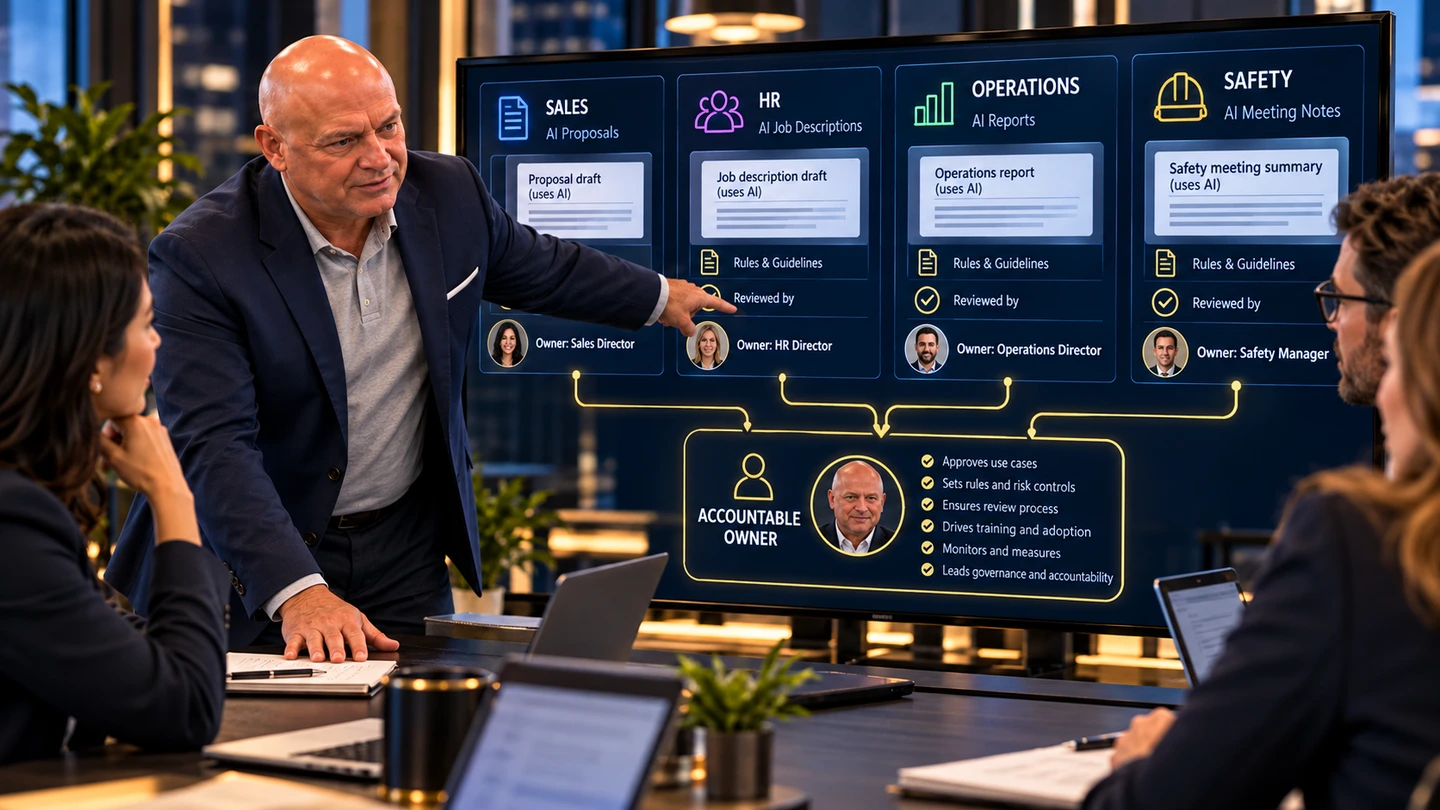
    Illustration: Every AI workflow needs an accountable owner. My avatar demonstrates the article’s AI lesson.
    Conceptual AI illustration using my avatar. The scene and interface are illustrative; they do not document an actual client engagement, product deployment or business result.

    The real business risk is not AI alone. It is AI with no owner, no clear rules, no review process, no governance, no measurement, and no leadership discipline.

    The responsible AI conversation needs more business discipline. AI can be useful and risky at the same time. It can improve speed, communication, and decision support. It can also scale weak inputs, bias, privacy problems, overconfidence, and poor accountability.

    The Real Issue

    Every company using AI should be able to answer one question: who owns AI accountability here? Not who bought the tool. Not who tested it first. Who owns the rules, risk, training, adoption, measurement, and review? If the answer is everyone, the real answer may be no one.

    People choose the tool. People define the use case. People provide the data. People write the prompts. People approve the workflow. People decide whether output is checked. People decide whether employees are trained. People decide whether governance exists. That means AI risk is also management risk.

    Business Example

    Sales uses AI for proposals, HR uses it for job descriptions, operations uses it for reports, and safety uses it for meeting notes. Then errors appear: an incorrect proposal claim, poor HR language, an off-policy customer answer, a safety summary missing a key detail. Leadership asks who approved the workflows. Nobody knows.

    The tool is part of the risk, but the bigger question is how the company uses it. AI can help businesses make better decisions, but it can also make weak decisions move faster. It can improve communication, but it can also create false confidence. It can reduce friction, but it can also hide accountability if leaders are careless.

    What Leaders Must Watch

    The higher the impact, the clearer the accountability must be. Drafting a lunch announcement is low risk. Helping evaluate candidates, analyze incidents, summarize legal matters, or influence financial decisions is higher risk and needs stronger controls.

    Responsible AI requires clear use cases, approved tools, data rules, human review, training, transparency, measurement, risk assessment, and accountability. It also requires humility. AI can be useful and wrong, fast and incomplete, polished and misleading, helpful and risky. Leaders need to hold all of that at the same time.

    Action Checklist

    Before using AI in a business workflow, ask: What decision or output is being supported? What data is being used? Could the data be biased or outdated? Who reviews the result? Who owns the final decision? What happens if the output is wrong? Is the customer, employee, or company exposed to risk? What rule controls the workflow?

    Closing Thought

    The goal is not to fear AI. The goal is to lead it. AI should support better decisions, better communication, and better execution. It should not become an excuse for avoiding responsibility.

    If your company is already using AI but nobody owns governance, measurement, and accountability, that is the first business risk to fix.

    Sources Consulted
    – NIST AI Risk Management Framework: https://www.nist.gov/itl/ai-risk-management-framework
    – NIST Generative AI Profile 2024: https://nvlpubs.nist.gov/nistpubs/ai/NIST.AI.600-1.pdf
    – IBM What is AI Governance: https://www.ibm.com/think/topics/ai-governance
    – OWASP Top 10 for LLM Applications: https://owasp.org/www-project-top-10-for-large-language-model-applications/
    – OWASP LLM01 Prompt Injection: https://genai.owasp.org/llmrisk/llm01-prompt-injection/
    ← All insights

    Original publication

  • Bad Inputs, Bad Incentives, Bad Outcomes

    Bad Inputs, Bad Incentives, Bad Outcomes

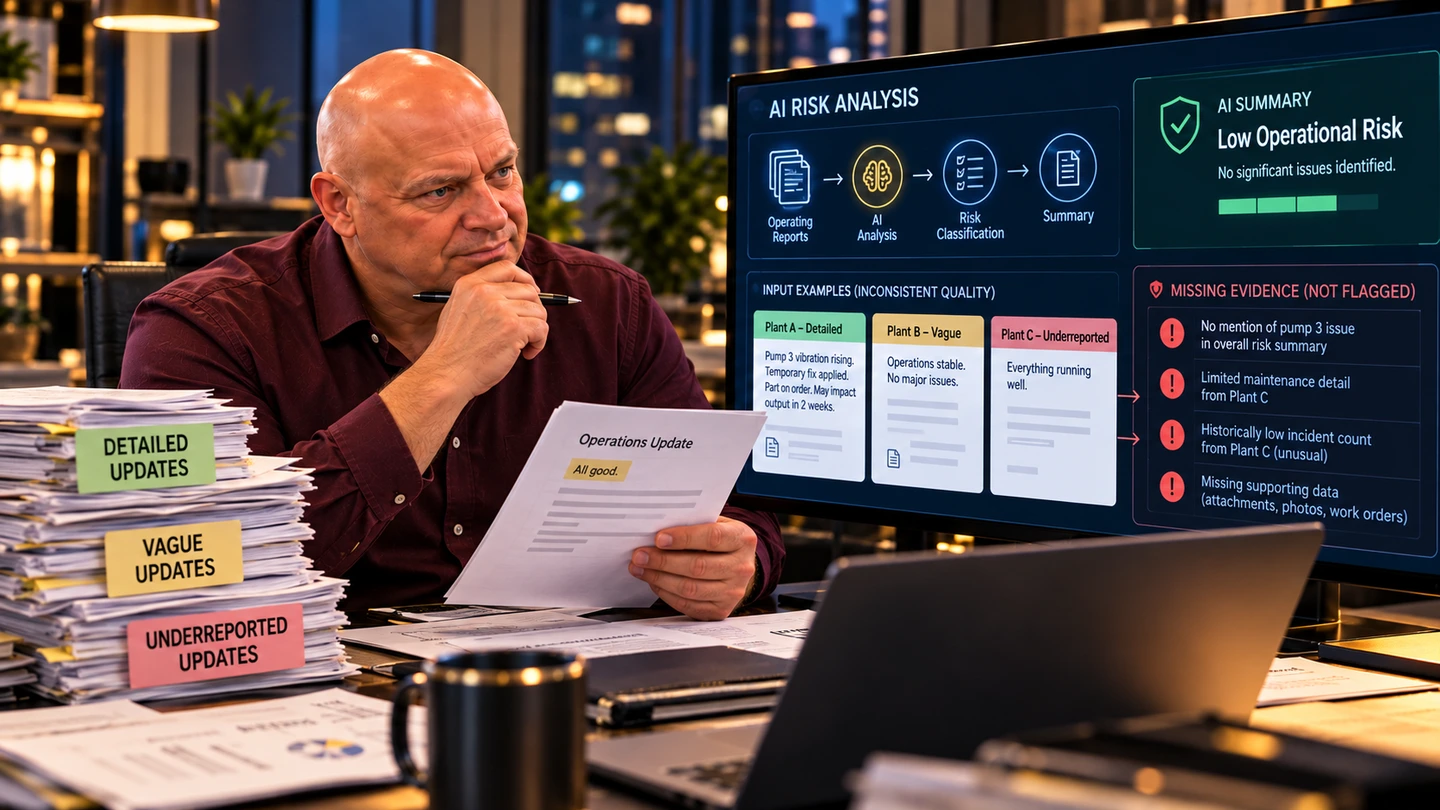
    Illustration: Weak inputs and incentives distort AI. My avatar demonstrates the article’s AI lesson.
    Conceptual AI illustration using my avatar. The scene and interface are illustrative; they do not document an actual client engagement, product deployment or business result.

    AI does not remove bad judgment. It can scale it. Many AI failures will come from the environment around the model: bad data, bad prompts, bad process, bad incentives, bad governance, and bad leadership assumptions.

    The responsible AI conversation needs more business discipline. AI can be useful and risky at the same time. It can improve speed, communication, and decision support. It can also scale weak inputs, bias, privacy problems, overconfidence, and poor accountability.

    The Real Issue

    Bad financial data creates bad forecasts. Bad maintenance records create bad equipment decisions. Bad customer data creates bad sales strategy. AI is no different. If information going into the system is wrong, incomplete, biased, outdated, or poorly structured, the output may be weak.

    People choose the tool. People define the use case. People provide the data. People write the prompts. People approve the workflow. People decide whether output is checked. People decide whether employees are trained. People decide whether governance exists. That means AI risk is also management risk.

    Business Example

    A company uses AI to identify operational risks from reports. But some managers document thoroughly, some write vague updates, and some underreport problems because they do not want attention. AI organizes the reports, but the input quality still controls the result.

    The tool is part of the risk, but the bigger question is how the company uses it. AI can help businesses make better decisions, but it can also make weak decisions move faster. It can improve communication, but it can also create false confidence. It can reduce friction, but it can also hide accountability if leaders are careless.

    What Leaders Must Watch

    If people are rewarded only for speed, they may use AI without checking quality. If managers are rewarded only for cost reduction, they may automate work that still needs judgment. If executives are rewarded for appearing innovative, they may push AI before the company is ready.

    Responsible AI requires clear use cases, approved tools, data rules, human review, training, transparency, measurement, risk assessment, and accountability. It also requires humility. AI can be useful and wrong, fast and incomplete, polished and misleading, helpful and risky. Leaders need to hold all of that at the same time.

    Action Checklist

    Before using AI in a business workflow, ask: What decision or output is being supported? What data is being used? Could the data be biased or outdated? Who reviews the result? Who owns the final decision? What happens if the output is wrong? Is the customer, employee, or company exposed to risk? What rule controls the workflow?

    Closing Thought

    The goal is not to fear AI. The goal is to lead it. AI should support better decisions, better communication, and better execution. It should not become an excuse for avoiding responsibility.

    I help companies look beyond the tool and examine the operating incentives that determine whether AI improves work or scales bad habits.

    Sources Consulted
    – NIST AI Risk Management Framework: https://www.nist.gov/itl/ai-risk-management-framework
    – NIST Generative AI Profile 2024: https://nvlpubs.nist.gov/nistpubs/ai/NIST.AI.600-1.pdf
    – IBM What is AI Governance: https://www.ibm.com/think/topics/ai-governance
    – OWASP Top 10 for LLM Applications: https://owasp.org/www-project-top-10-for-large-language-model-applications/
    – OWASP LLM01 Prompt Injection: https://genai.owasp.org/llmrisk/llm01-prompt-injection/

    ← All insights

    Original publication

  • Bias, Power, and Automation: What Businesses Must Watch

    Bias, Power, and Automation: What Businesses Must Watch

    Illustration: Audit AI candidate ranking for bias. My avatar demonstrates the article’s AI lesson.
    Conceptual AI illustration using my avatar. The scene and interface are illustrative; they do not document an actual client engagement, product deployment or business result.

    Automation can make unfair decisions look objective. When a human makes a decision, people know a human made it. When an automated system supports a decision, the result can appear scientific, neutral, or objective even when it reflects biased data or assumptions.

    The responsible AI conversation needs more business discipline. AI can be useful and risky at the same time. It can improve speed, communication, and decision support. It can also scale weak inputs, bias, privacy problems, overconfidence, and poor accountability.

    The Real Issue

    Bias can show up in patterns: who gets selected, who gets ignored, whose writing is rated professional, whose resume is considered relevant, whose complaint is prioritized, or whose performance is interpreted differently. AI can learn from historical data and reproduce historical patterns.

    People choose the tool. People define the use case. People provide the data. People write the prompts. People approve the workflow. People decide whether output is checked. People decide whether employees are trained. People decide whether governance exists. That means AI risk is also management risk.

    Business Example

    A company uses AI to rank candidates based on past successful employees. If past hiring favored certain schools, backgrounds, writing styles, or career paths, AI may screen out strong nontraditional candidates while appearing objective.

    The tool is part of the risk, but the bigger question is how the company uses it. AI can help businesses make better decisions, but it can also make weak decisions move faster. It can improve communication, but it can also create false confidence. It can reduce friction, but it can also hide accountability if leaders are careless.

    What Leaders Must Watch

    This connects directly to neurodiversity and dyslexia. If business systems reward only conventional communication, AI may reinforce that pattern and miss people with strong operational insight but unconventional documentation styles.

    Responsible AI requires clear use cases, approved tools, data rules, human review, training, transparency, measurement, risk assessment, and accountability. It also requires humility. AI can be useful and wrong, fast and incomplete, polished and misleading, helpful and risky. Leaders need to hold all of that at the same time.

    Action Checklist

    Before using AI in a business workflow, ask: What decision or output is being supported? What data is being used? Could the data be biased or outdated? Who reviews the result? Who owns the final decision? What happens if the output is wrong? Is the customer, employee, or company exposed to risk? What rule controls the workflow?

    Closing Thought

    The goal is not to fear AI. The goal is to lead it. AI should support better decisions, better communication, and better execution. It should not become an excuse for avoiding responsibility.

    If your organization uses AI in people-related decisions, audit the criteria, the data, the review process, and the human accountability before the tool becomes a gatekeeper.

    Sources Consulted
    – NIST AI Risk Management Framework: https://www.nist.gov/itl/ai-risk-management-framework
    – IBM What is AI Governance: https://www.ibm.com/think/topics/ai-governance
    – World Economic Forum – Neurodiversity at work: https://www.weforum.org/stories/2024/10/neurodiversity-neuroinclusion-workplace-business/

    ← All insights

    Original publication

  • From Funding Intelligence to Operations Intelligence — The Same Playbook

    From Funding Intelligence to Operations Intelligence — The Same Playbook

    Illustration for From Funding Intelligence to Operations Intelligence — The Same Playbook

    Reuse the evidence workflow while rebuilding the domain rules.

    EXECUTIVE ANALYSIS | H. Max Ottesen

    AI-generated conceptual editorial illustration. Fictional people and setting; not documentary evidence. Conceptual illustration linking a funding review desk and a separate fleet maintenance review.

    A funding project review and a maintenance review can share a sequence: define the requirement, collect evidence, identify gaps and assign the next action. They cannot safely share every decision rule. That distinction is the limit I would put on any reusable AI workflow.

    Disclosure: CapitalRoute AI is my own internal development work. Its guide is an owner-controlled design source, not independent evidence that the application or a related logistics system improves outcomes. [1]

    Reuse the questions

    The CapitalRoute V0.39E guide describes source verification, project documents, review stages and separation of internal notes from client-facing reports. It describes a local/internal application rather than a public SaaS product. [1]

    The reusable idea is an evidence record. For a proposed maintenance assistant, that could mean linking the relevant work order, unresolved question, authorized reviewer and next review point. A warehouse version could use a different record for inventory and customer commitments. Neither application is claimed to exist here.

    I would preserve three separations: the source record, the assistant’s interpretation and the authorized decision. Moving an item between those states should leave a traceable reason. If the evidence is incomplete, the workflow should preserve the gap.

    Rebuild the meaning in each domain

    A funding-readiness rubric cannot authorize a vehicle’s return to service. The people, evidence and authority needed for that decision must be defined by the relevant operating process. Reusing a screen layout should not obscure that responsibility.

    The same caution applies to an apparently familiar score. A proposed assessment of document completeness says nothing by itself about mechanical condition, driver availability or a safe loading sequence. Each requires its own definition and review.

    Research described by Harvard Business School shows that AI capability varies across tasks. [2] It supports testing the new task rather than treating success in one setting as transferable proof. It does not establish the performance of either CapitalRoute or a proposed operations assistant.

    Transfer a test discipline too

    For a new use, build a representative set of cases with domain specialists. Include conflicting evidence, missing records and situations where the correct response is to stop. Compare the tool’s preparation with the existing process and record the checking work it creates.

    NIST’s framework places AI use in its operating context. [3] My recommendation is to make a new approval decision for each domain: what the tool may read, what it may recommend, who must review and what it may change. A successful funding-document prototype should not automatically acquire maintenance authority.

    Keep the claim proportionate

    The proposed transfer is a management pattern, not a universal model or proven product platform. It could make evidence easier to review; that benefit still needs to be demonstrated in each setting.

    The playbook worth reusing is disciplined preparation. Domain knowledge must determine what counts as sufficient evidence and who is allowed to act on it.

    SOURCES & EVIDENCE

    [1] CapitalRoute AI / Growth Partners International (2026-07-08). CapitalRoute AI Application Workflow Guide. CAPITALROUTE_WORKFLOW_SOURCE.pdf, V0.39E, sections 1–2 and 6–12. Locator: CAPITALROUTE_WORKFLOW_SOURCE.pdf, V0.39E, sections 1–2 and 6–12. Supports: The documented internal evidence and review workflow. Limitations: Documents the described internal workflow at that version. It is not an independent test, current build inspection, adoption record or measured outcome study. Checked: 2026-10-17.

    [2] HBS AI Faculty / Harvard Business School (2023-09-21). Navigating the Jagged Technological Frontier. https://aiinstitute.hbs.edu/navigating-the-jagged-technological-frontier/. Locator: Study overview and Key Findings. Supports: Task-specific capability and the limited consultant-study setting. Limitations: Study involved 758 consultants and task-specific performance. It does not establish fleet, warehouse, safety or general software-production outcomes. Checked: 2026-10-17.

    [3] Elham Tabassi / NIST (2023-01-26). Artificial Intelligence Risk Management Framework (AI RMF 1.0). https://nvlpubs.nist.gov/nistpubs/ai/NIST.AI.100-1.pdf. Locator: NIST AI 100-1, Core, sections 5.1–5.4. Supports: Operating context in AI risk management. Limitations: A governance framework, not evidence that a proposed operating tool improves results. Checked: 2026-10-17.

    HOW THE CONCLUSION WAS REACHED

    The guide supports a documented review pattern, while task-specific research and governance guidance limit transfer claims. The analogy supports a design hypothesis for another domain. It supplies no causal evidence of deployment benefits.

    LIMITATIONS

    No cross-domain implementation, validation set, current product test or realized benefit was supplied. Domain-specific legal, safety and engineering requirements must be established before any operational use. Ownership is disclosed; public deployment is not claimed.

    © 2026 H. Max Ottesen. All rights reserved.

    ← All articles & insights

    Original publication

  • Make accountability visible in daily operations

    A useful operating review separates the measure from the action. Define the KPI, its source and the period it covers. Then ask which operating decision the gap requires.

    Illustrative example: a warehouse misses its loading schedule. Before asking everyone to work faster, review when orders were released, when stock was available, when equipment was ready and who could resolve exceptions.

    Use a simple action record: issue; evidence; owner; next action; due date; result at the next review. This is a suggested working format, not a report of a specific client engagement.

    A measure owner keeps the definition reliable. An action owner carries the correction. Those responsibilities may sit with different people, but both should be visible.

    Close the meeting with the few decisions that matter. At the next review, ask whether each action changed the work. If not, revisit the cause rather than repeating the same instruction.

    ← All insights

    Original publication

  • Practical AI needs clear boundaries

    Begin with a task whose output can be checked. Define the source material the workflow may use, the information it must not accept and the person responsible for approving the result.

    Illustrative example: an AI workflow drafts a weekly operating update from approved, non-sensitive manager notes. The draft may organize issues and actions; it must not invent figures, assign blame or make commitments.

    An acceptance checklist can ask: Does every number match the input? Are dates and owners preserved? Are missing facts marked as missing? Are recommendations clearly separate from recorded events?

    Test both ordinary inputs and difficult cases: incomplete notes, contradictory figures, irrelevant instructions and requests to disclose restricted information. Record where the workflow fails and what human review catches.

    The result is a draft until the responsible person accepts it. A successful demonstration is useful evidence of a bounded workflow; it does not establish reliability for every use case.

    ← All insights

    Original publication

  • Reliability across distributed operations

    Use consistent definitions across sites. Availability, uptime, on-time departure and on-time delivery describe different things. A review becomes confusing when teams use one label for several measures.

    Illustrative review: equipment readiness; loading constraints; planned versus actual departure; customer exceptions; recurring vendor issues. For each gap, record the source, the owner and the next review date.

    Bring the handoffs into the discussion. A vehicle can be ready while an order is not, and a site can meet its local target while creating a delay for the next site.

    Separate the immediate recovery action from the recurring correction. Recovering today’s delivery matters; resolving the repeat cause is what strengthens the operation.

    Use the same action format across sites, while leaving room for local constraints. This example is a suggested management practice, not an account of a particular client meeting.

    ← All insights

    Original publication

  • The Danger of Blind Trust: Why AI Needs Human Judgment

    The Danger of Blind Trust: Why AI Needs Human Judgment

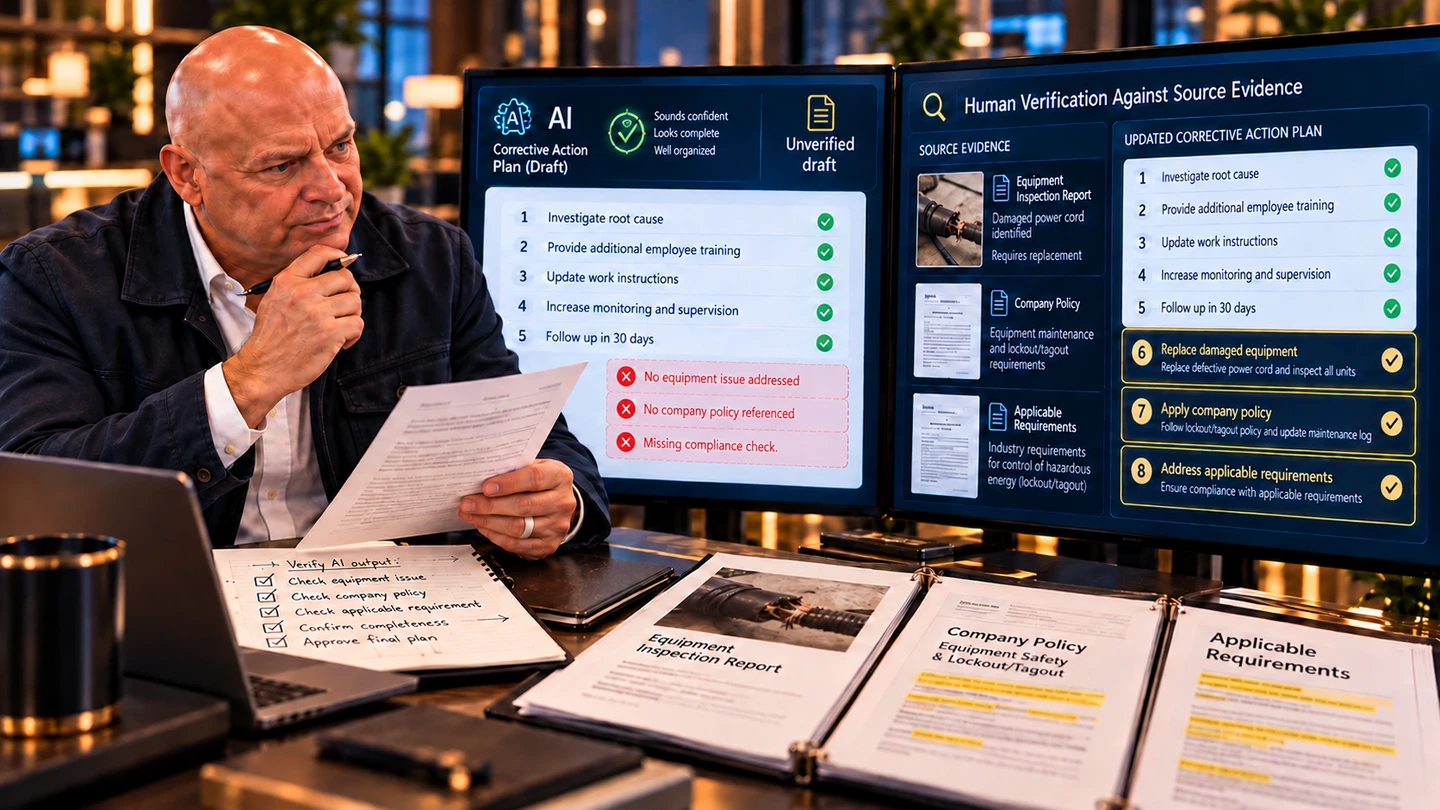
    Illustration: Verify a polished AI answer. My avatar demonstrates the article’s AI lesson.
    Conceptual AI illustration using my avatar. The scene and interface are illustrative; they do not document an actual client engagement, product deployment or business result.

    The most dangerous AI user may be the one who never checks the answer. AI can sound confident, write clearly, organize complex information, and produce polished reports. That is useful. It is also risky.

    The responsible AI conversation needs more business discipline. AI can be useful and risky at the same time. It can improve speed, communication, and decision support. It can also scale weak inputs, bias, privacy problems, overconfidence, and poor accountability.

    The Real Issue

    Confidence is not accuracy. A summary may miss context. A recommendation may rely on outdated information. A policy draft may sound legal but be incomplete. A customer response may sound professional but promise the wrong thing. A safety checklist may miss a critical step.

    People choose the tool. People define the use case. People provide the data. People write the prompts. People approve the workflow. People decide whether output is checked. People decide whether employees are trained. People decide whether governance exists. That means AI risk is also management risk.

    Business Example

    A manager asks AI to create a corrective action plan after a workplace incident. The draft looks strong, but it misses a key equipment issue, company policy, and a regulatory consideration. Used as a draft, it helps. Used blindly, it creates risk.

    The tool is part of the risk, but the bigger question is how the company uses it. AI can help businesses make better decisions, but it can also make weak decisions move faster. It can improve communication, but it can also create false confidence. It can reduce friction, but it can also hide accountability if leaders are careless.

    What Leaders Must Watch

    Human review should be mandatory when AI output affects customers, employees, safety, compliance, legal obligations, finance, hiring, discipline, pricing, contracts, public statements, or security.

    Responsible AI requires clear use cases, approved tools, data rules, human review, training, transparency, measurement, risk assessment, and accountability. It also requires humility. AI can be useful and wrong, fast and incomplete, polished and misleading, helpful and risky. Leaders need to hold all of that at the same time.

    Action Checklist

    Before using AI in a business workflow, ask: What decision or output is being supported? What data is being used? Could the data be biased or outdated? Who reviews the result? Who owns the final decision? What happens if the output is wrong? Is the customer, employee, or company exposed to risk? What rule controls the workflow?

    Closing Thought

    The goal is not to fear AI. The goal is to lead it. AI should support better decisions, better communication, and better execution. It should not become an excuse for avoiding responsibility.

    The best AI users will not be the people who blindly accept the first answer. They will be the people who ask better questions, verify output, and apply judgment.

    Sources Consulted
    – NIST AI Risk Management Framework: https://www.nist.gov/itl/ai-risk-management-framework
    – NIST Generative AI Profile 2024: https://nvlpubs.nist.gov/nistpubs/ai/NIST.AI.600-1.pdf
    – IBM What is AI Governance: https://www.ibm.com/think/topics/ai-governance
    – OWASP Top 10 for LLM Applications: https://owasp.org/www-project-top-10-for-large-language-model-applications/
    – OWASP LLM01 Prompt Injection: https://genai.owasp.org/llmrisk/llm01-prompt-injection/

    ← All insights

    Original publication

  • Transformation starts with the work

    Start by tracing one request through the operation. Identify the input, the person responsible, the next handoff and the decision that allows it to move.

    Illustrative example: a maintenance request is copied from a message into a spreadsheet, then copied again into a weekly report. A new platform may help, but first define the required fields, the owner of the record and the acceptance check at each handoff.

    A small process map can show request received → information checked → work assigned → completion recorded → exception reviewed. Mark the points where a person waits, re-enters information or makes a decision without the required context.

    Compare the proposed change against an agreed baseline. A shorter handoff time, fewer missing fields or clearer ownership may be more useful than counting software logins.

    Keep this first change bounded. Review it with the people doing the work, document the exception path and expand only after the revised process is usable.

    ← All insights

    Original publication

  • What CapitalRoute AI Taught Me About Readiness and Decision Support

    What CapitalRoute AI Taught Me About Readiness and Decision Support

    Illustration for What CapitalRoute AI Taught Me About Readiness and Decision Support

    An internal workflow can organize preparation without predicting an award.

    EXECUTIVE ANALYSIS | H. Max Ottesen

    AI-generated conceptual editorial illustration. Fictional people and setting; not documentary evidence. Illustrated funding project dossier with an evident document gap and no scores or award promises.

    Finding a funding opportunity and preparing a reviewable project are different jobs. CapitalRoute AI gives me a concrete way to examine the second: organize the requirements, preserve the evidence and make the next unanswered question visible.

    Disclosure: CapitalRoute AI is my own internal development work. This article draws on owner-controlled documentation and proposes further design choices. It is not an independent product review or evidence of funding success. [1]

    What the document actually describes

    The V0.39E workflow guide, dated July 8, 2026, describes an internal consulting application connecting client projects, funding records, source links, documents, sessions and follow-up work. It says that version is not a public SaaS product. The guide also separates internal notes from client-facing material and describes draft-only email handoff. These are documented workflow descriptions, not functions I independently verified in a current installation. [1]

    That scope is useful. It lets this discussion focus on preparation and review rather than suggesting that the software grants eligibility, approves a loan or submits an application on its own.

    Keep a readiness score in the proposal column

    For a future design, I would consider a route-specific readiness assessment. A proposed 1-to-10 scale would be an internal rubric for evidence completeness and fit, not a probability of obtaining money. The supplied guide does not validate that score or establish it as a working current feature.

    Before adopting a number, I would define the criteria with a qualified reviewer. The display should preserve mandatory gaps separately from any aggregate assessment. A missing required document should remain visible even if other parts of the project are strong. “Not assessed” may be more honest than a precise-looking score.

    Make every assessment reversible

    Consider a hypothetical budget submission. A reviewer should compare the document with the current requirement for the specific route, record any inconsistency and explain what further evidence is needed. The presence of an uploaded file should not count as acceptance of its contents.

    The guide’s source-verification and document-review workflow provides a documentary starting point for that process. [1] The extension proposed here would also retain the requirement version and the reason for any assessment change.

    NIST cautions against generalizing AI capability from narrow anecdotal evaluation. [2] I would therefore test readiness recommendations on representative cases, including incomplete and unsuitable projects, before claiming the tool improves advisory decisions.

    Define the useful lesson narrowly

    The lesson I take from this design work is to make preparation inspectable. The reviewer should see the requirement, the evidence, the uncertainty and the next responsible person. A negative finding can be useful if it prevents an unsupported recommendation.

    No funding award, client benefit or predictive accuracy is established here. CapitalRoute’s readiness idea should earn confidence through review evidence, rather than borrowing it from the appearance of a score.

    SOURCES & EVIDENCE

    [1] CapitalRoute AI / Growth Partners International (2026-07-08). CapitalRoute AI Application Workflow Guide. CAPITALROUTE_WORKFLOW_SOURCE.pdf, V0.39E, sections 1–2 and 6–12. Locator: CAPITALROUTE_WORKFLOW_SOURCE.pdf, V0.39E, sections 1–2 and 6–12. Supports: Private/internal product status, described objects, note separation, source checks and draft-only email. Limitations: Documents the described internal workflow at that version. It is not an independent test, current build inspection, adoption record or measured outcome study. Checked: 2026-10-17.

    [2] Chloe Autio et al. / NIST (2024-07-26). Artificial Intelligence Risk Management Framework: Generative Artificial Intelligence Profile. https://nvlpubs.nist.gov/nistpubs/ai/NIST.AI.600-1.pdf. Locator: NIST AI 600-1, section 2.2 and action MS-2.5-003. Supports: The warning against extrapolating performance from anecdotal or narrow evaluation. Limitations: Identifies risks and suggested controls; it does not validate these proposed workflows. Checked: 2026-10-17.

    HOW THE CONCLUSION WAS REACHED

    The guide establishes the intended internal workflow at a named version. The suggested readiness rubric is an extension presented as a proposal. The inference is that explicit evidence gaps could make review more inspectable, not that scores predict funding or that the application has delivered results.

    LIMITATIONS

    Current build, AI configuration, actual scoring implementation, external users, funding outcomes and advisory effectiveness were not tested. No current program rules or financial advice are supplied. The author’s ownership is a conflict of interest, disclosed above.

    © 2026 H. Max Ottesen. All rights reserved.

    ← All articles & insights

    Original publication