Author: admin

  • Start With Small Pilot Projects

    Start With Small Pilot Projects

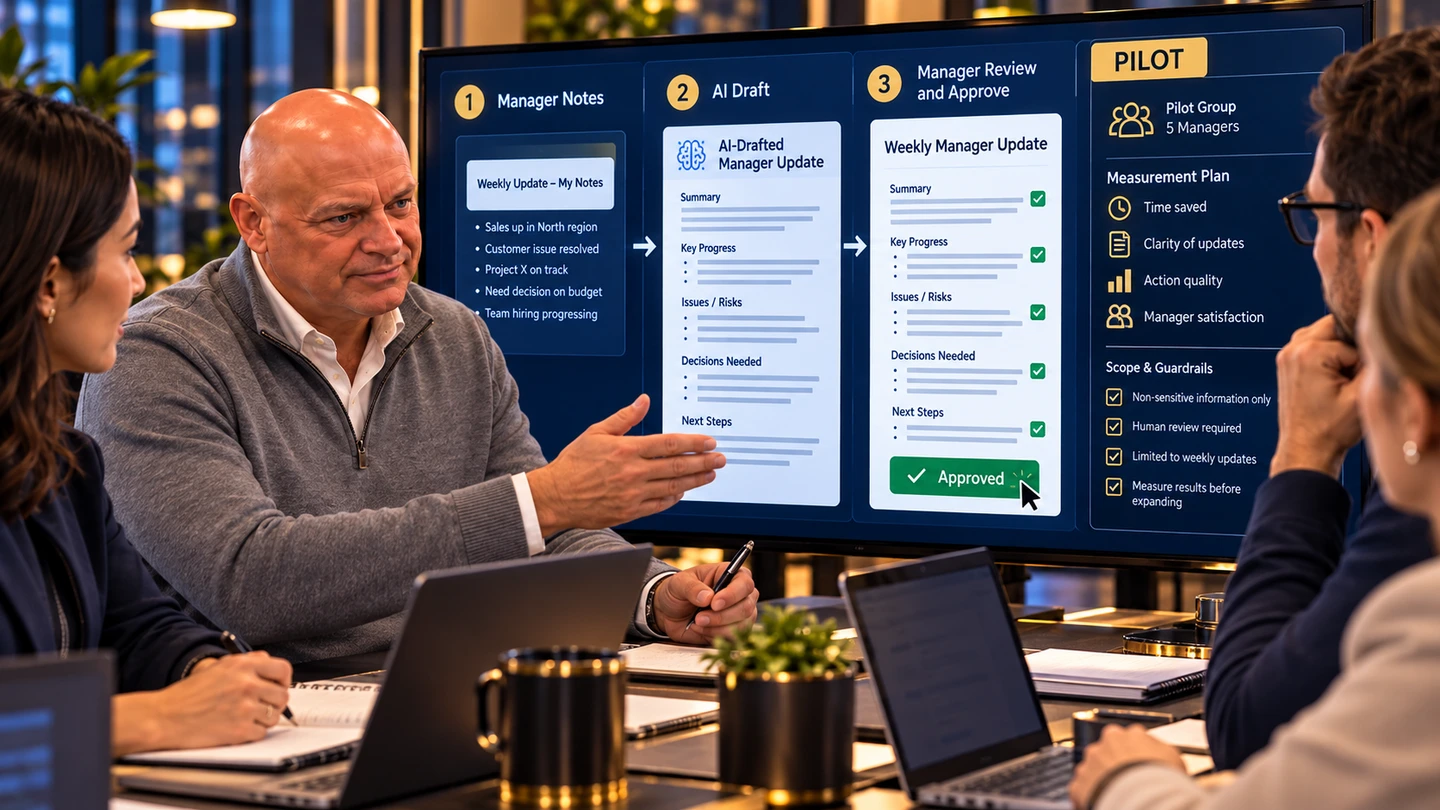
    Illustration: Pilot one AI workflow. My avatar demonstrates the article’s AI lesson.
    Conceptual AI illustration using my avatar. The scene and interface are illustrative; they do not document an actual client engagement, product deployment or business result.

    The smartest AI strategy starts small, proves value, and scales with discipline. A pilot is not a random experiment. It is a controlled test with a clear purpose, workflow, user group, risk boundary, and measurement plan.

    AI readiness is not about chasing software. It is about preparing the business to use AI with purpose, discipline, and accountability. The companies that win with AI will connect the technology to real work, real people, real process, and real measurement.

    Why This Matters

    Small pilots let a company test value before scaling. They show what works, what fails, what employees need, what risks appear, and what training is required. They also reduce fear because people can see practical proof.

    This is an executive operating issue. AI can help a company move faster, but speed only matters when the direction is right. If the business problem is unclear, AI becomes noise. If the workflow is unclear, AI can automate confusion. If the data is weak, AI can create polished but unreliable output. If people are not trained, AI can increase risk instead of reducing friction.

    What I Would Look For

    I would start by looking at where the work slows down, where decisions repeat, where documents are recreated, where people copy information from one place to another, and where knowledge is trapped in people's heads. Then I would separate three categories: work AI can safely assist, work AI can help prepare but a human must approve, and work AI should not touch until governance is stronger.

    Business Example

    A company can pilot AI for weekly manager updates. Managers enter non-sensitive bullet points. AI drafts a structured update. Managers review, correct, and approve. The company measures time saved, clarity, action quality, and manager satisfaction before expanding.

    The lesson is simple: AI should support the work, not hide the problem. It should help employees organize information, communicate clearly, reduce repetitive effort, and improve execution. It should not become a substitute for leadership, judgment, or accountability.

    Risk If Ignored

    If companies skip pilots, they may buy tools employees do not use, automate weak workflows, expose sensitive data, or decide AI does not work when the real issue was poor implementation.

    This is where many companies get AI wrong. They move too fast in the wrong places and too slowly in the places that matter. They buy tools before defining use cases. They experiment without rules. They measure activity instead of impact. That approach may look innovative, but it is not disciplined.

    Action Checklist

    Ask these questions before moving forward: What business problem are we solving? Who owns the workflow? What information is being used? What human review is required? What risk could be created? How will employees be trained? How will success be measured? Who is accountable if the output is wrong?

    Closing Thought

    AI should make businesses clearer, faster, and more disciplined. It should help people turn knowledge into action. But that only happens when companies treat AI adoption as an operating capability, not a technology trend.

    If you want AI adoption to succeed, start with one workflow, one pilot, one clear measurement, and one disciplined review cycle.

    Sources Consulted
    – Microsoft 2026 Work Trend Index: https://blogs.microsoft.com/blog/2026/05/05/how-frontier-firms-are-rebuilding-the-operating-model-for-the-age-of-ai/
    – Microsoft WorkLab – Agents and human agency: https://www.microsoft.com/en-us/worklab/work-trend-index/agents-human-agency-and-the-opportunity-for-every-organization
    – McKinsey State of AI 2025: https://www.mckinsey.com/capabilities/quantumblack/our-insights/the-state-of-ai
    – NIST AI Risk Management Framework: https://www.nist.gov/itl/ai-risk-management-framework
    – IBM What is AI Governance: https://www.ibm.com/think/topics/ai-governance
    ← All insights

    Original publication

  • Build an AI Adoption Roadmap

    Build an AI Adoption Roadmap

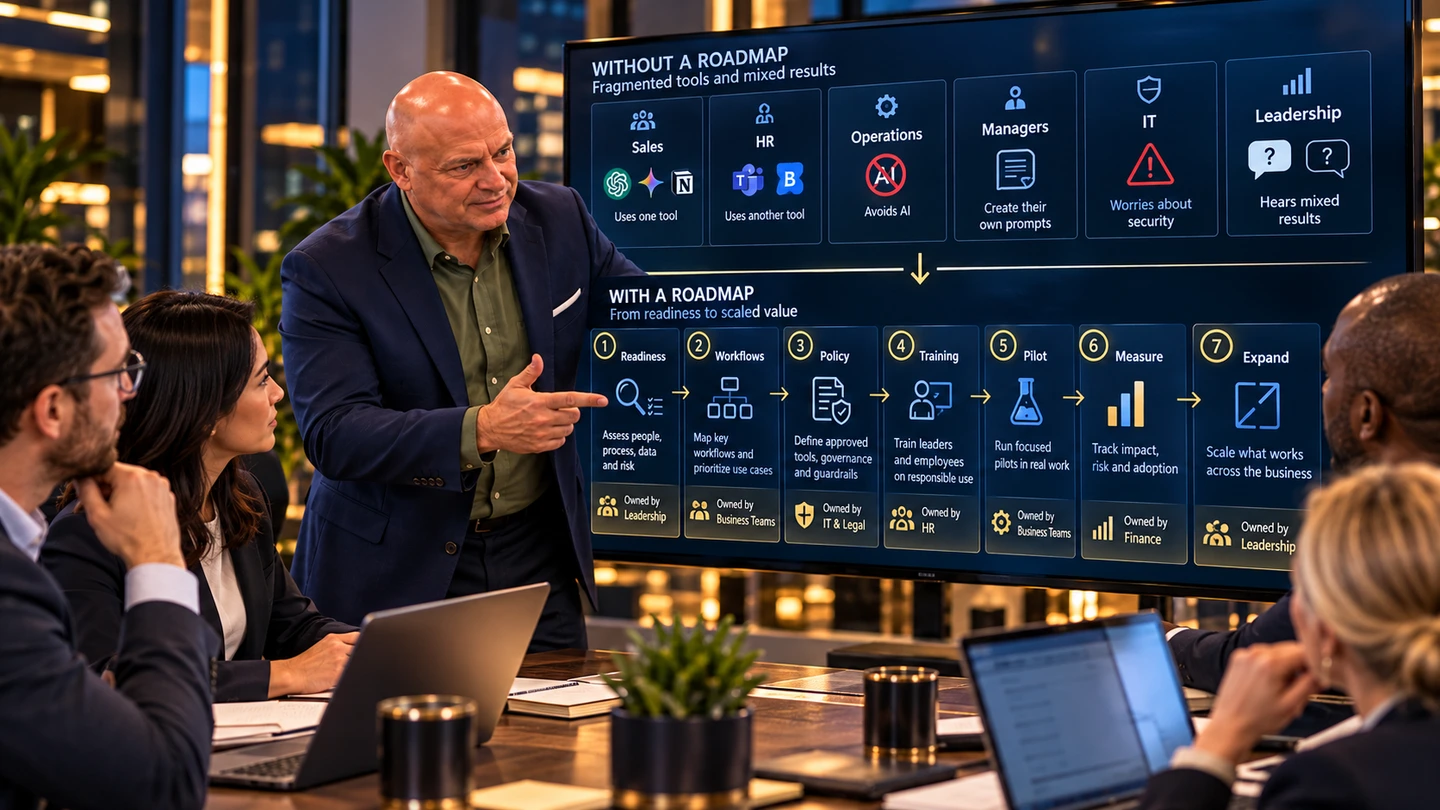
    Illustration: Readiness → policy → training → pilot → measure → expand. My avatar demonstrates the article’s AI lesson.
    Conceptual AI illustration using my avatar. The scene and interface are illustrative; they do not document an actual client engagement, product deployment or business result.

    AI adoption is not a software purchase. It is an operating plan. A roadmap turns scattered AI activity into disciplined business execution.

    AI readiness is not about chasing software. It is about preparing the business to use AI with purpose, discipline, and accountability. The companies that win with AI will connect the technology to real work, real people, real process, and real measurement.

    Why This Matters

    A practical AI roadmap connects tools, people, process, data, governance, training, risk, and measurement. It answers where the company is now, what problems it is solving first, what tools are approved, what risks must be controlled, and who owns the adoption path.

    This is an executive operating issue. AI can help a company move faster, but speed only matters when the direction is right. If the business problem is unclear, AI becomes noise. If the workflow is unclear, AI can automate confusion. If the data is weak, AI can create polished but unreliable output. If people are not trained, AI can increase risk instead of reducing friction.

    What I Would Look For

    I would start by looking at where the work slows down, where decisions repeat, where documents are recreated, where people copy information from one place to another, and where knowledge is trapped in people's heads. Then I would separate three categories: work AI can safely assist, work AI can help prepare but a human must approve, and work AI should not touch until governance is stronger.

    Business Example

    Without a roadmap, sales uses one tool, HR another, operations avoids AI, managers create their own prompts, IT worries about security, and leadership hears mixed results. With a roadmap, the company assesses readiness, maps workflows, creates policy, trains leaders, runs pilots, measures results, and expands what works.

    The lesson is simple: AI should support the work, not hide the problem. It should help employees organize information, communicate clearly, reduce repetitive effort, and improve execution. It should not become a substitute for leadership, judgment, or accountability.

    Risk If Ignored

    Without a roadmap, companies face tool sprawl, shadow AI, data exposure, employee confusion, weak measurement, wasted spending, and missed opportunities.

    This is where many companies get AI wrong. They move too fast in the wrong places and too slowly in the places that matter. They buy tools before defining use cases. They experiment without rules. They measure activity instead of impact. That approach may look innovative, but it is not disciplined.

    Action Checklist

    Ask these questions before moving forward: What business problem are we solving? Who owns the workflow? What information is being used? What human review is required? What risk could be created? How will employees be trained? How will success be measured? Who is accountable if the output is wrong?

    Closing Thought

    AI should make businesses clearer, faster, and more disciplined. It should help people turn knowledge into action. But that only happens when companies treat AI adoption as an operating capability, not a technology trend.

    If your organization has AI tools but no AI operating plan, this is the moment to build a roadmap before scattered activity becomes long-term confusion.

    Sources Consulted
    – Microsoft 2026 Work Trend Index: https://blogs.microsoft.com/blog/2026/05/05/how-frontier-firms-are-rebuilding-the-operating-model-for-the-age-of-ai/
    – Microsoft WorkLab – Agents and human agency: https://www.microsoft.com/en-us/worklab/work-trend-index/agents-human-agency-and-the-opportunity-for-every-organization
    – McKinsey State of AI 2025: https://www.mckinsey.com/capabilities/quantumblack/our-insights/the-state-of-ai
    – NIST AI Risk Management Framework: https://www.nist.gov/itl/ai-risk-management-framework
    – IBM What is AI Governance: https://www.ibm.com/think/topics/ai-governance
    ← All insights

    Original publication

  • Is AI Dangerous – Or Is the Real Risk How Humans Use It?

    Is AI Dangerous – Or Is the Real Risk How Humans Use It?

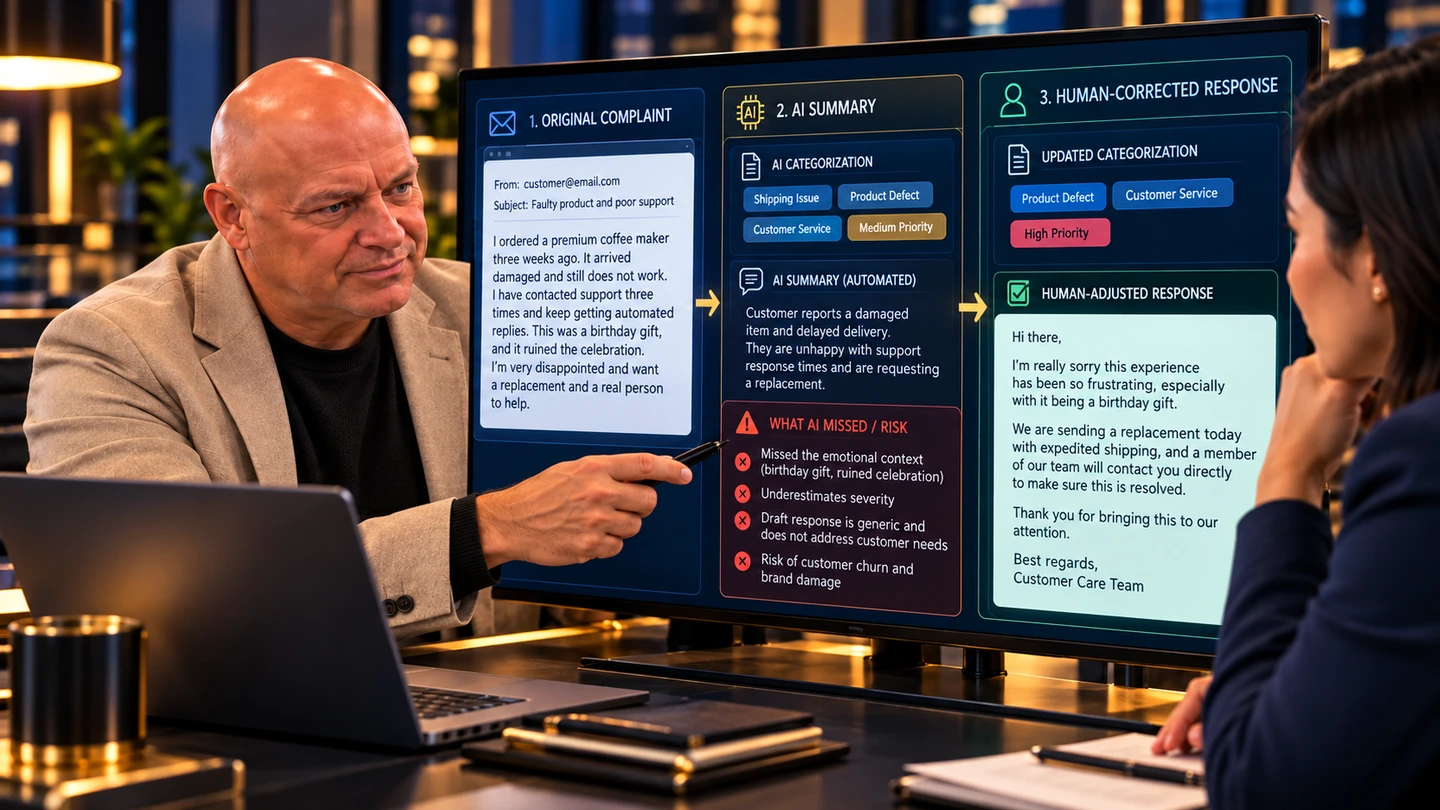
    Illustration: AI risk depends on human decisions. My avatar demonstrates the article’s AI lesson.
    Conceptual AI illustration using my avatar. The scene and interface are illustrative; they do not document an actual client engagement, product deployment or business result.

    AI risk is real, but the conversation is often too shallow. Some people talk about AI like it will save everything. Others talk about AI like it will destroy everything. Both views miss the business issue.

    The responsible AI conversation needs more business discipline. AI can be useful and risky at the same time. It can improve speed, communication, and decision support. It can also scale weak inputs, bias, privacy problems, overconfidence, and poor accountability.

    The Real Issue

    Powerful tools become dangerous when human incentives, weak governance, fear, greed, bias, poor judgment, or lack of accountability drive how those tools are used. AI does not appear inside a company by itself. People choose the tool, define the use case, provide data, write prompts, approve workflows, and decide whether output is checked.

    People choose the tool. People define the use case. People provide the data. People write the prompts. People approve the workflow. People decide whether output is checked. People decide whether employees are trained. People decide whether governance exists. That means AI risk is also management risk.

    Business Example

    A company uses AI to review customer complaints. Used well, AI can summarize themes and help leadership respond faster. Used poorly, it may categorize complaints incorrectly, miss context, or generate professional-sounding responses that do not solve the underlying problem.

    The tool is part of the risk, but the bigger question is how the company uses it. AI can help businesses make better decisions, but it can also make weak decisions move faster. It can improve communication, but it can also create false confidence. It can reduce friction, but it can also hide accountability if leaders are careless.

    What Leaders Must Watch

    The risk is not only the model. It is the management system around the model. Without leadership, governance, training, measurement, and accountability, AI can make weak decisions move faster.

    Responsible AI requires clear use cases, approved tools, data rules, human review, training, transparency, measurement, risk assessment, and accountability. It also requires humility. AI can be useful and wrong, fast and incomplete, polished and misleading, helpful and risky. Leaders need to hold all of that at the same time.

    Action Checklist

    Before using AI in a business workflow, ask: What decision or output is being supported? What data is being used? Could the data be biased or outdated? Who reviews the result? Who owns the final decision? What happens if the output is wrong? Is the customer, employee, or company exposed to risk? What rule controls the workflow?

    Closing Thought

    The goal is not to fear AI. The goal is to lead it. AI should support better decisions, better communication, and better execution. It should not become an excuse for avoiding responsibility.

    If your leadership team is debating AI risk, do not stop at fear or hype. Build a practical system for responsible use.

    Sources Consulted
    – NIST AI Risk Management Framework: https://www.nist.gov/itl/ai-risk-management-framework
    – NIST Generative AI Profile 2024: https://nvlpubs.nist.gov/nistpubs/ai/NIST.AI.600-1.pdf
    – IBM What is AI Governance: https://www.ibm.com/think/topics/ai-governance
    – OWASP Top 10 for LLM Applications: https://owasp.org/www-project-top-10-for-large-language-model-applications/
    – OWASP LLM01 Prompt Injection: https://genai.owasp.org/llmrisk/llm01-prompt-injection/

    ← All insights

    Original publication

  • Inventory Management Is Still Too Slow. Cameras, RFID, and AI May Change That.

    I think inventory management is still being discussed too much in the old way.

    SKU. FIFO. LIFO. EOQ. ROP. Safety stock. Cycle counts.

    Those concepts matter. But they mostly belong to a world where inventory is counted, scanned, reported, reconciled, and reviewed after the fact.

    The stronger question today is this:

    Why are we still depending so much on delayed inventory truth?

    We already have camera technology that can recognize faces, vehicles, labels, barcodes, defects, movement, and objects. In warehouses, that same direction can become very powerful.

    Imagine a camera system mounted across aisles, racks, or key inventory zones that can zoom into a shelf location, read barcodes or labels, recognize product placement, count visible units, and report what is actually sitting there back to the warehouse or inventory system.

    Now combine that with RFID.

    RFID does not have to do everything. It can act as the identity and locator signal.

    Computer vision can act as the visual confirmation layer.

    AI can compare both against the WMS, ERP, demand plan, replenishment rules, customer orders, and operational priorities.

    That is where inventory becomes a live operating signal.

    The system can ask:

    Is the right product in the right space? Does the shelf visually match the system quantity? Is the barcode or label correct? Is something misplaced? Is a stockout forming? Is the WMS saying one thing while the shelf says another? Does this need a cycle count, replenishment task, picking correction, or supervisor review?

    That is a different level of inventory control.

    Most companies still manage too much of this through handheld scans, manual counts, delayed reports, exception emails, and spreadsheets. That creates a permanent gap between what the system says and what the warehouse actually looks like.

    To me, the future is hybrid sensing.

    RFID gives identity and location. Cameras give visual truth. AI turns the mismatch into action.

    The advantage is not just knowing inventory better. The advantage is seeing the problem earlier and acting before it turns into a customer issue, picking error, stockout, billing problem, or working-capital drag.

    Inventory software should not only tell us what we think we have.

    It should show us what is actually there, what does not match, what is about to become a problem, and what action should happen next.

    That is when inventory management stops being a reporting function.

    It becomes an operating advantage.

    Original publication

  • From Funding Confusion to Execution Clarity: Why I Built CapitalRoute AI

    Finding funding is rarely just about finding money.

    The real challenge is understanding what is available, what is active, what applies to the business, what documents are required, what the project is actually ready for, and what needs to happen next.

    That challenge becomes even more complicated when you work across both Europe and the United States.

    The European and U.S. funding environments are fundamentally different operating systems.

    In Europe, the challenge is often navigating layers of EU programs, national priorities, regional rules, eligibility language, regional development logic, innovation funding, digitalization programs, EU-backed loan structures, and policy-driven funding calls.

    In the U.S., the challenge is often fragmentation across federal grants, state programs, local economic development initiatives, lender requirements, SBA-related financing, transportation/logistics programs, bank financing, private capital, and tax incentive structures.

    Different markets.

    Different language.

    Different logic.

    Different documentation.

    But the same need for structure.

    That is why I built CapitalRoute AI.

    I built CapitalRoute AI to support cross-border funding readiness work between U.S. and European business environments — first as an internal tool for my own consulting work and for my European partners.

    The goal was not to create another spreadsheet, another folder full of links, or another document-heavy process that only works if one person remembers where everything is.

    The goal was to create a shorter, more structured workflow for funding readiness, grants, loans, project evaluation, client preparation, source verification, document tracking, reporting, and follow-up.

    But CapitalRoute AI is not only a workflow tool.

    It is designed as an AI-supported funding intelligence and project-readiness system.

    The application can compare a project against different funding routes — EU grants, EU-backed loan programs, national and regional funding, U.S. federal or state programs, SBA-related financing, bank financing, transportation/logistics funding, and private capital.

    Each funding route can receive a Funding Readiness Score from 1 to 10.

    That score is not static.

    As more project information is added, documents are uploaded, sources are verified, requirements are checked, and the business case becomes clearer, the score can move up or down.

    If the system asks for a document and the document is uploaded, the AI-supported review can check it against the relevant funding requirements and project profile. It can help identify whether the document is strong enough, incomplete, unclear, misaligned, or needs improvement.

    That matters because funding readiness is not one big yes-or-no question.

    A project may be strong for one funding route and weak for another.

    It may fit an EU innovation grant but not a bank loan.

    It may fit an SBA-related financing path but not a U.S. federal grant.

    It may be promising for private capital but not ready for a public funding application.

    The point is not to guarantee funding.

    The point is to understand where the project stands, why it stands there, what is missing, what needs to improve, and which funding route deserves serious attention.

    That is where I believe AI becomes useful in real business work.

    Not as hype.

    Not as a replacement for professional judgment.

    Not as a magic button that “finds money.”

    But as an execution layer that helps turn experience, process knowledge, documents, workflows, and decision logic into something structured and usable.

    CapitalRoute AI also supports the project-building side.

    Many companies do not only need help finding funding.

    They need help describing the project clearly.

    What is the concept?

    What problem does it solve?

    What is the use of funds?

    What is the business case?

    What documentation supports it?

    What is the execution plan?

    What makes the project relevant to a specific funding route?

    A good funding process is not just about searching.

    It is about turning a business idea into a fundable project.

    That is why the application is being developed with specialized AI agents for different parts of the workflow: funding research, source verification, document review, project description, eligibility logic, funding-route comparison, scoring, reporting, and next-step planning.

    As the system develops and the workflow becomes more structured, those specialized agents become more useful.

    CapitalRoute AI organizes the work around companies, projects, funding opportunities, source links, client sessions, document readiness, internal notes, client-facing summaries, reports, email drafts, follow-up actions, and next best actions.

    That may not sound flashy.

    But in real business work, structure matters.

    A good system reduces confusion.

    It improves preparation.

    It protects the difference between internal thinking and client-facing communication.

    It helps avoid missed documents, unclear next steps, weak follow-up, and poor funding readiness.

    My background is not software engineering.

    It is operations, logistics, business development, compliance-aware execution, consulting, and building systems.

    That is also how I look at AI.

    I am less interested in AI as a writing trick and more interested in AI as a way to build practical operating systems around real business problems.

    In logistics, operations, consulting, funding readiness, compliance-aware workflows, and project execution, the same pattern shows up again and again:

    Information is scattered.

    Responsibilities are unclear.

    Documents are incomplete.

    Decisions are delayed.

    Follow-up is inconsistent.

    People are working hard, but the workflow is not strong enough.

    AI can help, but only if it is connected to the actual work.

    That is the lesson I keep coming back to.

    AI creates value when it is tied to a real business problem, a clear workflow, and experienced judgment.

    CapitalRoute AI started as an internal tool, but the underlying problem is large enough that the workflow could eventually support a broader platform.

    For now, the value is more immediate.

    It helps me and my partners work with more structure, better preparation, clearer visibility, and stronger follow-through across two very different funding environments.

    And that, to me, is where practical AI is going.

    Not replacing people.

    Not removing judgment.

    Not turning every business problem into a chatbot.

    But helping experienced people turn messy processes into organized systems that support better execution.

    CapitalRoute AI does not just help find funding opportunities.

    It helps a project become more fundable.

    That is the kind of AI work I find most interesting.

    Original publication

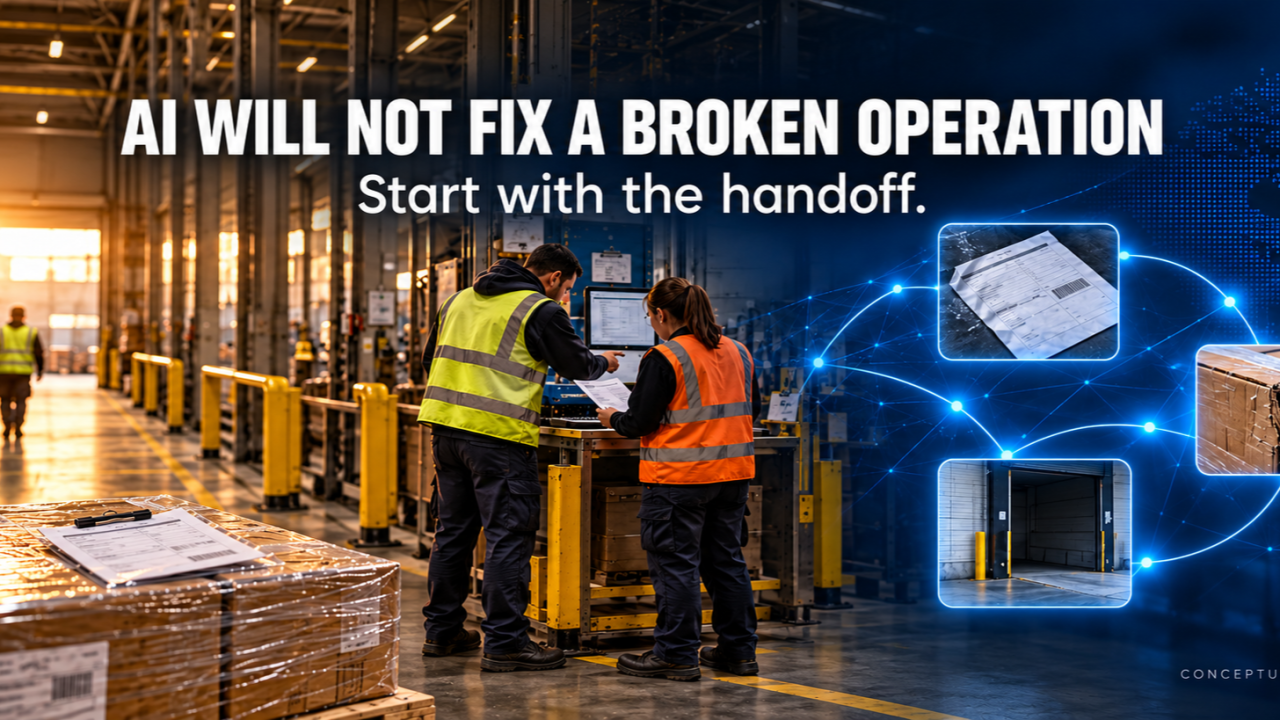
  • AI Will Not Fix a Broken Operation — But It Can Expose the Friction

    AI Will Not Fix a Broken Operation — But It Can Expose the Friction

    Illustration for AI Will Not Fix a Broken Operation — But It Can Expose the Friction

    Begin with a delayed decision, a trustworthy record and someone responsible for acting.

    EXECUTIVE ANALYSIS | H. Max Ottesen

    AI-generated conceptual editorial illustration. Fictional people and setting; not documentary evidence. Illustrated warehouse handoff with staged goods, paperwork and workers reviewing the gap safely.

    A late load can have several explanations. The warehouse may not have released it. The assigned vehicle may be unavailable. An appointment may have changed. Before buying an AI system, leadership should establish which explanation the available records actually support.

    That is the useful starting point for this article: a proposed way to examine operating friction, rather than a claim about a deployed AI system. My recommendation is to begin with one repeated decision and follow the evidence through the departments involved.

    Follow the handoff

    Consider a hypothetical load that dispatch marks ready while maintenance still shows the assigned vehicle on hold. A useful review would display both records, their timestamps and their owners. It would ask for reconciliation before recommending a dispatch action. A simple rule may identify that contradiction perfectly well. An AI assistant might help summarize the surrounding messages, provided a reviewer checks the summary.

    The distinction matters because generative systems can confidently produce false content, a risk identified in NIST’s generative-AI profile. [1] Fluent explanations should therefore remain separate from the underlying operating record.

    For this pilot, I would require an evidence trail: the original status, the most recent update, the person authorized to correct it and the action taken. A system that cannot distinguish an old status from a current one should stop and request confirmation.

    What my operating record supports

    My Career Vault records fleet uptime improving from 61.4% to 95.9% and outside-carrier spending falling from approximately USD 2 million to USD 300,000 per month at PetroChoice / MOOVE. These are author-controlled career figures, checked against that record rather than independently audited employer data. They are operating-management results; I do not attribute them to AI. [2]

    Their relevance is limited but practical. They identify the kinds of measures I would want an operating review to make understandable. They do not establish that the proposed assistant could reproduce the results, or establish which intervention caused each historical change.

    Test the smallest useful intervention

    I would first review a sample of exceptions manually. Record where evidence conflicts, how long reconciliation takes and whether the same problem returns. Then compare the existing process, a simple rules-based queue and an AI-assisted version using the same case definitions.

    Count reviewer corrections and missed cases as well as time saved. Include integration, checking and support work in the cost. If better data ownership solves the problem, keep that improvement even if the AI component adds nothing.

    NIST’s voluntary AI framework supports context-specific evaluation and accountability. [3] It does not supply a business case for this pilot. That case must come from the operation being tested.

    The first useful result may be an uncomfortable finding: nobody owns the disputed status. Software can help expose that gap. Leadership still has to assign the authority and follow through.

    SOURCES & EVIDENCE

    [1] Chloe Autio et al. / NIST (2024-07-26). Artificial Intelligence Risk Management Framework: Generative Artificial Intelligence Profile. https://nvlpubs.nist.gov/nistpubs/ai/NIST.AI.600-1.pdf. Locator: NIST AI 600-1, section 2.2 and action MS-2.5-003. Supports: The risk of confidently false generated content. Limitations: Identifies risks and suggested controls; it does not validate these proposed workflows. Checked: 2026-10-17.

    [2] H. Max Ottesen (2026-10-15). Executive Career Vault and Resume Rules. CAREER_VAULT_SOURCE.pdf, Version 3 Final, sections 5–7, pp. 2–4. Locator: CAREER_VAULT_SOURCE.pdf, Version 3 Final, sections 5–7, pp. 2–4. Supports: The two PetroChoice / MOOVE operating figures, with attribution and audit limits. Limitations: Verified against the governing Vault only. Employer records, underlying calculation definitions and independent audit evidence were not supplied. Checked: 2026-10-17.

    [3] Elham Tabassi / NIST (2023-01-26). Artificial Intelligence Risk Management Framework (AI RMF 1.0). https://nvlpubs.nist.gov/nistpubs/ai/NIST.AI.100-1.pdf. Locator: NIST AI 100-1, Core, sections 5.1–5.4. Supports: Context-specific evaluation and accountable governance. Limitations: A governance framework, not evidence that a proposed operating tool improves results. Checked: 2026-10-17.

    HOW THE CONCLUSION WAS REACHED

    The career record identifies relevant management measures; the NIST material identifies evaluation and reliability concerns. From those premises, a small comparison against the current process is a reasonable test design. Neither source proves that AI improves handoffs.

    LIMITATIONS

    No AI trial, cost study, employer source data or causal attribution was supplied. The warehouse example is hypothetical. The title describes a conditional possibility, not a finding that every broken operation can be diagnosed by AI.

    © 2026 H. Max Ottesen. All rights reserved.

    ← All articles & insights

    Original publication

  • From Dispatch to Dock — How AI Can Improve Daily Execution

    From Dispatch to Dock — How AI Can Improve Daily Execution

    Illustration for From Dispatch to Dock — How AI Can Improve Daily Execution

    A coordination pilot needs shared evidence and a safety boundary.

    EXECUTIVE ANALYSIS | H. Max Ottesen

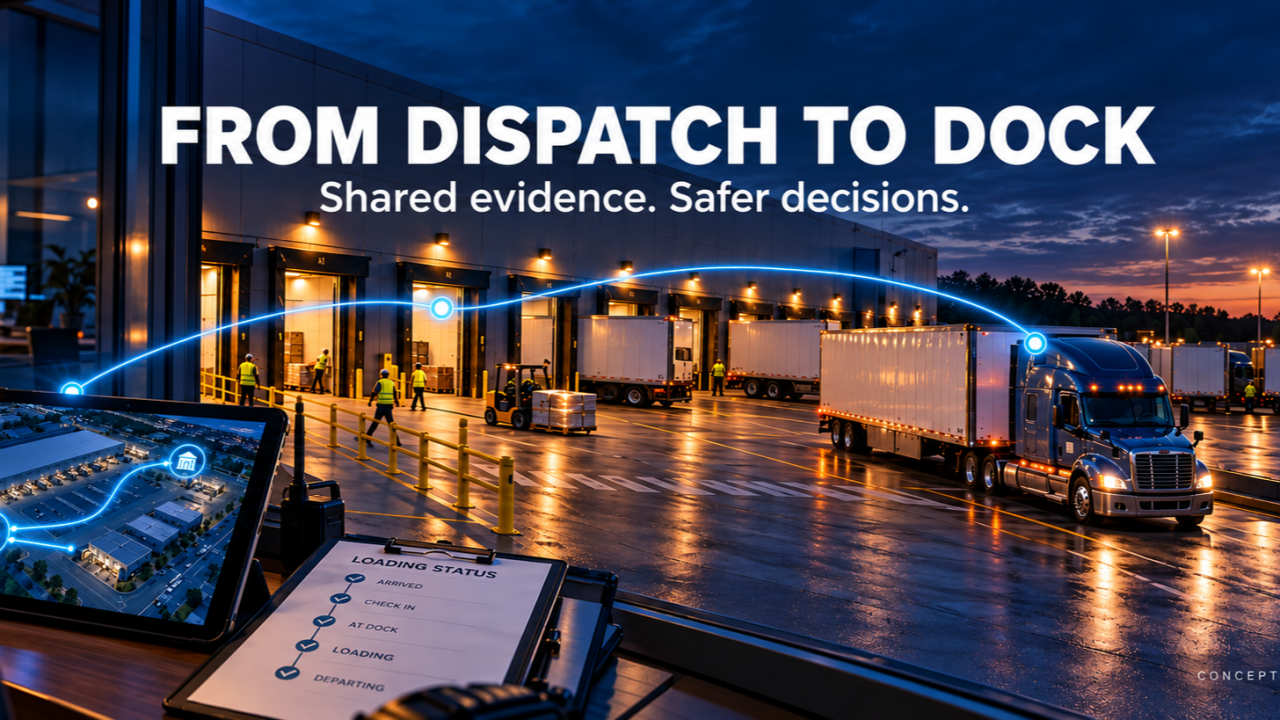
    AI-generated conceptual editorial illustration. Fictional people and setting; not documentary evidence. Wide illustrated loading bays with parked trailers and protected walkways linking dispatch and dock review.

    A truck’s arrival time is only one part of a dock appointment. For a coordination pilot, I would also want to know whether the goods are ready, the bay is available and the assigned equipment is cleared for its next job. A departure recommendation should show which of those conditions has actually been confirmed.

    This is a proposed workflow for one facility or customer lane. No dispatch-to-dock AI deployment or improvement is claimed here.

    Establish what the delay means

    FMCSA’s detention research page identifies a measurement problem: earlier work could not adequately separate ordinary loading and unloading from detention. [1] That is a useful warning for a local pilot. A long stay does not, by itself, identify its cause or the department responsible.

    I would agree on event definitions with dispatch, drivers and warehouse supervisors before collecting a baseline. Arrival, check-in, bay assignment, loading start and release should remain distinct. Record missing events as missing rather than allowing a model to invent a plausible sequence.

    A proposed assistant could bring approved records into a review queue and draft a short conflict summary. Its job would be to prepare the question: which record needs confirmation, and who can provide it? A source link and timestamp should accompany every important assertion.

    Make the next action specific

    Suppose, hypothetically, the estimated arrival falls outside the receiving window. The review card should identify the conflict, the receiving contact responsible for checking it and the next confirmation required. It should not quietly move the appointment or promise the customer a new delivery time.

    I would keep the initial pilot read-only. Staff could accept or reject a proposed action and record why. A missed warning, an unnecessary warning and a correct warning that nobody acted on are three different failures. Combining them into a single accuracy figure would conceal the operational problem.

    Protect the driver and the worksite

    FMCSA describes specific protections against carrier harassment involving ELD or connected-technology information and known or reasonably foreseeable hours-of-service violations. That does not make every digital alert harassment. It does mean the dispatch design must respect the rule’s particular boundary. [2]

    OSHA’s warehouse guidance addresses forklift and dock-edge hazards. [3] My operating recommendation is that any timing suggestion remain subordinate to the site’s safety process. A faster departure cannot justify unsafe movement, an unresolved equipment hold or pressure to bypass a required check.

    Measure a reliable handoff

    Compare the pilot with the existing process on the same lane. Review unresolved conflicts, duplicate calls, false alerts and the time to verified ownership. Keep a separate account of safety concerns and user objections. A service gain accompanied by worse safety conditions should fail the pilot.

    AI may help prepare a clearer shared picture. Whether it improves execution depends on the quality of the records, the usefulness of its summaries and the people authorized to act. Those are test questions, not benefits to announce in advance.

    SOURCES & EVIDENCE

    [1] Federal Motor Carrier Safety Administration (Updated 2025-10-03). Impact of Driver Detention Time on Safety and Operations. https://www.fmcsa.dot.gov/research-and-analysis/impact-driver-detention-time-safety-and-operations. Locator: Background and Project Goal. Supports: The distinction between ordinary dwell and detention, and the stated measurement gap. Limitations: Summarizes earlier research and a measurement gap. It is not a completed evaluation of an AI dock-coordination system. Checked: 2026-10-17.

    [2] Federal Motor Carrier Safety Administration (Updated 2018-03-27). Harassment Protection. https://www.fmcsa.dot.gov/hours-service/elds/harassment-protection. Locator: ELD Rule definition and Preventing Harassment. Supports: The specific ELD-linked harassment boundary. Limitations: A specific ELD-linked harassment protection; not every alert or use of ELD data constitutes harassment. Check controlling law and the facts for an actual case. Checked: 2026-10-17.

    [3] Occupational Safety and Health Administration (Undated live page; accessed 2026-10-17). Warehousing — Hazards and Solutions. https://www.osha.gov/warehousing/hazards-solutions. Locator: Forklift Operation, Other Considerations, and loading dock guidance. Supports: Warehouse forklift and dock hazards. Limitations: Hazard guidance, not a site-specific safety assessment or proof of AI effectiveness. Checked: 2026-10-17.

    HOW THE CONCLUSION WAS REACHED

    The sources establish a measurement ambiguity and safety constraints. The proposed event record and read-only queue are design responses to those constraints. They have not been validated as an effective intervention.

    LIMITATIONS

    No current rule thresholds, detention prevalence estimate or causal crash reduction is asserted. Local event quality, lawful access to driver data, integration and staff capacity remain untested. Regulatory sources must be refreshed before any implementation or public release.

    © 2026 H. Max Ottesen. All rights reserved.

    ← All articles & insights

    Original publication

  • The Best Use of AI in Operations Is Structure

    The Best Use of AI in Operations Is Structure

    Illustration for The Best Use of AI in Operations Is Structure

    A common operating record should make local exceptions easier to explain.

    EXECUTIVE ANALYSIS | H. Max Ottesen

    AI-generated conceptual editorial illustration. Fictional people and setting; not documentary evidence. Conceptual illustration of warehouse, maintenance and field-service sites connected to a shared review table.

    What should stay consistent across a warehouse network, and what should remain local? That is the question I would settle before building an AI assistant. A shared form is useful only if it captures the decisions people actually need to make.

    “Best” in this headline expresses an operating priority, not a research ranking of every possible AI application. The proposal is to establish usable structure before expanding automation.

    Define the shared record

    For a late outbound order, I would want the commitment, current status, supporting evidence, owner and next review point. Local teams should also be able to explain a circumstance the standard categories miss. A forced category can conceal uncertainty just as easily as free text can conceal inconsistency.

    AI could be tested as an aid to preparing the daily review. Begin with source records and allow the assistant to draft a summary of unresolved questions. Keep verified fields separate from generated interpretation. NIST’s framework treats accountability and context as part of AI risk management. [1]

    Scale does not remove local judgment

    My approved Career Vault records responsibility at PetroChoice / MOOVE involving approximately 500 fleet units and 52 warehouse locations, with operating coordination across 52 warehouse leaders in a 950-plus-employee organization. It does not say all those employees reported directly to me. This is a Vault-supported scope statement, not independently audited staffing data. [2]

    That background informs my preference for a common operating language. It does not establish that identical workflows fit every site, or that AI produced any historical result. I would preserve a local escalation path for unusual equipment, customer requirements and uncertain records.

    Build one review process first

    Choose one decision type at one location. Agree on definitions, record the existing workload and identify who may change the underlying status. Then compare manual preparation with the assisted version. Ask supervisors to record corrections rather than quietly repairing every output.

    Measure completeness and review effort together. A fuller report that takes longer to check may still be useful for a high-risk decision, but that tradeoff should be explicit. Conversely, more populated fields do not prove better management information.

    OSHA’s warehouse guidance identifies physical hazards that require appropriate operating controls. [3] My recommendation is to keep safety authority with the trained, accountable process. A shared reporting format should help expose an unresolved check; it should not allow a model to approve it.

    Keep the structure useful

    Review categories after the pilot. Retire fields nobody uses. Investigate patterns in “other” responses. Preserve evidence of a genuine local exception instead of treating deviation as failure by definition.

    The structure I would build is deliberately modest: enough shared information to make a decision reviewable, enough local context to make it sensible, and a clear person responsible for the next step. AI deserves a place only if it helps maintain that standard.

    SOURCES & EVIDENCE

    [1] Elham Tabassi / NIST (2023-01-26). Artificial Intelligence Risk Management Framework (AI RMF 1.0). https://nvlpubs.nist.gov/nistpubs/ai/NIST.AI.100-1.pdf. Locator: NIST AI 100-1, Core, sections 5.1–5.4. Supports: Accountability and context in AI governance. Limitations: A governance framework, not evidence that a proposed operating tool improves results. Checked: 2026-10-17.

    [2] H. Max Ottesen (2026-10-15). Executive Career Vault and Resume Rules. CAREER_VAULT_SOURCE.pdf, Version 3 Final, sections 5–7, pp. 2–4. Locator: CAREER_VAULT_SOURCE.pdf, Version 3 Final, sections 5–7, pp. 2–4. Supports: The exact operating scale and reporting distinction. Limitations: Verified against the governing Vault only. Employer records, underlying calculation definitions and independent audit evidence were not supplied. Checked: 2026-10-17.

    [3] Occupational Safety and Health Administration (Undated live page; accessed 2026-10-17). Warehousing — Hazards and Solutions. https://www.osha.gov/warehousing/hazards-solutions. Locator: Forklift Operation, Other Considerations, and loading dock guidance. Supports: Warehouse physical hazard context. Limitations: Hazard guidance, not a site-specific safety assessment or proof of AI effectiveness. Checked: 2026-10-17.

    HOW THE CONCLUSION WAS REACHED

    The career record provides experience relevant to multi-site coordination; risk and safety guidance provide constraints. The proposed shared record is a management design judgment. The sources do not establish it as the universally best AI use.

    LIMITATIONS

    No multi-site pilot or local workflow evidence was supplied. Scale is supported only by the approved Vault. Local differences and the cost of maintaining common definitions could outweigh standardization gains.

    © 2026 H. Max Ottesen. All rights reserved.

    ← All articles & insights

    Original publication

  • The Real Opportunity in Transportation AI Is Better Decisions

    The Real Opportunity in Transportation AI Is Better Decisions

    Illustration for The Real Opportunity in Transportation AI Is Better Decisions

    Evaluate the whole assignment before accepting a persuasive score.

    EXECUTIVE ANALYSIS | H. Max Ottesen

    AI-generated conceptual editorial illustration. Fictional people and setting; not documentary evidence. Overhead illustrated transportation planning desk with route paper, keys and maintenance information.

    Would you accept a load because its quoted rate looks attractive? I would want the rest of the assignment beside it: empty movement, waiting, equipment fit, available driver time, customer obligations and the next positioning choice. That is the decision I would ask a transportation tool to help prepare.

    The proposed application in this article is an advisory comparison of operating options. It is not a description of a tested optimizer or autonomous dispatcher.

    Show the tradeoff

    A useful comparison should let a dispatcher inspect the assumptions for each option. Which distance is being used? Is the receiving window confirmed? Is the equipment appropriate? What cost is estimated, and which cost comes from an actual record?

    I would keep safety and operating eligibility outside a negotiable commercial score. An attractive revenue estimate should not compensate mathematically for an unresolved maintenance hold. The review should first reject options that fail the applicable operating checks, then compare the eligible choices.

    EPA’s SmartWay resources combine performance measurement with operating and equipment strategies. [1] They support a broad view of fleet efficiency, not a claim that AI creates a particular saving. My suggested tool would similarly show several operating considerations without pretending they reduce to a universally correct ranking.

    Keep the career example in its proper place

    My Career Vault records on-time performance moving from 72% to 94% and transportation cost per mile from USD 3.75 to USD 3.02 at PetroChoice / MOOVE. The figures are checked against my approved career record; independent employer calculations were not supplied. They are not AI results. [2]

    I would use that experience to ask better questions of a new tool. Are cost and service being measured on comparable work? Did the customer mix change? Are savings shifted to another budget? These are proposed review questions, not explanations I can establish from the Vault alone.

    Compare decisions before automating them

    Select one repeated choice, such as late-load recovery. Record the existing dispatcher recommendation, the tool’s proposed alternative and the information available at the time. Avoid judging a recommendation using facts that arrived only after the decision.

    Begin with retrospective cases, then a supervised trial. Track why dispatchers override suggestions. An override may reveal a missing constraint, but it may also reflect habit. Both deserve examination. Include the time spent correcting data and reviewing recommendations in the evaluation.

    Research with consultants described by Harvard Business School found that AI capability varied across tasks. [3] That is a reason to test each intended transportation use. It is not evidence that a model performing well on consulting exercises can choose loads safely or profitably.

    The pilot should earn further authority only if it helps people make better decisions under the actual constraints. A neat score is easy to display. An assumption that a dispatcher can inspect, challenge and correct is more useful.

    SOURCES & EVIDENCE

    [1] U.S. Environmental Protection Agency (Undated live page; accessed 2026-10-17). SmartWay Truck Carrier Partner Resources. https://www.epa.gov/smartway/smartway-truck-carrier-partner-resources. Locator: Measure your Performance and Strategies for Efficiency. Supports: Fleet measurement and multiple efficiency strategies. Limitations: Describes measurement and operating strategies, not AI-caused savings or Max’s fleet results. Checked: 2026-10-17.

    [2] H. Max Ottesen (2026-10-15). Executive Career Vault and Resume Rules. CAREER_VAULT_SOURCE.pdf, Version 3 Final, sections 5–7, pp. 2–4. Locator: CAREER_VAULT_SOURCE.pdf, Version 3 Final, sections 5–7, pp. 2–4. Supports: The two historical PetroChoice / MOOVE measures, without AI attribution. Limitations: Verified against the governing Vault only. Employer records, underlying calculation definitions and independent audit evidence were not supplied. Checked: 2026-10-17.

    [3] HBS AI Faculty / Harvard Business School (2023-09-21). Navigating the Jagged Technological Frontier. https://aiinstitute.hbs.edu/navigating-the-jagged-technological-frontier/. Locator: Study overview and Key Findings. Supports: Task-specific capability in a consultant experiment. Limitations: Study involved 758 consultants and task-specific performance. It does not establish fleet, warehouse, safety or general software-production outcomes. Checked: 2026-10-17.

    HOW THE CONCLUSION WAS REACHED

    The operating record provides context, EPA supports multi-factor measurement, and the research cautions against assuming capability transfers between tasks. The proposed decision comparison follows from those premises but remains an untested design.

    LIMITATIONS

    No load-level cost data, optimizer evaluation or causal savings analysis was supplied. Historical measures lack underlying definitions and independent corroboration. Consultant research is not transportation evidence.

    © 2026 H. Max Ottesen. All rights reserved.

    ← All articles & insights

    Original publication

  • Visibility Still Wins — AI Exceptions and Follow Through

    Visibility Still Wins — AI Exceptions and Follow Through

    Illustration for Visibility Still Wins — AI Exceptions and Follow Through

    The operating test is whether a warning leads to a verified resolution.

    EXECUTIVE ANALYSIS | H. Max Ottesen

    AI-generated conceptual editorial illustration. Fictional people and setting; not documentary evidence. Illustrated night operations room focused on one open case and a supervisor checking evidence.

    A warning that nobody owns is unfinished work. For an exception-management pilot, I would start by defining what a resolved case looks like and work backward from there. Detection would be one step in the process, rather than the headline result.

    This article proposes a way to evaluate an AI-supported exception queue. It does not report a deployed control tower or measured reduction in failures.

    Give each warning a response

    The UK Health and Safety Executive’s alarm guidance says alarms should be relevant and have a defined response. [1] It concerns process-plant alarms, so applying that principle to a logistics queue is an analogy, not direct evidence of effectiveness.

    For a proposed queue, I would require the issue, supporting record, responsible person, next action and escalation condition. A case should remain open until the responsible person records what changed and verifies the relevant operating status. Clicking “done” should not erase the evidence.

    Imagine a hypothetical customer document missing before a delivery. The assistant could assemble the request history and draft a follow-up. It should preserve the original messages so the reviewer can check whether a promise was actually made. NIST identifies confidently false generated content as a risk. [2] An invented commitment would turn an administrative delay into a new problem.

    Count the work the queue creates

    I would distinguish alerts raised, useful alerts, missed cases, duplicate cases and cases closed without sufficient evidence. Review age and recurrence alongside time to closure. Closing something quickly is not an improvement if the same unresolved issue returns on the next shift.

    Protect the comparison from easy distortions. Keep the definition of a case stable. Check whether staff are splitting or merging cases differently. Include the checking time imposed on supervisors and the people asked to respond.

    An alert queue may be the wrong intervention if the real constraint is unavailable repair capacity or authority to make a decision. Better prioritization can help choose what waits; it cannot make that constraint disappear.

    Leave room for disagreement

    Operators should be able to challenge a category, add missing evidence and explain why a suggested action would fail. Keep those corrections for review. They may reveal that a general category hides several very different operating situations.

    My recommendation is to test a small number of consequential exception types first. Avoid adding warnings merely because data is available. If a rule or existing work-order system already supports the response reliably, compare the AI addition against that baseline.

    Visibility is useful when it helps the right person take an appropriate action and confirm the result. The pilot should be judged on that chain. A crowded screen proves only that the screen is crowded.

    SOURCES & EVIDENCE

    [1] UK Health and Safety Executive (Page date 2024-10-29; accessed 2026-10-17). Alarm management. https://www.hse.gov.uk/humanfactors/topics/alarm-management.htm. Locator: Key principles of alarm management. Supports: Relevant alarms with defined responses; analogy explicitly limited. Limitations: Process-plant alarm guidance is used by analogy. It is not a warehouse-AI trial. Checked: 2026-10-17.

    [2] Chloe Autio et al. / NIST (2024-07-26). Artificial Intelligence Risk Management Framework: Generative Artificial Intelligence Profile. https://nvlpubs.nist.gov/nistpubs/ai/NIST.AI.600-1.pdf. Locator: NIST AI 600-1, section 2.2 and action MS-2.5-003. Supports: Risk of confidently false generated summaries. Limitations: Identifies risks and suggested controls; it does not validate these proposed workflows. Checked: 2026-10-17.

    HOW THE CONCLUSION WAS REACHED

    A defined response is a defensible design principle from alarm management. Generated-summary risk makes source checking necessary. The conclusion that an exception queue should be evaluated through closure is executive analysis, not a demonstrated causal effect.

    LIMITATIONS

    No field evaluation of an AI exception queue was supplied. Process-plant guidance does not independently validate logistics triage. Capacity, incentives, case definitions and reviewer workload could dominate any result.

    © 2026 H. Max Ottesen. All rights reserved.

    ← All articles & insights

    Original publication