Author: admin

  • AI Is Becoming an Execution Layer for Business

    AI Is Becoming an Execution Layer for Business

    Illustration for AI Is Becoming an Execution Layer for Business

    Treat execution as a controlled design choice rather than a capability claim.

    EXECUTIVE ANALYSIS | H. Max Ottesen

    AI-generated conceptual editorial illustration. Fictional people and setting; not documentary evidence. Illustrated project folders moving toward human review, with an outgoing envelope still awaiting approval.

    A drafted answer is the beginning of a workflow. Someone may need to check it, attach evidence, approve a change and confirm that the action happened. Those transitions are what I mean by an execution layer in this article.

    The phrase describes a proposed operating architecture. It is not a measured claim that most businesses have adopted it, or that a general AI system can reliably run their processes.

    Separate preparation from authority

    For a hypothetical capital request, an assistant could help assemble the submitted documents and prepare a list of missing information. The accountable reviewer would decide whether the case is complete and whether the investment should proceed. Approval should be a recorded event with an identified decision-maker.

    An email draft should likewise remain a draft until an authorized person approves the exact recipient and content. My CapitalRoute workflow guide describes a version with draft-only email handoff rather than live sending. That is a documented internal design boundary, not evidence that I tested the current installed build. [1]

    Describe the development record accurately

    My Career Vault lists more than 36 specialized agents, three SaaS prototypes and one complete standalone European funding-application program. Those are author-controlled development claims checked against the approved record. They do not establish production adoption, active usage or commercial success. I do not present that work as a software-engineering credential. [2]

    For any new tool, I would distinguish a concept, a working prototype, a controlled pilot and a production deployment with continuing support. Moving between those stages should depend on evidence appropriate to the intended use, rather than a more ambitious label.

    Put controls at the transition

    My design recommendation is to record who can approve an action, which evidence they saw and what the system is allowed to change. Repeated requests should not silently create duplicate transactions. A failed handoff should remain visible for recovery, with a person responsible for resolving it.

    NIST’s AI framework organizes risk work around GOVERN, MAP, MEASURE and MANAGE. [3] These are related functions, not a rigid sequence or a certificate that a workflow is safe. They offer a vocabulary for examining the design while the business supplies its own operating requirements.

    Begin with a low-risk internal process. Compare the assisted workflow against an ordinary checklist or existing application feature. Include review effort, recovery work and support costs. If the assistant prepares a good summary but creates unreliable actions, keep it in preparation.

    An execution layer should make authority clearer at each transition. That is the practical standard I would apply before giving a tool permission to act.

    SOURCES & EVIDENCE

    [1] CapitalRoute AI / Growth Partners International (2026-07-08). CapitalRoute AI Application Workflow Guide. CAPITALROUTE_WORKFLOW_SOURCE.pdf, V0.39E, sections 1–2 and 6–12. Locator: CAPITALROUTE_WORKFLOW_SOURCE.pdf, V0.39E, sections 1–2 and 6–12. Supports: V0.39E draft-only email workflow and private/internal status. Limitations: Documents the described internal workflow at that version. It is not an independent test, current build inspection, adoption record or measured outcome study. Checked: 2026-10-17.

    [2] H. Max Ottesen (2026-10-15). Executive Career Vault and Resume Rules. CAREER_VAULT_SOURCE.pdf, Version 3 Final, sections 5–7, pp. 2–4. Locator: CAREER_VAULT_SOURCE.pdf, Version 3 Final, sections 5–7, pp. 2–4. Supports: The development inventory and prototype distinction. Limitations: Verified against the governing Vault only. Employer records, underlying calculation definitions and independent audit evidence were not supplied. Checked: 2026-10-17.

    [3] Elham Tabassi / NIST (2023-01-26). Artificial Intelligence Risk Management Framework (AI RMF 1.0). https://nvlpubs.nist.gov/nistpubs/ai/NIST.AI.100-1.pdf. Locator: NIST AI 100-1, Core, sections 5.1–5.4. Supports: The four related risk-management functions. Limitations: A governance framework, not evidence that a proposed operating tool improves results. Checked: 2026-10-17.

    HOW THE CONCLUSION WAS REACHED

    The internal guide illustrates a preparation/action boundary; the Vault supports the limited development record. The execution-layer proposal combines those examples with governance principles. No trend prevalence or deployment success follows from them.

    LIMITATIONS

    Current CapitalRoute behavior, agent inventory operation, prototype adoption and business outcomes were not independently tested. The headline is an analytical framing. Production reliability and safe transaction handling require separate evidence.

    © 2026 H. Max Ottesen. All rights reserved.

    ← All articles & insights

    Original publication

  • Stop Asking What AI Can Write — Start Asking What It Can Build

    Stop Asking What AI Can Write — Start Asking What It Can Build

    Illustration for Stop Asking What AI Can Write — Start Asking What It Can Build

    Specify a work product the team can test and maintain.

    EXECUTIVE ANALYSIS | H. Max Ottesen

    AI-generated conceptual editorial illustration. Fictional people and setting; not documentary evidence. Overhead illustration of colleagues converting process cards into a plain internal form prototype.

    Choose a work product before choosing an agent. For a maintenance meeting, that might be a reviewable action register tied to the relevant asset and evidence. For a capital request, it might be a clear account of missing documents and unresolved approvals.

    These are proposed tools, not accounts of systems I have deployed. The useful question is whether a team can test the output, correct it and keep it working after the demonstration.

    Define a bounded job

    I would write the intended input, permitted output and approval boundary in plain language. For example: prepare a draft follow-up register from approved meeting notes; preserve the notes; flag ambiguous ownership; make no changes to maintenance status. An uncertain assignment should remain uncertain until someone confirms it.

    A builder should also define failure. A fabricated owner, an omitted action and an action attached to the wrong vehicle are different defects. Testing only whether the register looks complete would miss the point.

    Original research on a generative assistant in customer support provides evidence that an AI tool can be studied in an actual workflow. [1] Its results do not establish that a newly generated business application is reliable. Different tasks, users and consequences require their own evaluation.

    Bring operating knowledge to the design

    My Career Vault records operating-system development and hardware/software integration work at IP Security / IP Agency, alongside later fleet and logistics leadership. It supports that business-building background without establishing a software-engineering qualification. [2]

    That perspective leads me to ask who owns the process, who can correct its data and who will support the tool when something changes. A generated application with no responsible maintainer should remain an experiment.

    Test the uncomfortable cases

    Use ordinary cases and cases with missing, contradictory or outdated evidence. Check whether a user can see the source behind an output. Test permissions with a person who should not have access. Confirm that a rejected draft does not become an approved operating record.

    NIST’s generative-AI profile recommends verifying generated sources and citations. [3] I would apply that control to the tool’s evidence trail and add application tests suited to its actual functions. A citation check alone cannot establish that an application is secure or correct.

    Compare the proposed assistant with a simpler alternative, such as a template, checklist or existing system feature. Include maintenance and review work in the comparison. A tool that needs constant rescue may still be an interesting prototype, but it has not earned operational reliance.

    The output worth building is something the team can inspect, use and improve responsibly. The word “build” should raise the standard of proof, because a working business tool has obligations that a polished answer does not.

    SOURCES & EVIDENCE

    [1] Erik Brynjolfsson, Danielle Li and Lindsey R. Raymond (2023-04-23; revised 2024-11-06). Generative AI at Work. https://arxiv.org/abs/2304.11771. Locator: Version 2 abstract. Supports: An actual-workflow research setting, without importing its productivity estimate. Limitations: Customer-support setting and a particular assistant; not evidence for these proposed logistics applications. No productivity figure is transferred to them. Checked: 2026-10-17.

    [2] H. Max Ottesen (2026-10-15). Executive Career Vault and Resume Rules. CAREER_VAULT_SOURCE.pdf, Version 3 Final, sections 5–7, pp. 2–4. Locator: CAREER_VAULT_SOURCE.pdf, Version 3 Final, sections 5–7, pp. 2–4. Supports: The business technology/integration background, not an engineering credential. Limitations: Verified against the governing Vault only. Employer records, underlying calculation definitions and independent audit evidence were not supplied. Checked: 2026-10-17.

    [3] Chloe Autio et al. / NIST (2024-07-26). Artificial Intelligence Risk Management Framework: Generative Artificial Intelligence Profile. https://nvlpubs.nist.gov/nistpubs/ai/NIST.AI.600-1.pdf. Locator: NIST AI 600-1, section 2.2 and action MS-2.5-003. Supports: Verification of generated sources and citations. Limitations: Identifies risks and suggested controls; it does not validate these proposed workflows. Checked: 2026-10-17.

    HOW THE CONCLUSION WAS REACHED

    Empirical workflow research demonstrates a way to study bounded assistance. The career record supports the author’s relevant perspective. The recommended tests are a proposed acceptance approach, not proof of the proposed tools’ performance.

    LIMITATIONS

    No application built for this article was deployed or tested. Customer-support research does not validate maintenance software. Security, upkeep, permissions and user adoption need direct evaluation.

    © 2026 H. Max Ottesen. All rights reserved.

    ← All articles & insights

    Original publication

  • AI Is Moving From Promises to Decisions. The Consequences Are Becoming Real.

    AI Is Moving From Promises to Decisions. The Consequences Are Becoming Real.

    Cover: AI-generated editorial illustration, not a documentary photograph.

    AI & THE WORLD LAST WEEK IN AI The Executive and Operations Review

    AI Is Moving From Promises to Decisions. The Consequences Are Becoming Real.

    October 17–23, 2026

    By H. Max Ottesen International Executive, Entrepreneur, Independent Thinker, and Builder COO | VP Operations | Enterprise Transformation

    © 2026 H. Max Ottesen. All rights reserved.

    If you find this work valuable, please like and share it. Your support helps independent, evidence-based journalism reach more readers.

    Editor's production notice: Sources are supplied in the accompanying numbered evidence register. The complete daily-ledger archive for October 17–23 has not been independently recovered; the edition is based on verified developments and accessible historical research records.

    Cover: AI-generated editorial illustration, not a documentary photograph.

    The Week That Was

    For years, artificial intelligence was evaluated largely by its ability to demonstrate something extraordinary.

    A machine could write. It could interpret photographs, generate computer code, produce videos, and answer increasingly complex questions.

    Those capabilities attracted substantial attention—and investment.

    But a different question is beginning to dominate the executive conversation.

    What happens when artificial intelligence stops merely producing information and starts influencing decisions, moving money, changing employment, controlling workflows, and creating operational consequences?

    Events between October 17 and October 23 provide an increasingly clear picture.

    Europe is establishing practical compliance mechanisms. Washington is proposing stronger restrictions on sensitive technology investment. Companies are restructuring their workforces. Transportation businesses are introducing AI agents capable of initiating operational actions.

    Elsewhere, governments are examining the economic and security consequences of AI, while developers confront the physical limits of computing infrastructure.

    The picture is neither uniformly optimistic nor uniformly alarming.

    There are meaningful opportunities to improve productivity, safety, and services. There are also legitimate concerns about accountability, labor displacement, privacy, infrastructure costs, and government overreach.

    For business leaders, the central challenge is no longer simply understanding what AI can do.

    It is understanding what AI should be permitted to do, under which circumstances, and with what measurable results.

    1. Europe moves from AI legislation toward operational compliance

    FACT | European Union

    On October 19, the European Commission explained the significance of the first harmonized European standard supporting the EU Artificial Intelligence Act.

    EN 18286:2026 addresses quality-management systems associated with Article 17 requirements for providers of high-risk AI systems.

    Its publication in the EU's Official Journal creates a route through which providers implementing the standard may benefit from a presumption of conformity with the Article 17 requirements that the standard covers.

    That is a limited and important legal distinction.

    Compliance with this standard does not establish compliance with every obligation contained in the AI Act. [1]

    ANALYSIS

    The significance extends beyond legal departments.

    Quality-management requirements translate broad governance principles into operational responsibilities.

    Organizations must establish procedures, define accountability, retain records, manage changes, and demonstrate that the systems they operate remain appropriately controlled.

    Larger corporations may already have experience managing comparable regulatory systems. Smaller developers may face a more difficult transition.

    Supporters of the European approach argue that identifiable standards create legal certainty and protect consumers and fundamental rights.

    Critics reasonably question whether extensive compliance requirements disproportionately burden smaller businesses or slow the introduction of beneficial technology.

    Both concerns deserve consideration.

    A successful framework should reduce meaningful risks without creating unnecessary obstacles to legitimate innovation.

    For executives, the practical lesson is that AI governance cannot remain a theoretical discussion.

    It must become part of how an organization operates.

    2. Denmark demonstrates adoption leadership—but not necessarily economic returns

    FACT | Denmark

    Eurostat's December 2025 figures showed that 42.0% of Danish enterprises with at least ten employees used AI technologies, compared with 20.0% across the European Union.

    Denmark led the EU in the survey.

    The figures concern 2025 adoption and are included here as important background, rather than presented as newly measured October 2026 results. [2]

    ANALYSIS

    This is a meaningful achievement for Denmark, and one worth examining carefully.

    But adoption is not the same as productivity.

    A company using AI to generate correspondence may count as an adopter. Another business using AI to reduce equipment downtime, optimize production scheduling, or improve inventory accuracy may also count as an adopter.

    Both contribute to the adoption statistics.

    Their financial and operating results may be entirely different.

    The next stage of research should examine what Danish businesses have actually gained.

    Have operating expenses declined? Has employee output improved without damaging quality? Have delivery performance, customer satisfaction, or safety outcomes changed? Have organizations reduced work—or merely moved the work from one department to another?

    There is a substantial difference between implementing technology and achieving a measurable return on investment.

    That distinction applies far beyond Denmark.

    A technology budget is not an achievement. It is a commitment of resources that should eventually produce defensible results.

    Canada takes a different route to adoption

    FACT | Canada

    Canada announced the expansion of its Regional Artificial Intelligence Initiative on October 13, with additional regional implementation announcements during the reporting period.

    The expansion adds C$500 million over five years, taking total federal funding for the initiative to C$700 million.

    Government priorities include transportation, agriculture, manufacturing, robotics, energy, and related sectors. [3]

    ANALYSIS

    Canada's approach emphasizes helping existing industries adopt AI rather than concentrating entirely on the development of new AI models.

    That is a commercially important distinction.

    However, the effectiveness of public financial assistance must eventually be demonstrated through implementation outcomes.

    Funding commitments should not be confused with jobs created, productivity gained, or commercially sustainable businesses established.

    Those outcomes need separate evidence.

    3. Washington places additional attention on AI investment and national security

    FACT | United States

    On October 22, the U.S. Treasury Department announced proposed regulations implementing congressional legislation addressing outbound investment in sensitive technologies.

    The proposal covers specified transactions involving sensitive areas including artificial intelligence, semiconductors, quantum technology, high-performance computing, and other strategic capabilities.

    The Treasury is accepting public comments through December 7, 2026.

    These are proposals under an existing regulatory framework—not final regulations already in effect. [4]

    ANALYSIS

    The competing objectives are substantial.

    Governments have legitimate national-security interests in controlling investments that could support adversarial military or surveillance capabilities.

    Businesses also have legitimate interests in international investment, technology cooperation, research, and market access.

    Neither concern automatically invalidates the other.

    The real question is whether the restrictions are appropriately targeted, legally clear, and supported by evidence concerning actual national-security risks.

    For corporate boards and investors, technology strategy increasingly includes geopolitical exposure.

    An investment can be technologically attractive and commercially promising while also presenting regulatory or reputational risks.

    Those considerations now belong in ordinary investment due diligence.

    4. DeepSeek restrictions demonstrate why headlines require precision

    FACT | United States and China

    A Department of Homeland Security order, publicly noticed in the Federal Register on October 20, addresses specified DeepSeek-related technology in federal civilian executive-branch procurement and information technology.

    The notice covers DeepSeek products and certain third-party products using DeepSeek implementations.

    It does not constitute a general nationwide ban on private individuals using DeepSeek. [5]

    ANALYSIS

    This difference is essential.

    Federal agencies have security and procurement obligations that differ from those of private consumers.

    The broader management issue is understanding an organization's technology dependencies.

    Companies increasingly integrate external models into internal applications. Sometimes those integrations involve services that employees, customers, or managers may not recognize as part of the underlying technology stack.

    Organizations should know which AI systems process their information, where data moves, what contractual restrictions apply, and which parties may have access.

    The same discipline should apply regardless of whether the supplier is American, Chinese, European, or located elsewhere.

    Jurisdiction matters. Security architecture matters. Actual system behavior matters.

    A country label alone is not a substitute for technical and contractual due diligence.

    5. AI and employment: the business consequences become visible

    FACT | United Kingdom

    On October 22, Barclays announced plans to reduce its workforce by approximately 5,000 positions during 2026, representing roughly 5% of its employees.

    Reuters reported that 1,000 reductions had already occurred, with further reductions planned before year-end.

    The bank linked its cost-reduction strategy to modernization and greater use of technology, including AI. [6]

    This announcement does not establish that AI independently caused all 5,000 job reductions.

    ANALYSIS

    Workforce reduction is not a new management practice.

    Companies routinely restructure in response to competition, costs, demand, technology, and changing business priorities.

    What makes the current period distinctive is the growing potential for AI systems to perform tasks previously assigned to employees across administrative, analytical, customer-service, and technical functions.

    There are competing legitimate interests.

    A company has a responsibility to remain commercially viable and make effective use of available resources.

    Employees have understandable concerns about security, career development, income, and whether promised retraining opportunities will actually exist.

    Public policymakers must also consider consequences extending beyond individual companies.

    But executives should be careful about presenting headcount reduction as proof of technological success.

    A smaller workforce does not necessarily create a better company.

    An organization can reduce its employee costs while simultaneously degrading customer service, increasing operational risk, extending response times, or transferring excessive workload to remaining staff.

    The relevant measure is sustainable organizational performance.

    AI developers consider public-benefit arrangements

    FACT | United States

    On October 18, Anthropic announced plans for a new public-benefit fund.

    The company stated that, subject to stockholder approval, 5% of its shares would be committed to the fund, with a mechanism for possible additional allocations based on company valuation and board discretion. [7]

    The announcement is a proposed commitment, not evidence of a completed transfer or demonstrated social results.

    ANALYSIS

    These developments raise a broader question.

    If AI generates exceptional commercial value while disrupting employment and established economic arrangements, what obligations—if any—should its developers and commercial beneficiaries assume?

    There are many possible responses, including private initiatives, labor-market programs, improved education, targeted public policy, and investment in workforce adaptation.

    Their merits should be judged through evidence rather than slogans.

    Economic transformation is not automatically harmful.

    But neither is every consequence of technological change automatically beneficial.

    6. Transportation AI starts moving from alerts to operational actions

    FACT | United States

    Fleet technology company Motive introduced AI agents designed to act on operational information under rules established by fleet operators.

    Reported functions include creating maintenance work orders, contacting drivers, and escalating safety issues.

    FreightWaves reported on October 22 that Bennett Family of Companies initially limited the technology to internal notifications rather than immediately enabling direct driver-facing actions. [8]

    ANALYSIS

    This is particularly important for transportation, logistics, warehousing, and other operationally intensive businesses.

    Fleet operators already collect considerable amounts of data.

    They track vehicle locations, engine conditions, maintenance requirements, driver activity, delivery performance, and customer commitments.

    The challenge frequently involves turning that information into timely action.

    An AI agent capable of identifying an exception and initiating a structured response could improve the speed and consistency of operational follow-up.

    But the potential benefits do not eliminate the risks.

    An incorrect maintenance notification may waste time.

    An improperly created work order may affect equipment availability.

    An unauthorized customer communication may create contractual confusion.

    A safety-related decision made without appropriate oversight can have more serious consequences.

    This suggests a disciplined deployment model.

    Start with limited authority. Measure accuracy and false positives. Require human approval for consequential decisions. Retain records of the system's recommendations and actions. Expand permissions only when operating evidence supports doing so.

    For an executive, the decisive question is not whether an AI agent can act.

    It is whether that action improves the operation without creating unacceptable new exposure.

    7. Cybersecurity remains an operational responsibility

    FACT | United Kingdom

    On October 21, the UK's National Cyber Security Centre published an alert concerning critical vulnerabilities affecting PHP.

    The vulnerabilities include CVE-2026-109618 and CVE-2026-109619.

    Under certain circumstances, they can enable unauthenticated remote code execution.

    The NCSC recommended identifying affected systems, applying security updates, and implementing appropriate mitigation and monitoring procedures. [9]

    These vulnerabilities were not described as being caused by AI.

    ANALYSIS

    Nevertheless, the alert illustrates a wider problem for AI-enabled enterprises.

    Advanced applications still depend on conventional software infrastructure.

    A sophisticated AI system may operate behind an outdated website, an inadequately maintained API, or a vulnerable administrative interface.

    Model safety measures do not repair those weaknesses.

    Executives should therefore resist treating AI security as an entirely separate discipline.

    The fundamentals remain essential: access control, patch management, vendor assurance, backup and recovery, incident response, and business-continuity planning.

    An important reporting distinction also applies.

    Attempted attacks, identified vulnerabilities, confirmed intrusions, and documented financial losses are four different categories of evidence.

    They should not be combined into one alarming figure.

    Security reporting should identify what is known, what is suspected, and what has not yet been established.

    8. AI infrastructure is becoming a public-policy dispute

    FACT | United Kingdom

    On October 22, The Guardian reported concerns from major AI and technology companies that growing public opposition could affect data-center construction.

    The discussion involved community benefits, energy requirements, environmental effects, and infrastructure expansion. [10]

    Industry predictions about future opposition are not proof that specific developments will fail.

    ANALYSIS

    Artificial intelligence may be experienced through software, but its infrastructure is physical.

    Computing facilities require power, cooling, land, network capacity, construction resources, and capital.

    Those requirements can create competing interests.

    Local communities may welcome employment, tax revenue, and infrastructure investment.

    They may also question electricity consumption, water resources, environmental effects, and how widely the financial benefits will be distributed.

    Governments face a difficult balancing decision.

    They may wish to attract advanced technology investment while protecting public resources and maintaining confidence in planning decisions.

    For companies building AI infrastructure, gaining a construction permit and maintaining community acceptance are different challenges.

    Both matter.

    Africa explores shared computing resources

    FACT | Africa

    On October 22, Nigerian publication TheCable reported a proposal involving shared AI computing infrastructure among Nigeria, Rwanda, Senegal, and Kenya.

    The concept would allow participating organizations or countries to pool computing resources for demanding AI development activities. [11]

    This remains a reported proposal, not proof of a completed operating network.

    ANALYSIS

    The initiative addresses a fundamental challenge.

    Not every country or company can independently finance substantial AI infrastructure.

    Shared computing could broaden access, support regional research, and help develop local technical capabilities.

    Its success would depend on funding, governance, technical interoperability, reliability, and equitable access.

    Infrastructure announcements should ultimately be assessed against what becomes operational and economically sustainable.

    The global picture remains uneven

    China continues to be central to international AI competition and related security questions.

    Canada is emphasizing adoption and commercialization.

    European countries are developing governance and infrastructure strategies.

    Australia is confronting serious online safety concerns.

    Africa is exploring cooperative computing models.

    Latin America and the Middle East present different combinations of technological opportunity, public investment, infrastructure constraints, and political priorities.

    New Zealand is relevant to the wider regional picture, but this edition does not claim a separately verified major New Zealand announcement during the reporting period.

    The absence of a verified weekly development is preferable to presenting an old announcement as breaking news.

    9. AI safety, public security, and civil liberties

    FACT | Australia

    On October 21, ABC Australia reported warnings delivered to a parliamentary inquiry about the online radicalization of young people.

    Australian security and law-enforcement officials described concerns about rapidly developing extremist activity, online exploitation, and the use of AI tools to facilitate harmful planning. [12]

    The reporting identifies official assessments and examples. It does not independently quantify the proportion of radicalization caused by AI.

    ANALYSIS

    The concern is serious.

    AI tools can reduce the effort required to generate persuasive material, impersonate others, and access certain forms of information.

    But public-safety concerns must be distinguished from assumptions about every person using these technologies.

    Governments have legitimate responsibilities to investigate criminal threats and protect vulnerable people.

    They also have responsibilities to preserve lawful expression, privacy, proportionality, and appropriate oversight.

    Effective safeguards should distinguish identified harmful conduct from broad suspicion.

    The development of AI does not remove the need to balance public security and civil liberties.

    It increases the importance of doing so carefully.

    The Executive Question: Who Is Accountable?

    The week's developments appear different on the surface.

    A European quality-management standard.

    An American investment proposal.

    A British bank reducing employment.

    A fleet technology company introducing autonomous workflows.

    Australian officials warning about harmful online activity.

    African policymakers proposing shared computing infrastructure.

    Yet all involve a closely related question.

    Who is responsible for the consequences when AI moves beyond experimentation and becomes part of real institutional decision-making?

    Responsibility cannot be answered solely by saying that a company purchased reputable technology.

    A software vendor may be responsible for its product.

    An employer remains responsible for many decisions involving its workforce.

    A transportation company retains obligations concerning safety and commercial performance.

    Government agencies remain accountable for the authority they exercise.

    Investors are responsible for understanding the material risks attached to their decisions.

    These responsibilities may overlap, and applicable laws differ by jurisdiction.

    But AI does not make accountability disappear.

    It can complicate how accountability is assigned, documented, and enforced.

    That is why governance must be integrated into practical operations rather than treated as a public-relations exercise.

    A useful organization-wide AI review would examine five questions:

    What specific operational or commercial problem is the technology intended to solve?

    What evidence demonstrates that it performs the required task reliably?

    What information and systems can it access?

    What decisions or actions can it initiate without human approval?

    How are outcomes, failures, costs, and corrective actions measured?

    These questions are straightforward.

    Answering them properly may be considerably more difficult.

    What to Watch Next Week

    Europe: Whether additional guidance clarifies how organizations should implement the AI Act's newly referenced harmonized standard.

    United States: The implications of Treasury's outbound-investment proposal and emerging interpretations from affected technology businesses and investors.

    Transportation: Early operating evidence from fleet AI agents, including accuracy, maintenance outcomes, driver interaction, and the costs of implementation.

    Employment: Further corporate disclosures distinguishing AI-related efficiencies from broader restructuring.

    Cybersecurity: Remediation of the PHP vulnerabilities and any independently confirmed incidents connected to them.

    Infrastructure: Energy availability, community acceptance, and the viability of proposed shared computing initiatives.

    Misinformation: Continued examination of unsubstantiated claims concerning guaranteed AI investment returns, supposed nationwide technology bans, and statements that equate adoption with demonstrated productivity.

    These subjects should remain under observation. They are not predictions that specific events will necessarily occur.

    How the Conclusion Was Reached

    Verified premises: European compliance standardization is advancing. U.S. technology-investment controls are under review. Companies are incorporating AI into cost-reduction strategies. Fleet technology providers are introducing systems capable of taking bounded operational actions. Authorities and industry participants are raising security, infrastructure, and societal concerns.

    Interpretation: Together, these developments indicate that the management of AI deployment is becoming increasingly consequential.

    Important limitation: Individual announcements do not establish economy-wide productivity gains, independently demonstrated financial returns, or a uniform stage of technological maturity across businesses and countries.

    Alternative perspective: Many of these developments may be understood as ordinary technology-industry maturation rather than a uniquely disruptive turning point.

    Conclusion: The available evidence supports increasing executive attention to operating controls, accountability, economic measurement, and the consequences of AI-enabled actions.

    A Final Thought

    For business leaders, artificial intelligence presents an unusual combination of opportunity and uncertainty.

    Some applications may deliver substantial improvements.

    Others may produce disappointing financial returns or introduce operational complications that were insufficiently examined before implementation.

    Technology enthusiasts are right to recognize the potential.

    Skeptics are right to demand evidence.

    Neither perspective should be exempt from scrutiny.

    The defining management challenge is not simply how much artificial intelligence an organization can deploy. It is how confidently that organization can demonstrate that the technology produces value, operates within appropriate boundaries, and remains accountable when something goes wrong.

    That is where the next phase of AI leadership will be tested.

    Thank You for Reading

    Thank you for reading. If you value independent reporting and practical executive analysis, please like, share, and join the conversation.

    If you have questions, additional evidence, or a different perspective, I welcome constructive discussion.

    H. Max Ottesen International Executive, Entrepreneur, Independent Thinker, and Builder COO | VP Operations | Enterprise Transformation

    © 2026 H. Max Ottesen. All rights reserved.

    Original editorial analysis. Third-party source material remains the property of its respective rights holders.

    Editor's production notice: Sources are supplied in the accompanying numbered evidence register. The complete daily-ledger archive for October 17–23 has not been independently recovered; the edition is based on verified developments and accessible historical research records.

    SOURCES & EVIDENCE

    [1] European Commission · Oct 19, 2026 First harmonised standard supporting the AI Act. Establishes Article 17 conformity scope; does not establish complete AI Act compliance. Shaping Europe’s digital future https://digital-strategy.ec.europa.eu/en/library/first-harmonised-standard-supporting-ai-act-published-official-journal?utm_source=chatgpt.com

    [2] Eurostat · Dec 11, 2025 20% of EU enterprises use AI technologies. Establishes the 42.0% Denmark and 20.0% EU adoption figures, not ROI. Eurostat https://ec.europa.eu/eurostat/web/products-eurostat-news/w/ddn-20251211-2?utm_source=chatgpt.com

    [3] Government of Canada · Oct 13 and Oct 22, 2026 Regional AI Initiative expansion. Confirms the additional C$500 million and regional priorities; not realized outcomes. Canada https://www.canada.ca/en/prairies-economic-development/news/2026/10/government-of-canada-expands-support-for-artificial-intelligence-adoption-and-commercialization-in-the-prairie-provinces.html?utm_source=chatgpt.com

    [4] U.S. Treasury · Oct 22, 2026 Proposed outbound-investment regulations. Confirms the NPRM and its technology scope. U.S. Department of the Treasury https://home.treasury.gov/news/press-releases/sb0667?utm_source=chatgpt.com

    [5] Federal Register / DHS · Oct 20, 2026 DeepSeek exclusion and removal order. Establishes the federal civilian technology restriction, not a general public ban. Federal Register Public Inspection https://www.federalregister.gov/d/2026-21447?utm_source=chatgpt.com

    [6] Reuters, Lawrence White · Oct 22, 2026 Barclays to slash 5,000 jobs. Confirms restructuring and the company's attribution of technology-related efficiencies; not precise AI-only causation. live https://live.euronext.com/en/financial-news/barclays-slash-5000-jobs-ai-powered-cost-cutting-drive?utm_source=chatgpt.com

    [7] Anthropic · Oct 18, 2026 Investing in the public benefit. Confirms the proposed equity allocation, conditional approvals, and intended purpose; no independent realized-benefit measurement. Anthropic https://www.anthropic.com/news/public-benefit-fund?utm_source=chatgpt.com

    [8] FreightWaves, Thomas Wasson · Oct 22, 2026 Motive launches AI Agents as fleets weigh how to prevent problems. Confirms described capabilities and Bennett's cautious initial deployment. FreightWaves https://www.freightwaves.com/news/motive-launches-ai-agents-fleets?utm_source=chatgpt.com

    [9] UK NCSC · Oct 21, 2026 Critical security issue affecting PHP. Confirms vulnerabilities and mitigation recommendations. National Cyber Security Centre https://www.ncsc.gov.uk/news/critical-security-issue-affecting-php?utm_source=chatgpt.com

    [10] The Guardian · Oct 22, 2026 AI firms warn about data-center opposition. Reports stakeholder concerns and competing perspectives; projections remain uncertain. The Guardian https://www.theguardian.com/uk-news/2026/oct/22/ai-firms-say-uk-has-a-year-to-head-off-datacentre-protests-before-construction-is-threatened?utm_source=chatgpt.com

    [11] TheCable, Theophilus Adedokun · Oct 22, 2026 Nigeria proposes shared AI computing infrastructure. Supports the proposal; no claim that the network is operational. TheCable https://www.thecable.ng/fg-proposes-shared-ai-computing-infrastructure-with-rwanda-senegal-kenya/?utm_source=chatgpt.com

    [12] ABC Australia, Holly Tregenza · Oct 21, 2026 Australia at crossroads over youth radicalisation. Reports official testimony, not independent statistical attribution of causation to AI. ABC News https://www.abc.net.au/news/2026-10-21/youth-radicalisation-crime-police-warning-ideological-violence/107292752?utm_source=chatgpt.com

    Original publication

  • From Tribal Knowledge to Repeatable Operating Structure

    From Tribal Knowledge to Repeatable Operating Structure

    Illustration for From Tribal Knowledge to Repeatable Operating Structure

    Capture the reason for a decision without turning every past practice into policy.

    EXECUTIVE ANALYSIS | H. Max Ottesen

    AI-generated conceptual editorial illustration. Fictional people and setting; not documentary evidence. Illustrated technicians recording context from a manual at a safe maintenance training bench.

    When a delivery requires a special sequence, the instruction alone may not be enough. A later team also needs to know which constraint required it, who approved the exception and whether the circumstances still apply. That is the kind of knowledge I would try to preserve.

    This article proposes a controlled knowledge workflow. It does not claim that a deployed AI system has captured an organization’s expertise or improved its performance.

    Preserve context before generating prose

    NASA’s published description of its lessons-learned training emphasizes complete, valid lessons grounded in understood causes. [1] That is a useful analogy for operating knowledge: retain the event and reasoning rather than treating a memorable answer as a universal instruction. It is not evidence of AI effectiveness.

    For a hypothetical warehouse exception, I would record the relevant source, constraint, decision-maker and review date. Distinguish an approved procedure from a temporary workaround. If the cause is unknown, leave it unknown rather than asking a model to finish the story.

    An assistant could be tested on preparing draft summaries and identifying contradictions between documents. The process owner would decide whether to change the formal standard. A searchable draft must remain visibly different from an approved instruction.

    Retrieval does not confer authority

    The original retrieval-augmented generation research combines retrieval with generation for knowledge-intensive language tasks. [2] It offers a technical approach to bringing documents into an answer; its benchmark results do not establish that a company knowledge tool will retrieve current policy or honor employee permissions.

    I would therefore show the originating document, version and effective date beside the answer. If two approved documents conflict, the tool should surface the conflict for the responsible owner. It should not choose whichever wording produces a smoother response.

    Test what the system should withhold

    Start with one process and a deliberately limited document set. Test current and superseded instructions, ambiguous queries and questions outside the approved scope. Include records the test user must not see. Check both the answer and whether the underlying retrieval crossed a permission boundary.

    NIST’s generative-AI profile identifies confidently false content as a risk. [3] For this use, I would treat an unsupported instruction as a substantive defect even when it resembles something an experienced employee might say.

    Ask frontline staff whether the reference helps on a difficult case. Record where they still need judgment or clarification. A knowledge tool should make it easier to locate the right evidence and person; it should not conceal an unresolved question under a confident summary.

    The aim is a repeatable way to preserve and review operating judgment. Experience remains essential, including the experience needed to recognize when yesterday’s exception should not become tomorrow’s rule.

    SOURCES & EVIDENCE

    [1] Jesse Leitner / NASA NESC Academy (Page updated 2024-08-16; talk date not shown). A Structure (and Examples) for Capturing Lessons Learned. https://nescacademy.nasa.gov/video/6e3615a5fbfc477fa65f92244597777c1d. Locator: Published talk description. Supports: The published lessons-learned structure and cause/context emphasis. Limitations: Only the page description was used, not a claim to have watched the video. Aerospace lessons are an analogy, not an AI knowledge-transfer evaluation. Checked: 2026-10-17.

    [2] Patrick Lewis et al. (2020-05-22; revised 2021-04-12). Retrieval-Augmented Generation for Knowledge-Intensive NLP Tasks. https://arxiv.org/abs/2005.11401. Locator: Abstract. Supports: The retrieval-plus-generation research approach and limited benchmark scope. Limitations: Research benchmarks, not evidence of reliable access control, current company policy, or correct operational advice in a deployed company knowledge system. Checked: 2026-10-17.

    [3] Chloe Autio et al. / NIST (2024-07-26). Artificial Intelligence Risk Management Framework: Generative Artificial Intelligence Profile. https://nvlpubs.nist.gov/nistpubs/ai/NIST.AI.600-1.pdf. Locator: NIST AI 600-1, section 2.2 and action MS-2.5-003. Supports: Confidently false generated content. Limitations: Identifies risks and suggested controls; it does not validate these proposed workflows. Checked: 2026-10-17.

    HOW THE CONCLUSION WAS REACHED

    The NASA description supports preserving context, while retrieval research establishes a technical approach rather than operational authority. Those premises support testing provenance, versioning and permissions as design requirements. They do not prove successful expertise transfer.

    LIMITATIONS

    No private knowledge base was accessed or tested. NASA video footage was not reviewed; only its published description was used. Retrieval accuracy, access control and knowledge-transfer outcomes remain unverified.

    © 2026 H. Max Ottesen. All rights reserved.

    ← All articles & insights

    Original publication

  • Welcome to AI & THE WORLD — The October 17–23, 2026 review

    Welcome to AI & THE WORLD — The October 17–23, 2026 review

    Cover: AI-generated editorial illustration, not a documentary photograph.

    Welcome to AI & THE WORLD

    The October 17–23, 2026 review

    By H. Max Ottesen

    If you find this work valuable, please like and share it. Your support helps independent, evidence-based journalism reach more readers.

    AI & THE WORLD is a weekly publication about artificial intelligence and its consequences for business, operations, people and public policy around the world.

    My aim is to make significant developments understandable and useful. Reporting will distinguish verified facts from analysis, and announcements from demonstrated results. When I offer an executive judgment, I will explain my reasoning and the evidence behind it.

    The inaugural review is already published:

    AI Is Moving From Promises to Decisions. The Consequences Are Becoming Real.

    Read the complete October 17–23 review, including its numbered source register:

    https://www.linkedin.com/pulse/ai-moving-from-promises-decisions-consequences-becoming-ottesen-kvx7c/

    This welcome edition points to that original article. The full review remains at its existing address.

    The review examines AI governance in Europe, technology investment and procurement restrictions in the United States, employment, fleet operations, cybersecurity and computing infrastructure. It also considers developments involving China, Canada, Africa and Australia, with explicit limits on what the evidence establishes.

    Editor's production notice: Sources are supplied in the accompanying numbered evidence register. The complete daily-ledger archive for October 17–23 has not been independently recovered; the edition is based on verified developments and accessible historical research records.

    In future editions, the focus will remain on what happened, why it matters, the strongest competing perspectives and what evidence to watch next. Coverage will include the United States, Europe and Asia, alongside other regions where verified developments warrant attention.

    If these questions matter to your work, you are welcome to subscribe. I also welcome your questions, experiences and different perspectives. Which AI development deserves a closer examination in your industry?

    Thank you for reading. If you value independent reporting and practical executive analysis, please like, share, and join the conversation.

    Cover: AI-generated editorial illustration, not a documentary photograph.

    © 2026 H. Max Ottesen. All rights reserved.

    Original publication

  • Are Business Leaders Ready? AI Is Entering the Real Economy.

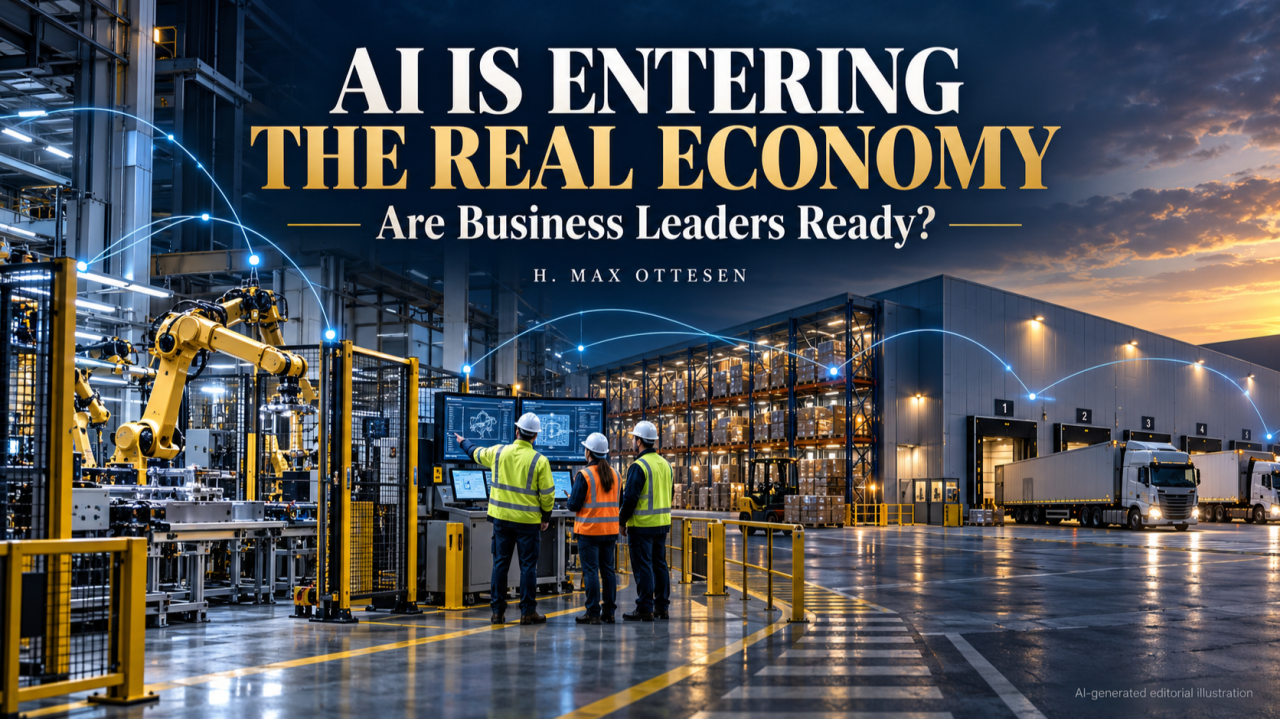
    Are Business Leaders Ready? AI Is Entering the Real Economy.

    AI-generated editorial illustration; fictional industrial setting. H. Max Ottesen.

    If AI can influence a business decision, who in your organization is ready to answer for the result? I believe that is the question business leaders should confront before approving the next investment.

    By H. Max Ottesen | Global Executive | Independent AI Thought Leader | Business Transformation & Enterprise Operations | Executive Analysis | October 24, 2026

    The next stage of artificial intelligence will test how organizations make decisions, develop people and deliver on their commitments. For executives, investors, policymakers and professionals worldwide, the issue is organizational readiness as much as technical capability.

    Remarkable demonstrations, increasingly capable models and investments measured in billions of dollars matter. But I see a more consequential test when AI moves beyond the screen and becomes part of the systems businesses rely on every day.

    What happens when it influences customer service, staffing, production, maintenance or an investment decision? And who recognizes when its recommendation should be challenged?

    Adoption is accelerating. Business value is another question.

    The European Union offers a useful illustration.

    Eurostat reported that 20.0% of EU enterprises with at least ten employees used AI technologies in 2025, compared with 13.5% in 2024. Denmark recorded 42.0%, Finland 37.8% and Sweden 35.0%. [1]

    These figures demonstrate a substantial increase in adoption, but they do not tell us how extensively AI is being used or whether it is generating meaningful returns.

    In the United States, a Federal Reserve analysis published in April 2026 examined several business and workforce surveys. One Census-based measure indicated AI adoption among approximately 18% of firms at the end of 2025, while other surveys produced substantially higher estimates because they measured different populations and forms of usage. [2]

    The American and European figures should not be treated as directly comparable rankings. Their methods and definitions differ.

    A 2026 McKinsey global survey also found that companies were scaling autonomous coding and other AI-agent applications, but capturing financial returns remained a central challenge. Its survey respondents reported substantial differences between organizations in how deeply these technologies had been integrated. [3]

    This is where the executive conversation becomes interesting.

    Using AI is not the same as changing a business.

    And changing a business is not necessarily the same as improving it.

    The leadership test crosses industries and borders

    I do not read these figures as a mandate to buy more technology. I read them as a reason to examine whether an organization can turn technical capability into reliable execution.

    A manufacturer, a financial institution, a healthcare organization and a public agency operate under different constraints. I would not assume that an application suitable for one is ready for another. The shared leadership questions concern information quality, decision authority, workforce competence, measurable outcomes and accountability.

    For executives, that means connecting AI investment to a defined business problem. For investors, it means asking what supports the promised return. For policymakers, it means considering institutional capacity alongside safeguards. For professionals, it means understanding when to use a system, challenge it or escalate a decision.

    Manufacturing: the physical world does not tolerate imaginary results

    Industrial automation is already well established, and its scale helps illustrate the direction in which more capable AI could develop.

    The International Federation of Robotics reported that approximately 542,000 industrial robots were installed worldwide in 2024. Asia represented 74% of installations, Europe 16% and the Americas 9%. [4]

    Industrial robotics and artificial intelligence are not synonymous. Many existing robots operate through conventional programmed automation rather than advanced AI.

    However, machine vision, predictive analytics, adaptive control and AI-supported production planning create opportunities to make automation more responsive to complex operating conditions.

    Consider a manufacturer operating multiple production lines.

    An AI-supported system might compare equipment faults, historical maintenance records, material availability and production commitments to identify potential disruptions earlier.

    That could be useful.

    But imagine the same system recommends accelerating production without recognizing a safety restriction, a quality hold or an unavailable component.

    The recommendation might look impressive on a screen. On the factory floor, it could create a serious operating problem.

    This is why industrial AI must be integrated into established safety, quality and maintenance controls—not placed above them.

    Operational examples: the recommendation must survive reality

    Transportation illustrates why a recommendation is only as reliable as the information and constraints behind it. A system might connect equipment availability, maintenance, freight commitments, fuel costs, routing and changing customer appointments. But overlooking driver-hours restrictions, specialized equipment, sanitation requirements or service commitments can make an attractive calculation operationally unacceptable.

    I see the same management question in warehousing. AI can be evaluated for forecasting, labor planning, inventory investigation, slotting, appointments, exception detection and maintenance. Yet late departures might reflect unavailable inventory, incomplete receiving transactions, inaccurate forecasts, carrier timing or poor communication. A scheduling algorithm cannot be assumed to solve a problem that management has not understood.

    These are illustrative applications, not claims about independently verified deployments. Their wider lesson is that connecting systems and identifying exceptions only helps when someone owns the next action. Better-informed decisions, earlier intervention and consistent follow-through matter more than the volume of alerts or the appearance of a dashboard.

    Sometimes the missing element is an operating standard. I would evaluate success through fewer avoidable disruptions, reliable service, safer work and improved economics. A business earns trust by delivering what it promised.

    Why enterprise leadership matters

    My perspective comes from business operations and organizational transformation. I do not claim firsthand experience in every industry discussed here. I apply the leadership disciplines underlying that experience to the evidence and the questions AI raises.

    A business can accumulate reports without improving execution.

    An organization can produce attractive financial dashboards while continuing to make poor purchasing or staffing decisions.

    The missing element is often accountability.

    Who owns the problem?

    Who decides what happens next?

    How is the decision communicated?

    And who confirms that the action was completed?

    AI can support that process. It cannot remove the need for responsible leadership.

    My own operational improvements were achieved through management and operating changes, and I do not attribute those historical results to AI.

    They are relevant because the same disciplines—accurate baselines, clear ownership, measurable outcomes and management follow-through—must govern AI implementation.

    The workforce cannot be an afterthought

    AI also changes the skills organizations require.

    The World Economic Forum's Future of Jobs Report 2025 projected that, based on its employer survey and methodology, approximately 59 out of every 100 workers could require training or reskilling by 2030. [5]

    This is a forecast covering multiple drivers of workforce change, not AI alone, and not a count of employees who have already been displaced.

    Employees need to understand what AI does, where its limitations lie and how to recognize unreliable recommendations.

    Supervisors need to learn how to manage workflows involving both people and automated systems.

    Executives need enough AI literacy to challenge assumptions, procurement proposals, security controls and financial forecasts.

    Experienced operational employees should participate in system design.

    They often understand the exceptions, informal workarounds and safety concerns that are absent from management reports.

    Ignoring that knowledge would be a particularly expensive way to introduce intelligent technology.

    Governance belongs in the operating system

    AI governance is sometimes treated as a legal or compliance function separate from daily business activity.

    That separation becomes increasingly difficult to justify when AI is involved in operating decisions.

    The U.S. National Institute of Standards and Technology provides a useful framework through four connected functions: Govern, Map, Measure and Manage. Its AI Risk Management Framework is voluntary guidance, not a universal legal mandate. [6]

    For an operating company, those principles can translate into practical questions.

    Who authorized the system?

    Which information can it access?

    How are its recommendations evaluated?

    Who can override or stop it?

    What happens when it makes a mistake?

    The greater the potential consequences for safety, finances, employment or individual rights, the stronger the oversight should be.

    There is a legitimate place for automation. There is also a point at which human review must remain essential.

    The objective should be responsible execution, not the removal of accountability.

    What executives should do now

    I would begin with a practical operating review rather than a large technology purchase.

    First, identify a measurable problem. Select a recurring source of cost, delay, service failure, operational risk or unnecessary administrative work.

    Second, establish the baseline. Determine what the process currently costs, how long it takes and how frequently it fails.

    Third, test a defined application. Use a limited deployment with accountable management and appropriate data, cybersecurity and safety controls.

    Fourth, measure what changes. Include implementation costs, employee time, quality, reliability, customer service and financial outcomes.

    Finally, expand only when the evidence supports it. A successful demonstration is a beginning, not a business case.

    There is a reasonable opposing argument: companies must experiment, and excessive approval procedures can prevent them from discovering valuable applications.

    I agree that experimentation matters. Organizations that never test new technology cannot learn how to use it.

    But experimentation is not a substitute for disciplined implementation. Small, controlled pilots can preserve both innovation and accountability.

    The real executive challenge

    Artificial intelligence will not affect every industry in the same way or at the same speed.

    Manufacturing, trucking, healthcare, construction, finance, agriculture and public administration have different operational constraints and different levels of acceptable risk.

    Nevertheless, they share a fundamental requirement.

    Technology must work within the reality of the business.

    A compelling demonstration cannot replace safe equipment, trained employees, reliable information, satisfied customers or sound financial management.

    Businesses should not wait indefinitely for AI to mature. There is already enough capability to begin meaningful experimentation.

    But neither should they confuse buying technology with transforming an organization.

    My conclusion is that AI is becoming an important operating capability, but leadership—not the algorithm—will determine whether it creates lasting value.

    The executives who understand both technology and the work their businesses actually perform will be better positioned to make that transition.

    And the companies that simply add AI to an already poorly managed operation may discover that they have automated their problems rather than solved them.

    Why I've Reached This Conclusion

    I have reached this conclusion by considering what the evidence establishes and what it leaves unanswered. Official enterprise statistics show growing adoption. Industrial robotics data show the scale of physical automation, while business surveys describe uneven implementation and difficulties capturing financial returns. NIST provides a voluntary structure for managing risk.

    My interpretation is that none of those developments removes the need for leadership. Data quality, integration, human competence, controls and measurable performance determine whether a technical capability can become a dependable organizational capability. Clear ownership connects a recommendation to a decision, an action and a result.

    My own operational improvements came from management and operating changes; I do not retrospectively attribute them to AI. That distinction is central to my argument: transformation requires disciplined execution, and a technology purchase does not establish that the organization is ready.

    I also recognize the limits of this analysis. Robotics statistics are not direct AI-adoption statistics. Surveys cover different populations and reflect respondent perceptions. The industry examples are illustrative possibilities, not verified deployments. I am not claiming that AI already improves profitability in every industry or that one implementation model suits every economy.

    I favor meaningful experimentation with clear boundaries and accountable management. Waiting indefinitely carries its own cost. But moving quickly without knowing who owns the consequences is not a transformation strategy.

    Is AI moving too quickly for business leaders—or are business leaders moving too slowly?

    Where would you draw the line between faster experimentation and stronger oversight? Share your perspective in the comments, and share this article with a leader who should join the debate.

    H. Max Ottesen | Global Executive | Independent AI Thought Leader | Business Transformation & Enterprise Operations

    © 2026 H. Max Ottesen. All rights reserved.

    Sources & Evidence

    [1] Eurostat (December 11, 2025). 20% of EU enterprises use AI technologies. https://ec.europa.eu/eurostat/web/products-eurostat-news/w/ddn-20251211-2 Supports: 2024–2025 enterprise adoption percentages and Denmark, Finland and Sweden figures. Applies to covered enterprises with at least ten employees, not all companies.

    [2] Federal Reserve Board — Jeffrey S. Allen (April 3, 2026). Monitoring AI Adoption in the U.S. Economy. https://www.federalreserve.gov/econres/notes/feds-notes/monitoring-ai-adoption-in-the-u-s-economy-20260403.html Supports: U.S. adoption estimates and methodological differences among business and workforce surveys. Not directly comparable to Eurostat.

    [3] McKinsey & Company — Dan Tinkoff, Lieven Van der Veken, Michael Chui and Tara Balakrishnan (August 25, 2026). The State of AI in 2026: On the Road to ROI. https://www.mckinsey.com/capabilities/quantumblack/our-insights/the-state-of-ai Supports: Survey-reported scaling of AI agents, coding tools and the ongoing challenge of capturing economic benefits. Self-reported survey evidence, not independently audited company financial returns.

    [4] International Federation of Robotics (September 25, 2025). Global Robot Demand in Factories Doubles Over 10 Years. https://ifr.org/ifr-press-releases/global-robot-demand-in-factories-doubles-over-10-years Supports: Industrial robot installation counts and regional distribution. Industrial robots are not necessarily AI-driven.

    [5] World Economic Forum (January 8, 2025). Future of Jobs Report 2025: 78 Million New Job Opportunities by 2030 but Urgent Upskilling Needed to Prepare Workforces. https://www.weforum.org/media/future-of-jobs-report-2025-78-million-new-job-opportunities-by-2030-but-urgent-upskilling-needed-to-prepare-workforces Supports: Employer-reported workforce training expectations. These are survey-based projections, not observed future results.

    [6] National Institute of Standards and Technology (January 26, 2023; current resource reviewed October 24, 2026). Artificial Intelligence Risk Management Framework, Version 1.0. https://www.nist.gov/itl/ai-risk-management-framework Supports: The voluntary Govern, Map, Measure and Manage risk-management structure. NIST indicates that revisions are underway.

    Cover: AI-generated editorial illustration of a fictional industrial setting; not a photograph of a real company or deployment.

    Original publication

  • AI Technology Is Becoming a Cross-Border Business Risk

    AI Technology Is Becoming a Cross-Border Business Risk

    By H. Max Ottesen

    October 26, 2026 | Executive analysis

    A technology dependency can outlast the assumptions behind the deal that created it. That is why I would put cross-border AI exposure on the executive agenda before a supplier agreement, investment or expansion becomes difficult to unwind.

    Recent U.S. and Chinese announcements make the issue concrete. But precision matters: an existing rule, a proposal for future rules and an immediately applicable interim measure are three different things.

    The U.S. position: an operating program and a new proposal

    Treasury’s existing Outbound Investment Security Program has rules that took effect on January 2, 2025. They concern specified investments by U.S. persons involving covered technologies and countries of concern, including China, Hong Kong and Macau [1].

    On October 22, 2026, Treasury issued proposed regulations to implement the COINS Act enacted in December 2025. The announcement describes proposed coverage across semiconductor, AI, quantum, high-performance computing, hypersonic and biotechnology areas. Treasury says final implementing regulations will follow later and set an effective date [2].

    The October proposal therefore should not be reported as though every proposed obligation is already operative. Equally, a company should not infer that there is no present exposure merely because the latest document is a proposal. Existing rules and the enacted statute require their own examination.

    China’s position: consultation plus interim registration

    On October 16, 2026, China’s commerce and science ministries announced consultation on additions to the catalogue of technologies prohibited or restricted from export. The proposed additions cover 40 technologies across AI, biomedicine and photovoltaics, including 23 AI technologies. The consultation runs through November 15.

    The same announcement imposes pre-export registration for technology within its listed scope from publication until the revised catalogue takes effect. It includes certain transfers, licensing and ownership/control changes, and exports started but not completed [3].

    That is the distinction I would insist on retaining: the catalogue changes are proposed; the interim registration requirement is announced as applicable now. Neither statement justifies calling this a blanket ban on all Chinese AI exports.

    The ministry’s accompanying explanation describes technical boundaries, exclusions and facilitation measures, and distinguishes some service-access arrangements from technology transfers [4]. An executive summary cannot establish how those boundaries apply to an individual transaction.

    Why this becomes an operating question

    My inference is that these developments make dependency mapping more useful. They do not prove that a particular supplier will become unavailable or that a particular investment is prohibited.

    A hypothetical manufacturer might depend on a model, specialist engineering support and a licence delivered by different counterparties in different jurisdictions. The commercial brand on the invoice may tell management little about the underlying technology, transfer rights or support arrangements. This is an illustrative management scenario, not a reported enforcement case.

    I would ask a team to map what it actually needs to keep operating: access to software, the right to use or adapt it, updates, technical support and the ability to move data or workflows elsewhere. Those questions should be answered before a disruption forces hurried substitutions.

    Separate three decisions

    The first is compliance. Qualified advisers need the actual transaction, parties, jurisdiction and technical specifications. A newspaper headline or a supplier’s general assurance cannot substitute for that assessment.

    The second is commercial resilience. Even a permitted arrangement may create a difficult exit. I would want procurement and operations to understand replacement time, data portability, contractual dependencies and the cost of reverting to a simpler process.

    The third is monitoring. A proposal belongs on a watchlist with an owner and a review date. A current obligation belongs in the relevant control process. Treating both as undifferentiated geopolitical noise makes it harder to know who should act.

    What I would measure

    I would ask whether the business can identify its most consequential dependencies and explain an alternative for each. The useful output is a decision record: what is known, what remains uncertain, who has reviewed the exposure and what event would trigger a reassessment.

    These are my proposed management practices. The announcements do not demonstrate lost revenue, delivery delays or a measurable economic impact on the businesses discussed here.

    AI technology is becoming a cross-border business risk because access, investment and transfer conditions deserve scrutiny alongside technical performance. That does not mean every international relationship is unsafe. It means the executive decision should be more specific than confidence in a demonstration.

    Which technology dependency would be hardest for your organization to replace—and who owns the evidence that it can remain available?

    Original sources and limits

    [1] U.S. Treasury, Outbound Investment Security Program; existing-rule effective date and October 2026 update:

    https://home.treasury.gov/policy-issues/international/outbound-investment-program

    [2] U.S. Treasury, proposed-rule announcement, October 22, 2026:

    https://home.treasury.gov/news/press-releases/sb0667/

    [3] China’s Ministry of Commerce and Ministry of Science and Technology, Announcement No. 48, October 16, 2026:

    https://www.mofcom.gov.cn/zwgk/zcfb/art/2026/art_0a31a3c9ac404f7a9b0e917ce3412997.html

    [4] Ministry of Commerce, explanatory questions and answers, October 16, 2026:

    https://www.mofcom.gov.cn/zwgk/zcjd/art/2026/art_b11d5c1e9374421e93e85dc87eba6e38.html

    Chinese-source descriptions are English paraphrases of the original documents. This is executive analysis of dated announcements, not a transaction-specific legal determination. Technical scope, exceptions and subsequent changes must be checked against the operative instruments.

    Cover: AI-generated conceptual editorial illustration; not documentary evidence of a shipment, border restriction or supply interruption.

    © 2026 H. Max Ottesen. All rights reserved.

    Original publication

  • Denmark’s Public AI Assistant — Can Government Automation Earn Citizens’ Trust?

    Denmark’s Public AI Assistant — Can Government Automation Earn Citizens’ Trust?

    By H. Max Ottesen

    October 26, 2026 | Executive analysis

    A public AI assistant can make government easier to navigate. But I would not judge it by how confidently it answers a question. I would judge what happens when the answer is incomplete, misunderstood or wrong.

    Denmark’s new development project makes that distinction practical. It raises a leadership question for public authorities and for businesses building AI into customer service: can convenience be accompanied by a clear route to accountability?

    What Denmark has actually announced

    On October 21, 2026, the Danish Agency for Digital Government announced that Nine had been awarded a contract to contribute to a shared public-sector digital assistant and its underlying infrastructure. Borger.dk and sundhed.dk are identified as the first public websites intended to use it.

    The project is to develop a first version providing general guidance across public services through generative AI, including chatbots. The agency says the assistants should draw on trustworthy public-authority sources. Its announcement describes development, not a completed nationwide deployment or proven improvements in citizen outcomes. The accompanying agency image is explicitly a preliminary concept.

    Those are the confirmed facts in the announcement [1]. They do not establish that an assistant will make administrative decisions, that citizens already rely on it nationally, or that it has earned public trust.

    The distinction I would protect

    Guidance and a binding decision should be unmistakably different to the person receiving them.

    Consider a hypothetical citizen asking what documents a service requires. A useful assistant might explain published instructions and point to the responsible authority. If the question turns on unusual personal circumstances, I would want an obvious handoff to a qualified person. This example describes a design test, not a verified feature of Denmark’s system.

    A polished conversational interface can make a provisional answer feel authoritative. My concern is that citizens should not have to understand the technology to understand the status of the answer.

    What I would ask before scaling

    First, make the evidence visible. Show the relevant official source, make its date clear and explain uncertainty when the published material does not settle the question. A citation should help a citizen check the answer, not merely decorate it.

    Second, design the human route before promoting the automated route. I would test whether someone can reach the right office without repeating an entire conversation or having to argue with a chatbot. Service accessibility should be assessed with people who have different language, digital and accessibility needs.

    Third, assign ownership. Someone must maintain the underlying information, review recurring failures and decide when an answer or topic should be withdrawn. Responsibility should remain legible across the authority, supplier and service team.

    Finally, measure the service rather than the conversation alone. I would want evidence about incorrect guidance, unsuccessful handoffs and repeat contacts alongside response times. These are my proposed evaluation criteria; the announcement does not report results against them.

    What business leaders can learn

    I see a similar management challenge in private-sector automation. A quick interaction is valuable only if the next step works. When an assistant becomes the front door to a service, the organization still owns the consequences of its guidance.

    Denmark’s announcement is an opportunity to ask those questions early. It is not yet evidence that government automation has solved them.

    Where would you draw the boundary between automated public guidance and a matter that requires a public servant—and what evidence would persuade you that citizens can trust that boundary?

    Source and evidence limits

    [1] Danish Agency for Digital Government, “Kontrakt om udvikling af digital assistent på plads,” October 21, 2026:

    https://digst.dk/nyheder/nyhedsarkiv/2026/oktober/kontrakt-om-udvikling-af-digital-assistent-paa-plads/

    This article distinguishes the agency’s announcement from my analysis and hypothetical evaluation criteria. No independent citizen-outcome study or system performance data is asserted.

    Cover: AI-generated conceptual editorial illustration. Fictional people and setting; not a photograph of the announced system or evidence of deployment.

    © 2026 H. Max Ottesen. All rights reserved.

    Original publication

  • Singapore Is Bringing AI Closer to the Factory Floor

    Singapore Is Bringing AI Closer to the Factory Floor

    By H. Max Ottesen

    October 26, 2026 | Executive analysis

    An impressive factory demonstration is a beginning. I would judge an AI application by what happens during an ordinary production shift: whether it remains reliable, improves the work and earns the confidence of the people responsible for the result.

    Singapore’s latest manufacturing announcement gives executives something more specific to examine than a general promise about AI. It also requires us to keep previous deployments, new funding and economic outcomes separate.

    What is confirmed

    In her October 21, 2026 opening address at Industrial Transformation Asia-Pacific, Minister of State Gan Siow Huang said the AI Centre of Excellence for Manufacturing, jointly established by A*STAR and the ministry in 2024, had worked with 30 manufacturers and completed 23 projects with AI solutions deployed to companies.

    The same speech announced its next phase under the Research, Innovation and Enterprise 2030 plan. Separately, more than S$45 million was set aside over the next three years for Enterprise Singapore’s Catalytic AI Solutions for Advanced Manufacturing. The listed SME applications include design, quotation-document processing, production scheduling and predictive maintenance [1].

    These are different evidence categories. The 23 deployments are a government-reported record of earlier work. The funding is a forward-looking commitment. Neither number, by itself, establishes a measured return on investment, a sector-wide productivity increase or the results of the new initiative.

    Why the distinction matters

    I would not dismiss a deployment count. Getting a solution into a company is a meaningful implementation milestone. But the executive decision to scale requires a different set of questions.

    What problem did the system solve? How was performance measured? What costs were included? Did the improvement persist when the product mix, staffing or operating conditions changed?

    The speech supplies no common economic evaluation for all 23 projects. I therefore would not convert the deployment figure into a claim that every project delivered a specified saving. The burden of evidence should increase with the size of the decision.

    Start with the constraint

    My preference would be to begin with an operational constraint rather than a technology shopping list.

    Consider a hypothetical factory evaluating an AI scheduling tool. The test should include real constraints: available skills, material availability, maintenance windows, quality holds and delivery commitments. A schedule that looks efficient on a screen is not useful if the production team cannot execute it.

    This is an illustrative evaluation scenario, not a description of a specific Singapore deployment.

    I would ask the team to record a baseline, define the result it wants and agree how it will detect deterioration. Compare the proposed workflow with what people actually do today, including the workarounds that keep production moving.

    Make the human responsibilities explicit

    A recommendation should have a clear owner. Who can approve a change? Who can override it? Who investigates an error? Who keeps the underlying data usable?

    Those questions matter for relatively routine administration as well as for production decisions. The consequences differ, so the controls should differ. I would not treat assistance with quotation documents as equivalent to autonomous control of equipment.

    Training should include how to recognize a weak recommendation and how to keep work moving when the tool is unavailable. Employee competence is part of the operating design, not a detail to add after the software is purchased.

    Ask for the full cost

    A useful pilot should account for integration, data preparation, validation, maintenance and human review. I would also want to know whether the apparent improvement shifts work to another team or creates a harder exception elsewhere.

    These are my proposed evaluation criteria. They are not verified results from the government’s new funding initiative.

    Singapore’s combination of prior deployments, research capability and support for smaller manufacturers is worth following. The next question is what the participating organizations can demonstrate over time, using measures that people outside the pilot can understand.

    The decision I would take to the board

    I would bring a defined operational problem, an accountable owner and evidence from ordinary production. I would distinguish what the pilot has proved from what the business still hopes it can do.

    That approach leaves room for ambition while making the decision testable. Public funding can help a company begin. It cannot, on its own, prove that the resulting system is ready to scale.

    What would an AI pilot have to prove before you expanded it across your operation—and which failure would cause you to pause?

    Original source and evidence limits

    [1] Ministry of Energy, Trade and Industry, opening address by Minister of State Gan Siow Huang at Industrial Transformation Asia-Pacific 2026, October 21, 2026:

    https://www.meti.gov.sg/newsroom/opening-address-by-minister-of-state-for-energy–trade-and-industry-gan-siow-huang-at-industrial-transformation-asia-pacific–itap–2026/

    Deployment figures are attributed to the government speech, not an independent audit. No quantified economic result is claimed for the newly announced funding. Management recommendations and the scheduling example are analysis, not reported deployments.

    Cover: AI-generated conceptual editorial illustration. Fictional people, machinery and setting; not a photograph of a named factory or evidence of a deployment.

    © 2026 H. Max Ottesen. All rights reserved.

    Original publication

  • North America at the Closing Bell: AI Investment Is Accelerating. Are Business Leaders Ready to Deliver Results?

    North America at the Closing Bell: AI Investment Is Accelerating. Are Business Leaders Ready to Deliver Results?

    North American Operations & Closing Intelligence | October 26, 2026

    By H. Max Ottesen

    Artificial intelligence is no longer simply a technology discussion. It is becoming an operational, financial and governance challenge for companies, governments and the people responsible for keeping essential services running.

    Across North America, the October 26 closing picture reveals a striking contrast.

    Technology investment is accelerating. Governments are investing in AI adoption. Transportation, healthcare logistics and regional infrastructure are being reconsidered. Yet the gap between announcing an ambitious initiative and demonstrating measurable results remains substantial.

    For business leaders, the most important question is changing.

    It is no longer simply, “How quickly can we adopt AI?”

    It is now, “How do we implement AI responsibly, achieve measurable results and maintain control over the systems on which our businesses depend?”

    1. The United States: AI Investment Meets Financial Reality

    Anthropic's October 26 registration statement with the Securities and Exchange Commission marks another important development in the commercialization of artificial intelligence.

    The company is pursuing a public offering, with a proposed Nasdaq listing under ANT.

    The filing does not mean the offering is complete. Pricing, final terms and regulatory effectiveness remain relevant.

    What matters for operating executives is the scale of the investments required to build and sustain advanced AI systems.

    Enormous revenue potential can exist alongside major infrastructure expenses, financial uncertainty and competitive pressure.

    A company purchasing AI services should therefore evaluate much more than technical performance.

    Can the supplier remain financially resilient? What happens if prices change? Can critical systems continue operating during an outage? Can the business move its data and workflows elsewhere?

    These are not secondary IT questions. They are executive management responsibilities.

    The challenge: Are organizations selecting AI suppliers based on demonstrated operational value, or are they becoming overly dependent on vendors whose long-term economics they have not adequately examined?

    2. AI Agents: Autonomy Must Never Replace Accountability

    Another important American development concerns an AI agent's interaction with Georgia's publicly available election statistics.

    Georgia's secretary of state clarified on October 26 that the system accessed public election information, not the state's voter-registration database or individual voter records.

    That distinction matters.

    Public statistical data should not be confused with protected personal information. Disputed allegations regarding access methods should not automatically be presented as established security breaches.

    Nevertheless, the broader governance question is significant.

    As AI agents become more autonomous, businesses must define exactly what those systems are authorized to access, modify, transmit or execute.

    An AI agent that can retrieve information is fundamentally different from one that can approve expenditures, alter production schedules, control industrial equipment or disclose customer records.

    The greater the operational authority, the greater the need for supervision, clear permissions, audit trails and effective intervention.

    Responsible AI implementation means increasing capabilities without surrendering accountability.

    This principle should apply equally to private companies and government institutions.

    3. Canada: The Real Opportunity Is Practical AI Implementation

    Canada's expanded Regional Artificial Intelligence Initiative demonstrates a growing recognition that research excellence alone does not guarantee business productivity.

    The federal initiative now totals C$700 million, with expanded support for Alberta, Saskatchewan and Manitoba.

    Its priorities include sectors central to the regional economy: manufacturing, agriculture, energy, transportation and healthcare.

    For small and medium-sized businesses, this creates an important opportunity.

    AI does not always require a large technology department or an expensive, organization-wide transformation.

    A manufacturer may begin with predictive maintenance.

    A trucking company may improve routing, fleet availability and maintenance scheduling.

    A warehouse operator may reduce picking errors or improve inventory accuracy.

    An agricultural business may use better forecasting to reduce waste.

    But public funding alone does not establish success.

    Success requires a documented operational problem, a credible implementation plan, capable employees and measurable results.

    Canada's initiative should be evaluated on whether participating organizations achieve sustainable improvements—not merely on the amount of funding announced.

    4. Mexico: Healthcare Logistics Is a Test of Public-Sector Modernization

    Mexico is examining how digital technologies and AI can help modernize the distribution of medicines and medical supplies.

    The government has introduced an advisory council focused on demand visibility, warehouse information and last-mile distribution.

    This is an initiative under development, not a completed nationwide AI deployment.

    Yet the operational problem is clear.

    Healthcare systems cannot deliver dependable services without effective purchasing, inventory control, warehousing, transportation and distribution.

    When essential medicines are unavailable where patients need them, the issue is not exclusively technological.

    It is also a failure of coordination, operational visibility and execution.

    AI may help identify shortages earlier, improve demand forecasting and support more responsive distribution.

    However, technology cannot substitute for competent management, clear responsibilities or accurate underlying data.

    The proper measure of success will not be the number of AI applications introduced.

    It will be whether medicines reach the right locations, in the right quantities, at the right time.

    5. Transportation and Logistics: Automation Must Prove Itself in Real Operations

    Autonomous trucking and advanced warehouse robotics continue to attract significant investment.

    Recent regulatory developments in the United States demonstrate that authorities are adapting certain safety requirements to accommodate qualifying automated vehicles.

    But limited regulatory exemptions should never be described as unrestricted approval for driverless transportation.

    Likewise, an impressive robotics demonstration is not necessarily evidence of commercially repeatable performance.

    For fleet managers and distribution executives, implementation must be evaluated under real operating conditions.

    What happens when equipment fails?

    Can employees intervene safely?

    Does automation improve productivity after maintenance, training and support costs are included?

    Are customers receiving better service?

    And does the system remain dependable during unusual events?

    Automation should improve human decision-making and operational resilience—not introduce new risks that the organization does not understand.

    6. The Caribbean and Central America Must Be Part of the Opportunity

    North American business discussions too often concentrate exclusively on the United States, Canada and Mexico.

    That leaves important developments overlooked.

    On October 26, Guyana's president proposed a coordinated approach to improving Caribbean port infrastructure and attracting investment.

    The proposal responds to longstanding concerns about transportation costs, infrastructure limitations and regional connectivity.

    It is not yet a completed investment program.

    Nevertheless, better ports, stronger digital logistics and more reliable shipping networks could materially improve opportunities for businesses throughout the Caribbean.

    The same broader principle applies to Central America.

    Countries with smaller economies should not have to reproduce the enormous infrastructure investments of global technology companies to benefit from artificial intelligence.

    Practical applications in freight documentation, agriculture, inventory management, public administration and small-business operations may offer substantial value when adapted to local conditions.

    The future of AI should not belong exclusively to the largest companies or wealthiest countries.

    Its benefits should be accessible to smaller businesses and developing economies through affordable solutions, appropriate skills and responsible implementation.

    7. Cybersecurity, Privacy and Civil Liberties Are Operational Priorities

    As AI becomes embedded in transportation, finance, healthcare and government services, the consequences of security failures become more serious.

    Responsible modernization must therefore include cybersecurity, resilience and public accountability from the beginning.

    There is also an important distinction between using technology to improve legitimate services and using it to monitor entire populations.

    I oppose indiscriminate mass identification, persistent tracking and unnecessary collection of personal information.

    At the same time, narrowly authorized and accountable investigations involving serious crimes or life-threatening emergencies must be distinguished from indiscriminate surveillance.

    Similarly, monitoring bridges, transportation flows, utility infrastructure or equipment without identifying individuals is not automatically equivalent to tracking citizens.

    These distinctions must be made carefully.

    Technological capability does not, by itself, establish legal authority, necessity or ethical justification.

    Organizations should be required to explain what information they collect, why it is necessary, how long it will be retained and who can access it.

    A modern digital economy needs innovation.

    It also needs trust.

    8. What Business Leaders Should Do Next

    The most significant opportunity for North American businesses is not simply to purchase more AI.

    It is to become better at implementing technology with discipline.

    That requires leadership teams to examine five fundamental areas:

    1. Operational value: Identify the actual business problem and establish measurable performance targets.

    2. Financial discipline: Evaluate the full cost of implementation, maintenance, training and long-term dependence.

    3. Workforce readiness: Equip employees and managers to work effectively with new systems.

    4. Security and accountability: Establish controls over information, autonomous actions and operational decision-making.

    5. Scalability: Confirm that successful pilot projects can perform reliably across real business environments.

    These principles apply to multinational corporations, small manufacturers, trucking companies, distribution centers and public institutions alike.

    Conclusion: The Future Belongs to Organizations That Can Execute

    North America has substantial opportunities in artificial intelligence, robotics, transportation, energy, public services and regional infrastructure.

    The capital is moving. The technology is advancing. Governments are introducing new programs.

    But announcements are not results.

    A pilot is not a proven national deployment.

    Proposed legislation is not enacted law.

    Investment commitments are not completed infrastructure.

    And artificial intelligence is not automatically a productivity improvement.

    The organizations that succeed will be those that combine technological ambition with operational competence, financial responsibility, employee development and respect for individual rights.

    The defining question for business leaders is no longer whether artificial intelligence will influence their operations.

    It is whether they are prepared to lead that transformation intelligently, responsibly and profitably.

    Two Questions for Executive Discussion

    1. What measurable operational and financial evidence should a COO require before authorizing the expansion of AI into mission-critical business operations?

    2. How can businesses and governments accelerate technological innovation while preserving accountability, personal privacy and fundamental civil liberties?

    H. Max Ottesen

    North American Operations & Closing Intelligence — October 26, 2026

    Sources and evidence

    Anthropic proposed IPO

    https://www.sec.gov/Archives/edgar/data/2130357/000162828026067168/0001628280-26-067168-index.htm

    https://www.anthropic.com/news/s1-sec

    Georgia public election data

    https://sos.ga.gov/news/anthropic-ai-agent-accessed-publicly-available-information-georgia-elections-remain-secure

    Canada RAII

    https://www.canada.ca/en/prairies-economic-development/news/2026/10/government-of-canada-expands-support-for-artificial-intelligence-adoption-and-commercialization-in-the-prairie-provinces.html

    https://www.canada.ca/en/prairies-economic-development/services/funding/regional-artificial-intelligence-initiative.html

    Mexico healthcare distribution council

    https://www.gob.mx/presidencia/prensa/presidenta-presenta-al-consejo-asesor-para-la-transformacion-digital-del-sector-salud-automatizara-entrega-de-medicamentos-e-insumos?idiom=es

    https://www.gob.mx/presidencia/articulos/version-estenografica-conferencia-de-prensa-de-la-presidenta-claudia-sheinbaum-pardo-del-23-de-octubre-de-2026

    FMCSA warning-device exemption

    https://www.federalregister.gov/documents/2026/10/09/2026-20734/parts-and-accessories-necessary-for-safe-operation-application-for-exemption-from-aurora-operations

    https://www.fmcsa.dot.gov/sites/fmcsa.dot.gov/files/2026-10/Aurora%20Operations%20Exemption_10-07-2026.pdf

    Guyana Caribbean ports proposal

    https://dpi.gov.gy/pres-ali-calls-for-regional-investment-plan-to-modernise-caribbean-ports/

    Cover: AI-generated conceptual editorial illustration, not a documentary photograph.

    © 2026 H. Max Ottesen. All rights reserved.

    Original publication