If AI can influence a business decision, who in your organization is ready to answer for the result? I believe that is the question business leaders should confront before approving the next investment.
By H. Max Ottesen | Global Executive | Independent AI Thought Leader | Business Transformation & Enterprise Operations | Executive Analysis | October 24, 2026
The next stage of artificial intelligence will test how organizations make decisions, develop people and deliver on their commitments. For executives, investors, policymakers and professionals worldwide, the issue is organizational readiness as much as technical capability.
Remarkable demonstrations, increasingly capable models and investments measured in billions of dollars matter. But I see a more consequential test when AI moves beyond the screen and becomes part of the systems businesses rely on every day.
What happens when it influences customer service, staffing, production, maintenance or an investment decision? And who recognizes when its recommendation should be challenged?
Adoption is accelerating. Business value is another question.
The European Union offers a useful illustration.
Eurostat reported that 20.0% of EU enterprises with at least ten employees used AI technologies in 2025, compared with 13.5% in 2024. Denmark recorded 42.0%, Finland 37.8% and Sweden 35.0%. [1]
These figures demonstrate a substantial increase in adoption, but they do not tell us how extensively AI is being used or whether it is generating meaningful returns.
In the United States, a Federal Reserve analysis published in April 2026 examined several business and workforce surveys. One Census-based measure indicated AI adoption among approximately 18% of firms at the end of 2025, while other surveys produced substantially higher estimates because they measured different populations and forms of usage. [2]
The American and European figures should not be treated as directly comparable rankings. Their methods and definitions differ.
A 2026 McKinsey global survey also found that companies were scaling autonomous coding and other AI-agent applications, but capturing financial returns remained a central challenge. Its survey respondents reported substantial differences between organizations in how deeply these technologies had been integrated. [3]
This is where the executive conversation becomes interesting.
Using AI is not the same as changing a business.
And changing a business is not necessarily the same as improving it.
The leadership test crosses industries and borders
I do not read these figures as a mandate to buy more technology. I read them as a reason to examine whether an organization can turn technical capability into reliable execution.
A manufacturer, a financial institution, a healthcare organization and a public agency operate under different constraints. I would not assume that an application suitable for one is ready for another. The shared leadership questions concern information quality, decision authority, workforce competence, measurable outcomes and accountability.
For executives, that means connecting AI investment to a defined business problem. For investors, it means asking what supports the promised return. For policymakers, it means considering institutional capacity alongside safeguards. For professionals, it means understanding when to use a system, challenge it or escalate a decision.
Manufacturing: the physical world does not tolerate imaginary results
Industrial automation is already well established, and its scale helps illustrate the direction in which more capable AI could develop.
The International Federation of Robotics reported that approximately 542,000 industrial robots were installed worldwide in 2024. Asia represented 74% of installations, Europe 16% and the Americas 9%. [4]
Industrial robotics and artificial intelligence are not synonymous. Many existing robots operate through conventional programmed automation rather than advanced AI.
However, machine vision, predictive analytics, adaptive control and AI-supported production planning create opportunities to make automation more responsive to complex operating conditions.
Consider a manufacturer operating multiple production lines.
An AI-supported system might compare equipment faults, historical maintenance records, material availability and production commitments to identify potential disruptions earlier.
That could be useful.
But imagine the same system recommends accelerating production without recognizing a safety restriction, a quality hold or an unavailable component.
The recommendation might look impressive on a screen. On the factory floor, it could create a serious operating problem.
This is why industrial AI must be integrated into established safety, quality and maintenance controls—not placed above them.
Operational examples: the recommendation must survive reality
Transportation illustrates why a recommendation is only as reliable as the information and constraints behind it. A system might connect equipment availability, maintenance, freight commitments, fuel costs, routing and changing customer appointments. But overlooking driver-hours restrictions, specialized equipment, sanitation requirements or service commitments can make an attractive calculation operationally unacceptable.
I see the same management question in warehousing. AI can be evaluated for forecasting, labor planning, inventory investigation, slotting, appointments, exception detection and maintenance. Yet late departures might reflect unavailable inventory, incomplete receiving transactions, inaccurate forecasts, carrier timing or poor communication. A scheduling algorithm cannot be assumed to solve a problem that management has not understood.
These are illustrative applications, not claims about independently verified deployments. Their wider lesson is that connecting systems and identifying exceptions only helps when someone owns the next action. Better-informed decisions, earlier intervention and consistent follow-through matter more than the volume of alerts or the appearance of a dashboard.
Sometimes the missing element is an operating standard. I would evaluate success through fewer avoidable disruptions, reliable service, safer work and improved economics. A business earns trust by delivering what it promised.
Why enterprise leadership matters
My perspective comes from business operations and organizational transformation. I do not claim firsthand experience in every industry discussed here. I apply the leadership disciplines underlying that experience to the evidence and the questions AI raises.
A business can accumulate reports without improving execution.
An organization can produce attractive financial dashboards while continuing to make poor purchasing or staffing decisions.
The missing element is often accountability.
Who owns the problem?
Who decides what happens next?
How is the decision communicated?
And who confirms that the action was completed?
AI can support that process. It cannot remove the need for responsible leadership.
My own operational improvements were achieved through management and operating changes, and I do not attribute those historical results to AI.
They are relevant because the same disciplines—accurate baselines, clear ownership, measurable outcomes and management follow-through—must govern AI implementation.
The workforce cannot be an afterthought
AI also changes the skills organizations require.
The World Economic Forum's Future of Jobs Report 2025 projected that, based on its employer survey and methodology, approximately 59 out of every 100 workers could require training or reskilling by 2030. [5]
This is a forecast covering multiple drivers of workforce change, not AI alone, and not a count of employees who have already been displaced.
Employees need to understand what AI does, where its limitations lie and how to recognize unreliable recommendations.
Supervisors need to learn how to manage workflows involving both people and automated systems.
Executives need enough AI literacy to challenge assumptions, procurement proposals, security controls and financial forecasts.
Experienced operational employees should participate in system design.
They often understand the exceptions, informal workarounds and safety concerns that are absent from management reports.
Ignoring that knowledge would be a particularly expensive way to introduce intelligent technology.
Governance belongs in the operating system
AI governance is sometimes treated as a legal or compliance function separate from daily business activity.
That separation becomes increasingly difficult to justify when AI is involved in operating decisions.
The U.S. National Institute of Standards and Technology provides a useful framework through four connected functions: Govern, Map, Measure and Manage. Its AI Risk Management Framework is voluntary guidance, not a universal legal mandate. [6]
For an operating company, those principles can translate into practical questions.
Who authorized the system?
Which information can it access?
How are its recommendations evaluated?
Who can override or stop it?
What happens when it makes a mistake?
The greater the potential consequences for safety, finances, employment or individual rights, the stronger the oversight should be.
There is a legitimate place for automation. There is also a point at which human review must remain essential.
The objective should be responsible execution, not the removal of accountability.
What executives should do now
I would begin with a practical operating review rather than a large technology purchase.
First, identify a measurable problem. Select a recurring source of cost, delay, service failure, operational risk or unnecessary administrative work.
Second, establish the baseline. Determine what the process currently costs, how long it takes and how frequently it fails.
Third, test a defined application. Use a limited deployment with accountable management and appropriate data, cybersecurity and safety controls.
Fourth, measure what changes. Include implementation costs, employee time, quality, reliability, customer service and financial outcomes.
Finally, expand only when the evidence supports it. A successful demonstration is a beginning, not a business case.
There is a reasonable opposing argument: companies must experiment, and excessive approval procedures can prevent them from discovering valuable applications.
I agree that experimentation matters. Organizations that never test new technology cannot learn how to use it.
But experimentation is not a substitute for disciplined implementation. Small, controlled pilots can preserve both innovation and accountability.
The real executive challenge
Artificial intelligence will not affect every industry in the same way or at the same speed.
Manufacturing, trucking, healthcare, construction, finance, agriculture and public administration have different operational constraints and different levels of acceptable risk.
Nevertheless, they share a fundamental requirement.
Technology must work within the reality of the business.
A compelling demonstration cannot replace safe equipment, trained employees, reliable information, satisfied customers or sound financial management.
Businesses should not wait indefinitely for AI to mature. There is already enough capability to begin meaningful experimentation.
But neither should they confuse buying technology with transforming an organization.
My conclusion is that AI is becoming an important operating capability, but leadership—not the algorithm—will determine whether it creates lasting value.
The executives who understand both technology and the work their businesses actually perform will be better positioned to make that transition.
And the companies that simply add AI to an already poorly managed operation may discover that they have automated their problems rather than solved them.
Why I've Reached This Conclusion
I have reached this conclusion by considering what the evidence establishes and what it leaves unanswered. Official enterprise statistics show growing adoption. Industrial robotics data show the scale of physical automation, while business surveys describe uneven implementation and difficulties capturing financial returns. NIST provides a voluntary structure for managing risk.
My interpretation is that none of those developments removes the need for leadership. Data quality, integration, human competence, controls and measurable performance determine whether a technical capability can become a dependable organizational capability. Clear ownership connects a recommendation to a decision, an action and a result.
My own operational improvements came from management and operating changes; I do not retrospectively attribute them to AI. That distinction is central to my argument: transformation requires disciplined execution, and a technology purchase does not establish that the organization is ready.
I also recognize the limits of this analysis. Robotics statistics are not direct AI-adoption statistics. Surveys cover different populations and reflect respondent perceptions. The industry examples are illustrative possibilities, not verified deployments. I am not claiming that AI already improves profitability in every industry or that one implementation model suits every economy.
I favor meaningful experimentation with clear boundaries and accountable management. Waiting indefinitely carries its own cost. But moving quickly without knowing who owns the consequences is not a transformation strategy.
Is AI moving too quickly for business leaders—or are business leaders moving too slowly?
Where would you draw the line between faster experimentation and stronger oversight? Share your perspective in the comments, and share this article with a leader who should join the debate.
H. Max Ottesen | Global Executive | Independent AI Thought Leader | Business Transformation & Enterprise Operations
© 2026 H. Max Ottesen. All rights reserved.
Sources & Evidence
[1] Eurostat (December 11, 2025). 20% of EU enterprises use AI technologies. https://ec.europa.eu/eurostat/web/products-eurostat-news/w/ddn-20251211-2 Supports: 2024–2025 enterprise adoption percentages and Denmark, Finland and Sweden figures. Applies to covered enterprises with at least ten employees, not all companies.
[2] Federal Reserve Board — Jeffrey S. Allen (April 3, 2026). Monitoring AI Adoption in the U.S. Economy. https://www.federalreserve.gov/econres/notes/feds-notes/monitoring-ai-adoption-in-the-u-s-economy-20260403.html Supports: U.S. adoption estimates and methodological differences among business and workforce surveys. Not directly comparable to Eurostat.
[3] McKinsey & Company — Dan Tinkoff, Lieven Van der Veken, Michael Chui and Tara Balakrishnan (August 25, 2026). The State of AI in 2026: On the Road to ROI. https://www.mckinsey.com/capabilities/quantumblack/our-insights/the-state-of-ai Supports: Survey-reported scaling of AI agents, coding tools and the ongoing challenge of capturing economic benefits. Self-reported survey evidence, not independently audited company financial returns.
[4] International Federation of Robotics (September 25, 2025). Global Robot Demand in Factories Doubles Over 10 Years. https://ifr.org/ifr-press-releases/global-robot-demand-in-factories-doubles-over-10-years Supports: Industrial robot installation counts and regional distribution. Industrial robots are not necessarily AI-driven.
[5] World Economic Forum (January 8, 2025). Future of Jobs Report 2025: 78 Million New Job Opportunities by 2030 but Urgent Upskilling Needed to Prepare Workforces. https://www.weforum.org/media/future-of-jobs-report-2025-78-million-new-job-opportunities-by-2030-but-urgent-upskilling-needed-to-prepare-workforces Supports: Employer-reported workforce training expectations. These are survey-based projections, not observed future results.
[6] National Institute of Standards and Technology (January 26, 2023; current resource reviewed October 24, 2026). Artificial Intelligence Risk Management Framework, Version 1.0. https://www.nist.gov/itl/ai-risk-management-framework Supports: The voluntary Govern, Map, Measure and Manage risk-management structure. NIST indicates that revisions are underway.
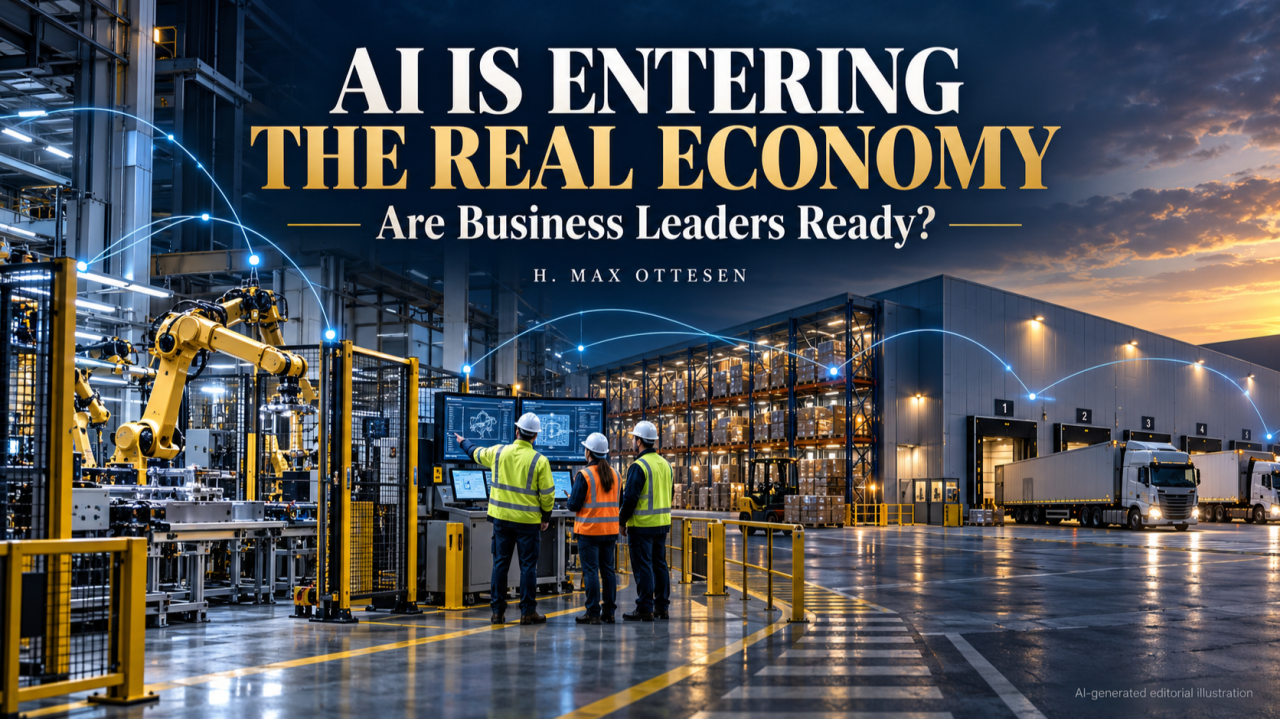
Cover: AI-generated editorial illustration of a fictional industrial setting; not a photograph of a real company or deployment.