Category: Logistics & operations

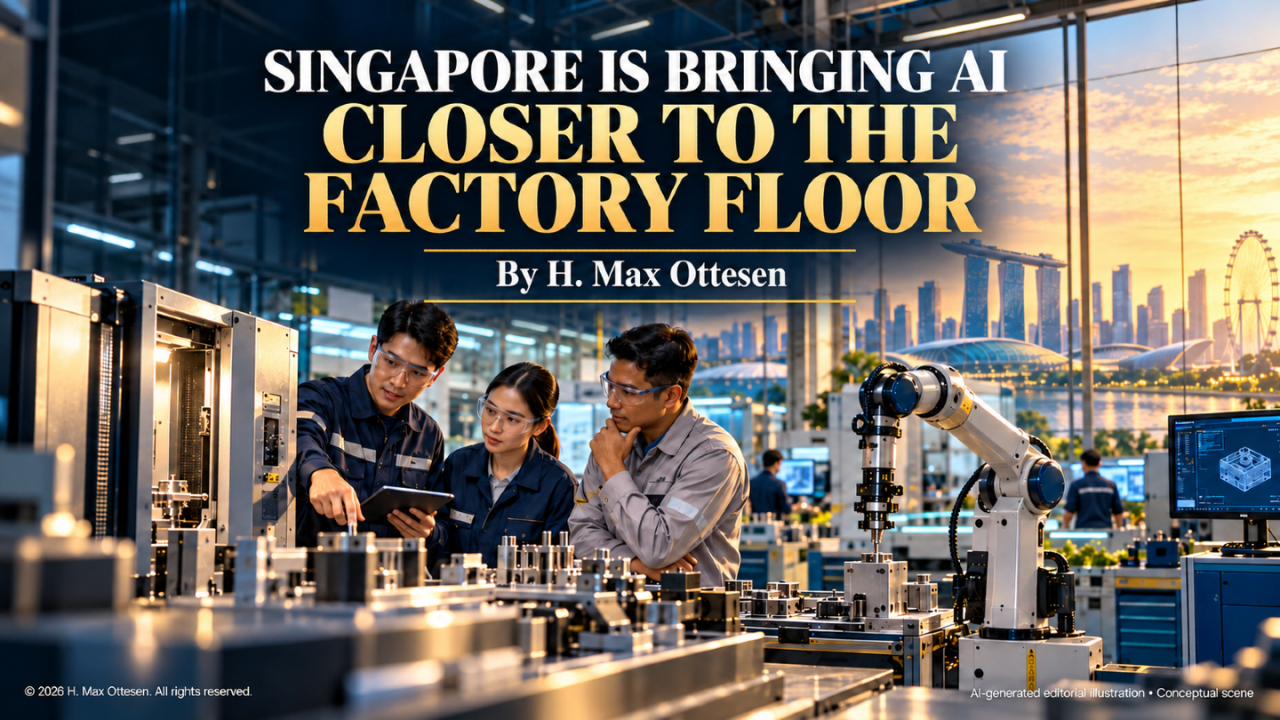
  • Singapore Is Bringing AI Closer to the Factory Floor

    Singapore Is Bringing AI Closer to the Factory Floor

    By H. Max Ottesen

    October 26, 2026 | Executive analysis

    An impressive factory demonstration is a beginning. I would judge an AI application by what happens during an ordinary production shift: whether it remains reliable, improves the work and earns the confidence of the people responsible for the result.

    Singapore’s latest manufacturing announcement gives executives something more specific to examine than a general promise about AI. It also requires us to keep previous deployments, new funding and economic outcomes separate.

    What is confirmed

    In her October 21, 2026 opening address at Industrial Transformation Asia-Pacific, Minister of State Gan Siow Huang said the AI Centre of Excellence for Manufacturing, jointly established by A*STAR and the ministry in 2024, had worked with 30 manufacturers and completed 23 projects with AI solutions deployed to companies.

    The same speech announced its next phase under the Research, Innovation and Enterprise 2030 plan. Separately, more than S$45 million was set aside over the next three years for Enterprise Singapore’s Catalytic AI Solutions for Advanced Manufacturing. The listed SME applications include design, quotation-document processing, production scheduling and predictive maintenance [1].

    These are different evidence categories. The 23 deployments are a government-reported record of earlier work. The funding is a forward-looking commitment. Neither number, by itself, establishes a measured return on investment, a sector-wide productivity increase or the results of the new initiative.

    Why the distinction matters

    I would not dismiss a deployment count. Getting a solution into a company is a meaningful implementation milestone. But the executive decision to scale requires a different set of questions.

    What problem did the system solve? How was performance measured? What costs were included? Did the improvement persist when the product mix, staffing or operating conditions changed?

    The speech supplies no common economic evaluation for all 23 projects. I therefore would not convert the deployment figure into a claim that every project delivered a specified saving. The burden of evidence should increase with the size of the decision.

    Start with the constraint

    My preference would be to begin with an operational constraint rather than a technology shopping list.

    Consider a hypothetical factory evaluating an AI scheduling tool. The test should include real constraints: available skills, material availability, maintenance windows, quality holds and delivery commitments. A schedule that looks efficient on a screen is not useful if the production team cannot execute it.

    This is an illustrative evaluation scenario, not a description of a specific Singapore deployment.

    I would ask the team to record a baseline, define the result it wants and agree how it will detect deterioration. Compare the proposed workflow with what people actually do today, including the workarounds that keep production moving.

    Make the human responsibilities explicit

    A recommendation should have a clear owner. Who can approve a change? Who can override it? Who investigates an error? Who keeps the underlying data usable?

    Those questions matter for relatively routine administration as well as for production decisions. The consequences differ, so the controls should differ. I would not treat assistance with quotation documents as equivalent to autonomous control of equipment.

    Training should include how to recognize a weak recommendation and how to keep work moving when the tool is unavailable. Employee competence is part of the operating design, not a detail to add after the software is purchased.

    Ask for the full cost

    A useful pilot should account for integration, data preparation, validation, maintenance and human review. I would also want to know whether the apparent improvement shifts work to another team or creates a harder exception elsewhere.

    These are my proposed evaluation criteria. They are not verified results from the government’s new funding initiative.

    Singapore’s combination of prior deployments, research capability and support for smaller manufacturers is worth following. The next question is what the participating organizations can demonstrate over time, using measures that people outside the pilot can understand.

    The decision I would take to the board

    I would bring a defined operational problem, an accountable owner and evidence from ordinary production. I would distinguish what the pilot has proved from what the business still hopes it can do.

    That approach leaves room for ambition while making the decision testable. Public funding can help a company begin. It cannot, on its own, prove that the resulting system is ready to scale.

    What would an AI pilot have to prove before you expanded it across your operation—and which failure would cause you to pause?

    Original source and evidence limits

    [1] Ministry of Energy, Trade and Industry, opening address by Minister of State Gan Siow Huang at Industrial Transformation Asia-Pacific 2026, October 21, 2026:

    https://www.meti.gov.sg/newsroom/opening-address-by-minister-of-state-for-energy–trade-and-industry-gan-siow-huang-at-industrial-transformation-asia-pacific–itap–2026/

    Deployment figures are attributed to the government speech, not an independent audit. No quantified economic result is claimed for the newly announced funding. Management recommendations and the scheduling example are analysis, not reported deployments.

    Cover: AI-generated conceptual editorial illustration. Fictional people, machinery and setting; not a photograph of a named factory or evidence of a deployment.

    © 2026 H. Max Ottesen. All rights reserved.

    Original publication
  • The Real Opportunity in Transportation AI Is Better Decisions

    The Real Opportunity in Transportation AI Is Better Decisions

    Illustration for The Real Opportunity in Transportation AI Is Better Decisions

    Evaluate the whole assignment before accepting a persuasive score.

    EXECUTIVE ANALYSIS | H. Max Ottesen

    AI-generated conceptual editorial illustration. Fictional people and setting; not documentary evidence. Overhead illustrated transportation planning desk with route paper, keys and maintenance information.

    Would you accept a load because its quoted rate looks attractive? I would want the rest of the assignment beside it: empty movement, waiting, equipment fit, available driver time, customer obligations and the next positioning choice. That is the decision I would ask a transportation tool to help prepare.

    The proposed application in this article is an advisory comparison of operating options. It is not a description of a tested optimizer or autonomous dispatcher.

    Show the tradeoff

    A useful comparison should let a dispatcher inspect the assumptions for each option. Which distance is being used? Is the receiving window confirmed? Is the equipment appropriate? What cost is estimated, and which cost comes from an actual record?

    I would keep safety and operating eligibility outside a negotiable commercial score. An attractive revenue estimate should not compensate mathematically for an unresolved maintenance hold. The review should first reject options that fail the applicable operating checks, then compare the eligible choices.

    EPA’s SmartWay resources combine performance measurement with operating and equipment strategies. [1] They support a broad view of fleet efficiency, not a claim that AI creates a particular saving. My suggested tool would similarly show several operating considerations without pretending they reduce to a universally correct ranking.

    Keep the career example in its proper place

    My Career Vault records on-time performance moving from 72% to 94% and transportation cost per mile from USD 3.75 to USD 3.02 at PetroChoice / MOOVE. The figures are checked against my approved career record; independent employer calculations were not supplied. They are not AI results. [2]

    I would use that experience to ask better questions of a new tool. Are cost and service being measured on comparable work? Did the customer mix change? Are savings shifted to another budget? These are proposed review questions, not explanations I can establish from the Vault alone.

    Compare decisions before automating them

    Select one repeated choice, such as late-load recovery. Record the existing dispatcher recommendation, the tool’s proposed alternative and the information available at the time. Avoid judging a recommendation using facts that arrived only after the decision.

    Begin with retrospective cases, then a supervised trial. Track why dispatchers override suggestions. An override may reveal a missing constraint, but it may also reflect habit. Both deserve examination. Include the time spent correcting data and reviewing recommendations in the evaluation.

    Research with consultants described by Harvard Business School found that AI capability varied across tasks. [3] That is a reason to test each intended transportation use. It is not evidence that a model performing well on consulting exercises can choose loads safely or profitably.

    The pilot should earn further authority only if it helps people make better decisions under the actual constraints. A neat score is easy to display. An assumption that a dispatcher can inspect, challenge and correct is more useful.

    SOURCES & EVIDENCE

    [1] U.S. Environmental Protection Agency (Undated live page; accessed 2026-10-17). SmartWay Truck Carrier Partner Resources. https://www.epa.gov/smartway/smartway-truck-carrier-partner-resources. Locator: Measure your Performance and Strategies for Efficiency. Supports: Fleet measurement and multiple efficiency strategies. Limitations: Describes measurement and operating strategies, not AI-caused savings or Max’s fleet results. Checked: 2026-10-17.

    [2] H. Max Ottesen (2026-10-15). Executive Career Vault and Resume Rules. CAREER_VAULT_SOURCE.pdf, Version 3 Final, sections 5–7, pp. 2–4. Locator: CAREER_VAULT_SOURCE.pdf, Version 3 Final, sections 5–7, pp. 2–4. Supports: The two historical PetroChoice / MOOVE measures, without AI attribution. Limitations: Verified against the governing Vault only. Employer records, underlying calculation definitions and independent audit evidence were not supplied. Checked: 2026-10-17.

    [3] HBS AI Faculty / Harvard Business School (2023-09-21). Navigating the Jagged Technological Frontier. https://aiinstitute.hbs.edu/navigating-the-jagged-technological-frontier/. Locator: Study overview and Key Findings. Supports: Task-specific capability in a consultant experiment. Limitations: Study involved 758 consultants and task-specific performance. It does not establish fleet, warehouse, safety or general software-production outcomes. Checked: 2026-10-17.

    HOW THE CONCLUSION WAS REACHED

    The operating record provides context, EPA supports multi-factor measurement, and the research cautions against assuming capability transfers between tasks. The proposed decision comparison follows from those premises but remains an untested design.

    LIMITATIONS

    No load-level cost data, optimizer evaluation or causal savings analysis was supplied. Historical measures lack underlying definitions and independent corroboration. Consultant research is not transportation evidence.

    © 2026 H. Max Ottesen. All rights reserved.

    ← All articles & insights

    Original publication

  • From Dispatch to Dock — How AI Can Improve Daily Execution

    From Dispatch to Dock — How AI Can Improve Daily Execution

    Illustration for From Dispatch to Dock — How AI Can Improve Daily Execution

    A coordination pilot needs shared evidence and a safety boundary.

    EXECUTIVE ANALYSIS | H. Max Ottesen

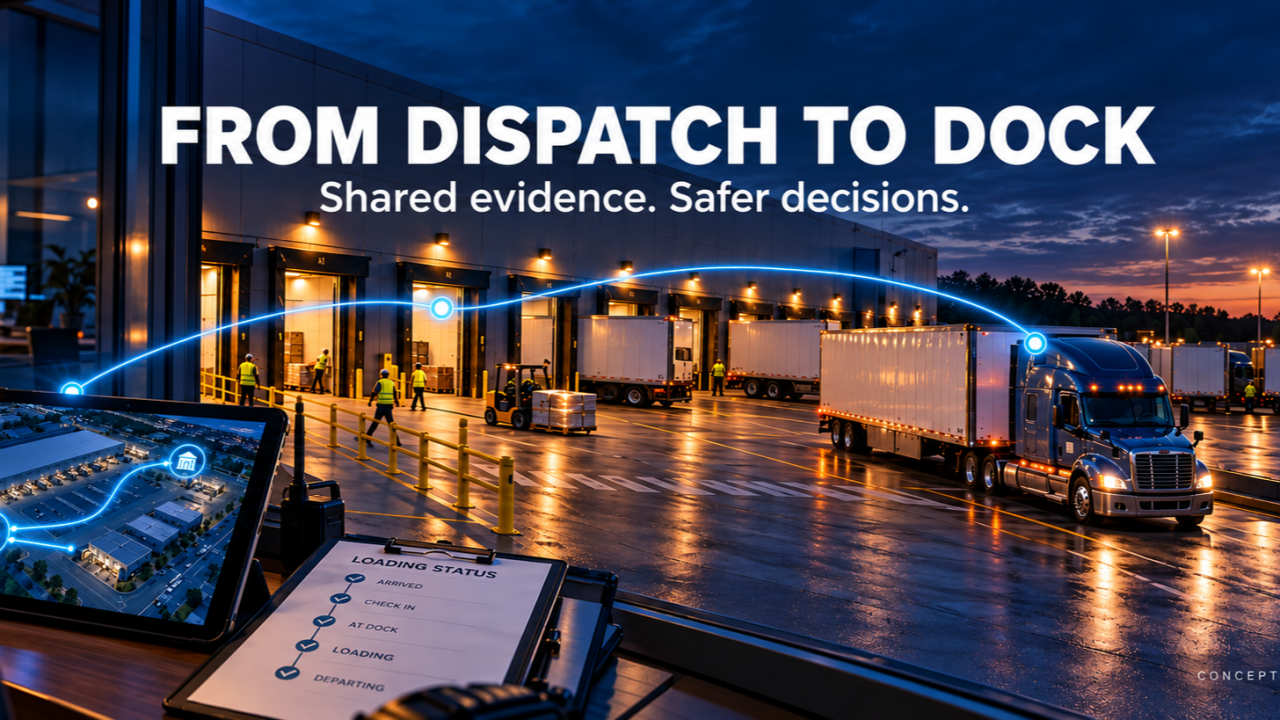
    AI-generated conceptual editorial illustration. Fictional people and setting; not documentary evidence. Wide illustrated loading bays with parked trailers and protected walkways linking dispatch and dock review.

    A truck’s arrival time is only one part of a dock appointment. For a coordination pilot, I would also want to know whether the goods are ready, the bay is available and the assigned equipment is cleared for its next job. A departure recommendation should show which of those conditions has actually been confirmed.

    This is a proposed workflow for one facility or customer lane. No dispatch-to-dock AI deployment or improvement is claimed here.

    Establish what the delay means

    FMCSA’s detention research page identifies a measurement problem: earlier work could not adequately separate ordinary loading and unloading from detention. [1] That is a useful warning for a local pilot. A long stay does not, by itself, identify its cause or the department responsible.

    I would agree on event definitions with dispatch, drivers and warehouse supervisors before collecting a baseline. Arrival, check-in, bay assignment, loading start and release should remain distinct. Record missing events as missing rather than allowing a model to invent a plausible sequence.

    A proposed assistant could bring approved records into a review queue and draft a short conflict summary. Its job would be to prepare the question: which record needs confirmation, and who can provide it? A source link and timestamp should accompany every important assertion.

    Make the next action specific

    Suppose, hypothetically, the estimated arrival falls outside the receiving window. The review card should identify the conflict, the receiving contact responsible for checking it and the next confirmation required. It should not quietly move the appointment or promise the customer a new delivery time.

    I would keep the initial pilot read-only. Staff could accept or reject a proposed action and record why. A missed warning, an unnecessary warning and a correct warning that nobody acted on are three different failures. Combining them into a single accuracy figure would conceal the operational problem.

    Protect the driver and the worksite

    FMCSA describes specific protections against carrier harassment involving ELD or connected-technology information and known or reasonably foreseeable hours-of-service violations. That does not make every digital alert harassment. It does mean the dispatch design must respect the rule’s particular boundary. [2]

    OSHA’s warehouse guidance addresses forklift and dock-edge hazards. [3] My operating recommendation is that any timing suggestion remain subordinate to the site’s safety process. A faster departure cannot justify unsafe movement, an unresolved equipment hold or pressure to bypass a required check.

    Measure a reliable handoff

    Compare the pilot with the existing process on the same lane. Review unresolved conflicts, duplicate calls, false alerts and the time to verified ownership. Keep a separate account of safety concerns and user objections. A service gain accompanied by worse safety conditions should fail the pilot.

    AI may help prepare a clearer shared picture. Whether it improves execution depends on the quality of the records, the usefulness of its summaries and the people authorized to act. Those are test questions, not benefits to announce in advance.

    SOURCES & EVIDENCE

    [1] Federal Motor Carrier Safety Administration (Updated 2025-10-03). Impact of Driver Detention Time on Safety and Operations. https://www.fmcsa.dot.gov/research-and-analysis/impact-driver-detention-time-safety-and-operations. Locator: Background and Project Goal. Supports: The distinction between ordinary dwell and detention, and the stated measurement gap. Limitations: Summarizes earlier research and a measurement gap. It is not a completed evaluation of an AI dock-coordination system. Checked: 2026-10-17.

    [2] Federal Motor Carrier Safety Administration (Updated 2018-03-27). Harassment Protection. https://www.fmcsa.dot.gov/hours-service/elds/harassment-protection. Locator: ELD Rule definition and Preventing Harassment. Supports: The specific ELD-linked harassment boundary. Limitations: A specific ELD-linked harassment protection; not every alert or use of ELD data constitutes harassment. Check controlling law and the facts for an actual case. Checked: 2026-10-17.

    [3] Occupational Safety and Health Administration (Undated live page; accessed 2026-10-17). Warehousing — Hazards and Solutions. https://www.osha.gov/warehousing/hazards-solutions. Locator: Forklift Operation, Other Considerations, and loading dock guidance. Supports: Warehouse forklift and dock hazards. Limitations: Hazard guidance, not a site-specific safety assessment or proof of AI effectiveness. Checked: 2026-10-17.

    HOW THE CONCLUSION WAS REACHED

    The sources establish a measurement ambiguity and safety constraints. The proposed event record and read-only queue are design responses to those constraints. They have not been validated as an effective intervention.

    LIMITATIONS

    No current rule thresholds, detention prevalence estimate or causal crash reduction is asserted. Local event quality, lawful access to driver data, integration and staff capacity remain untested. Regulatory sources must be refreshed before any implementation or public release.

    © 2026 H. Max Ottesen. All rights reserved.

    ← All articles & insights

    Original publication

  • Inventory Management Is Still Too Slow. Cameras, RFID, and AI May Change That.

    I think inventory management is still being discussed too much in the old way.

    SKU. FIFO. LIFO. EOQ. ROP. Safety stock. Cycle counts.

    Those concepts matter. But they mostly belong to a world where inventory is counted, scanned, reported, reconciled, and reviewed after the fact.

    The stronger question today is this:

    Why are we still depending so much on delayed inventory truth?

    We already have camera technology that can recognize faces, vehicles, labels, barcodes, defects, movement, and objects. In warehouses, that same direction can become very powerful.

    Imagine a camera system mounted across aisles, racks, or key inventory zones that can zoom into a shelf location, read barcodes or labels, recognize product placement, count visible units, and report what is actually sitting there back to the warehouse or inventory system.

    Now combine that with RFID.

    RFID does not have to do everything. It can act as the identity and locator signal.

    Computer vision can act as the visual confirmation layer.

    AI can compare both against the WMS, ERP, demand plan, replenishment rules, customer orders, and operational priorities.

    That is where inventory becomes a live operating signal.

    The system can ask:

    Is the right product in the right space? Does the shelf visually match the system quantity? Is the barcode or label correct? Is something misplaced? Is a stockout forming? Is the WMS saying one thing while the shelf says another? Does this need a cycle count, replenishment task, picking correction, or supervisor review?

    That is a different level of inventory control.

    Most companies still manage too much of this through handheld scans, manual counts, delayed reports, exception emails, and spreadsheets. That creates a permanent gap between what the system says and what the warehouse actually looks like.

    To me, the future is hybrid sensing.

    RFID gives identity and location. Cameras give visual truth. AI turns the mismatch into action.

    The advantage is not just knowing inventory better. The advantage is seeing the problem earlier and acting before it turns into a customer issue, picking error, stockout, billing problem, or working-capital drag.

    Inventory software should not only tell us what we think we have.

    It should show us what is actually there, what does not match, what is about to become a problem, and what action should happen next.

    That is when inventory management stops being a reporting function.

    It becomes an operating advantage.

    Original publication

  • Reliability across distributed operations

    Use consistent definitions across sites. Availability, uptime, on-time departure and on-time delivery describe different things. A review becomes confusing when teams use one label for several measures.

    Illustrative review: equipment readiness; loading constraints; planned versus actual departure; customer exceptions; recurring vendor issues. For each gap, record the source, the owner and the next review date.

    Bring the handoffs into the discussion. A vehicle can be ready while an order is not, and a site can meet its local target while creating a delay for the next site.

    Separate the immediate recovery action from the recurring correction. Recovering today’s delivery matters; resolving the repeat cause is what strengthens the operation.

    Use the same action format across sites, while leaving room for local constraints. This example is a suggested management practice, not an account of a particular client meeting.

    ← All insights

    Original publication

  • Global logistik bliver smartere. Kan ledelsen følge med?

    Læs den engelske original

    Global logistik i 2028. Udvikler AI sig hurtigere, end ledelserne kan følge med, og ansætter virksomhederne de rette folk til at håndtere det, der kommer?

    Af H. Max Ottesen

    Kunstig intelligens ændrer den globale logistik hurtigere, end mange virksomheder kan omlægge deres drift.

    Transportplanlægning, lagerstyring, lagerdrift og internationale forsyningskæder bliver stadig mere avancerede. Virksomheder investerer i systemer, der kan analysere enorme mængder information og anbefale en beslutning på få sekunder.

    Alligevel vender jeg tilbage til et mere grundlæggende spørgsmål. Kan de ledere, der har ansvaret for driften, følge med?

    Jeg har ejet virksomheder, ledet komplekse driftsorganisationer og arbejdet på tværs af brancher og internationale markeder. Det har givet mig stor tro på, hvad teknologi kan udrette, og gjort mig skeptisk over for forestillingen om, at et indkøb af bedre teknologi automatisk giver en bedre virksomhed.

    Et AI-system kan pege på ineffektiv drift. Det er ledelsens ansvar at gøre noget ved det. Med 2028 i sigte har virksomhederne måske mindre tid, end de tror, til at få omsat den indsigt til handling.

    Verdenshandlen ændrer sig. Det angår også USA

    Internationale forsyningskæder er gentagne gange blevet sat på prøve i det seneste årti. Pandemien afslørede svagheder i indkøb, lagerstyring og transportkapacitet. De efterfølgende geopolitiske forstyrrelser tvang virksomhederne til at genoverveje ruter, leverandører og driftsomkostninger.

    Nu påvirker investeringer i AI både de varer, verden handler med, og de systemer, der bruges til at transportere dem.

    I oktober 2026 forventede Verdenshandelsorganisationen, WTO, at mængden af varer handlet globalt ville vokse med 3,9 % i 2026 og 4,1 % i 2027. WTO opgjorde også, at varer, der understøtter AI, herunder halvledere og servere, stod for 47 % af væksten i den globale varehandel i første halvår 2026. Tallet måler AI-relaterede varers bidrag til handelsvæksten. Produktiviteten i logistik er et andet spørgsmål. [1]

    FN’s organisation for handel og udvikling, UNCTAD, opgjorde, at mængden af varer transporteret til søs steg med 2,2 % i 2024. Organisationen forventede dengang en vækst på blot 0,5 % i 2025. Omlægning af sejlruter har samtidig øget transportafstandene. UNCTAD opgjorde stigningen i søtransportarbejdet til 5,9 % målt i ton-sømil i 2024. [2]

    Når samme gods skal transporteres længere, stiger omkostningerne og behovet for transportkapacitet. For amerikanske producenter, detailhandlere, distributører og transportvirksomheder er det konkrete driftsproblemer. En international forstyrrelse kan ændre leveringsplaner, lagerbehov, transportomkostninger og aftaler med kunder flere tusinde kilometer væk.

    Selv en virksomhed, der primært opererer i USA, kan være stærkt afhængig af beslutninger andre steder i den globale forsyningskæde. Frem mod 2028 forventer jeg, at evnen til at reagere hurtigt på forandringer bliver mindst lige så vigtig som evnen til at forudse dem.

    Flere bruger AI. Hvor er de økonomiske resultater?

    I september 2026 fandt McKinsey, at knap 90 % af de adspurgte transportkøbere havde taget AI i brug til mindst én opgave på transportområdet. Det er en betydelig udbredelse. [3]

    I marts 2026 rapporterede Boston Consulting Group, at omkring én ud af ti af de adspurgte logistikleverandører havde opnået en målbar økonomisk effekt af AI. Undersøgelserne dækker forskellige grupper. Tilsammen illustrerer de forskellen mellem at tage AI i brug og at få et økonomisk udbytte af det. [4]

    En virksomhed kan indføre avanceret prognosesoftware og stadig træffe de samme indkøbsbeslutninger. Den kan købe værktøjer til transportoptimering og fortsat køre unødvendige kilometer. Den kan automatisere sit lager og samtidig lade ineffektive rutiner for lagerstyring fortsætte. Resultatet afhænger af, hvordan organisationen bruger teknologien.

    Jeg mener, at administrerende direktører og bestyrelser bør stille mere krævende spørgsmål om deres AI-investeringer.

    • Hvilket driftsproblem vil vi løse?
    • Hvad er det økonomiske udgangspunkt?
    • Hvem har ansvaret for at ændre processen?
    • Hvordan måler vi, om investeringen har virket?
    • Hvad gør vi, hvis resultaterne udebliver?

    Det er almindelige ledelsesspørgsmål. AI gør dem endnu vigtigere.

    Nogle driftsproblemer kræver først og fremmest ledelse

    I løbet af min karriere har jeg arbejdet i virksomheder, hvor de største muligheder for forbedring var ret tydelige. Driftsomkostningerne krævede nærmere gennemgang. Informationen lå spredt. Ansvaret var uklart, og procedurerne blev fulgt, fordi det var sådan, man plejede at gøre.

    Nogle gange fandtes de nødvendige oplysninger allerede. Det svære var at få folk til at handle på dem.

    Jeg har også lært, at bedre drift sjældent følger af én dramatisk beslutning. Som regel kræver det en række praktiske ændringer, konsekvent opfølgning og en ledelse, der er villig til at udfordre sine egne antagelser.

    AI kan finde mønstre, det ellers tager lang tid at opdage. Teknologien kan sammenligne transportalternativer, opdage usædvanlige mønstre i vedligeholdelsen, finde ubalancer i lagerbeholdningen og hjælpe driftsledere med at reagere, når forholdene ændrer sig.

    At finde problemet er første skridt. Nogen skal vurdere, om anbefalingen giver mening, tage højde for konsekvenserne og stå på mål for resultatet.

    Et AI-system kan eksempelvis anbefale at sænke lagerbeholdningen på et distributionscenter. Det kan frigøre arbejdskapital. Det kan også føre til svigt i leverancerne, hvis systemet regner med, at leverandørerne altid leverer som aftalt, overser aftaler med kunderne eller tager for lidt højde for uventet efterspørgsel. Beslutningen skal vurderes i den sammenhæng.

    Det er derfor, jeg ser den største mulighed i at kombinere AI med økonomisk dømmekraft og indgående kendskab til driften. Brug automatisering selektivt. Målet bør være hurtigere, bedre og mere ensartede beslutninger med tydeligt ansvar for konsekvenserne.

    Hvad bør virksomhederne have opnået inden 2028?

    Jeg ville afstå fra at sætte et præcist tal på størrelsen af det globale logistikmarked om to år. Grundlaget giver ikke belæg for den form for sikkerhed. Jeg ville koncentrere mig om, hvad virksomhederne realistisk kan forbedre frem mod 2028.

    • Transportplanlægning. Undersøg valget af transportører, ruternes effektivitet, udnyttelsen af materiel, tomkørsel og omkostningerne ved at håndtere driftsforstyrrelser.
    • Lagerdrift. Bedre prognoser, placering af beholdninger, bemandingsplanlægning og håndtering af afvigelser kan forbedre servicen og sænke unødvendige omkostninger.
    • Vedligeholdelse. AI-understøttet analyse kan fange problemer med materiellet, før de fører til dyre nedbrud. Det kræver pålidelige data og et vedligeholdelsesteam med ressourcer til at reagere.

    Der ligger også en betydelig mulighed i at samordne beslutninger mellem afdelingerne. Indkøb påvirker beholdningen. Beholdningen påvirker lagerdriften. Lagrenes placering påvirker transporten. Transporten påvirker kundeservicen og arbejdskapitalen.

    For mange virksomheder styrer stadig disse områder hver for sig. AI kan hjælpe med at samle beslutningerne, hvis ledelsen er villig til at fjerne de organisatoriske barrierer for samarbejde. [5]

    Inden 2028 ville jeg forvente, at en seriøs AI-satsning kunne vise målbare fremskridt i driftsomkostninger, leveringssikkerhed, udnyttelse af aktiver eller arbejdskapital. Nogle investeringer kræver infrastruktur, uddannelse og omlægning af arbejdsprocesserne, før gevinsten viser sig. Det er rimeligt. Mål forbedringen i driften, før indførelsen af teknologien regnes som en succes.

    Ansætter virksomhederne de rette ledere til omstillingen?

    Her bliver diskussionen mere ubekvem. Virksomheder investerer i teknologi, der ændrer, hvordan arbejdet udføres, hvordan beslutninger træffes, og hvordan resultater måles. Genovervejer de samtidig, hvad de har brug for hos dem, der skal lede driften?

    Ved ansættelse af ledere lægges der ofte stor vægt på erfaring fra en bestemt branche. Jeg forstår godt hvorfor. En virksomhed med strenge sikkerheds- eller myndighedskrav har brug for ledere, som forstår deres forpligtelser. Teknisk indsigt og kendskab til kunderne kan også være afgørende.

    Erfaring fra andre brancher fortjener også en reel vurdering. En leder, der har stået i spidsen for kompleks drift, truffet væsentlige økonomiske beslutninger, forhandlet internationale forretningsaftaler og ledet organisatoriske forandringer, kan have kompetencer, der kan bruges i en anden sektor.

    Produkter, regler og kunder kan være forskellige. Mange af de grundlæggende ledelsesspørgsmål går igen.

    • Hvordan styrer vi omkostningerne uden at forringe servicen?
    • Hvordan organiserer vi medarbejdere og ressourcer effektivt?
    • Hvordan vurderer vi investeringsbeslutninger?
    • Hvordan finder og retter vi svagheder i driften?
    • Hvordan indfører vi ny teknologi og bevarer kontrollen med virksomheden?

    Jeg mener, at virksomheder bør skelne mellem nødvendig brancheviden og ansættelseskrav, der mest af alt afspejler vaner. Det bliver vigtigere, når teknologien ændrer selve vilkårene for driften.

    En leder med dyb brancheviden kan få svært ved opgaven, hvis vedkommende stritter imod nødvendige ændringer. En leder med bredere erfaring og forståelse for økonomisk ansvar, driftsdisciplin og organisatorisk omstilling kan bidrage med et andet perspektiv. Begge baggrunde skal vurderes ud fra de kompetencer, virksomheden faktisk får brug for.

    AI ændrer kravene til ledelsens dømmekraft

    Jeg mener, at erfarne driftsledere og tekniske specialister har hver deres opgave. En driftsdirektør behøver ikke at blive AI-ingeniør. Teknologispecialister skal forstå, hvad systemerne kan, og hvordan de indføres ansvarligt. Driftsledere skal forstå de forretningsmæssige konsekvenser.

    De skal beslutte, hvor en investering giver mening, hvilke processer der skal lægges om, hvilke risici virksomheden kan acceptere, og hvordan resultaterne skal måles.

    De skal også forstå AI’s begrænsninger. Data kan være ufuldstændige. Anbefalinger kan være forkerte. Automatiserede beslutninger kan skabe problemer med sikkerhed, overholdelse af regler, cybersikkerhed og kundeservice.

    Et system, der fungerer under normale forhold, kan reagere anderledes, når en leverandør svigter, transportnetværket bliver forstyrret, eller efterspørgslen pludselig ændrer driftsprioriteterne. Det taler for tættere ledelsesmæssigt tilsyn.

    Jeg forventer, at de stærkeste ledelsesteams vil kombinere brancheviden, bred driftserfaring, økonomisk disciplin og teknisk ekspertise. Det afgørende er, at holdet tilsammen har kompetencerne.

    Derfor når jeg frem til denne vurdering

    Mit syn bygger på mange år som virksomhedsejer og driftsleder, hvor mine beslutninger havde reelle økonomiske og menneskelige konsekvenser. Jeg har set, hvor svært det kan være at ændre etablerede vaner. Jeg har også set, hvad klare prioriteringer, korrekte oplysninger og en ledelse, der tager ansvar, kan betyde.

    Derfor er jeg optimistisk om AI, samtidig med at jeg vil se, hvad teknologien faktisk betyder for driften. I 2028 forventer jeg, at flere logistikvirksomheder bruger AI i deres daglige arbejde. Det usikre er, hvor mange der også har ændret deres ledelsespraksis tilstrækkeligt til at få gavn af teknologien.

    Nogle virksomheder vil forbedre sig ved at koble teknologien til praktiske beslutninger i driften. Andre kan opdage, at dyre systemer ikke kan opveje organisatorisk opsplitning, manglende økonomisk disciplin eller en ledelse, der holder fast i sine antagelser.

    Jeg mener også, at virksomheder bør overveje, hvor snævert de definerer den erfaring, der kræves af den øverste driftsledelse. Brancheviden er stadig værdifuld. Evnen til at håndtere kompleksitet, vurdere økonomiske konsekvenser, lede medarbejdere og tilpasse sig ændrede vilkår fortjener lige så stor opmærksomhed.

    De næste to år afgør ikke alle spørgsmål om AI. De kan imidlertid vise, hvilke virksomheder der faktisk ændrer den måde, de arbejder på, og hvilke der blot køber ny teknologi.

    Det efterlader to spørgsmål, jeg vil stille til administrerende direktører, bestyrelser og dem, der rekrutterer ledere.

    • Ændrer vi vores forventninger til driftsledelsen hurtigt nok til at følge med udviklingen i AI?
    • Ansætter vi ud fra den erfaring, virksomheden havde brug for i går, eller ud fra den dømmekraft og de kompetencer, den får brug for i morgen?

    Kilder og belæg

    1. World Trade Organization, 8. oktober 2026. Prognoser for varehandlen i 2026 og 2027 samt opgørelsen af AI-relaterede varers bidrag til væksten i første halvår 2026. AI boom and trade resilience to Middle East crisis lift outlook, but gains to be uneven.
    2. UN Trade and Development, 24. september 2025. Søtransportmængde og ton-sømil i 2024 samt det daværende skøn for 2025. Review of Maritime Transport 2025: Staying the Course in Turbulent Waters. Officielt resumé.
    3. McKinsey & Company, 8. september 2026. AI-anvendelse blandt de adspurgte transportkøbere og betydningen af at koble AI til driftsbeslutninger. Creating value from AI and digital capabilities in logistics operations.
    4. Boston Consulting Group, 27. marts 2026. Den selvrapporterede økonomiske effekt blandt de adspurgte logistikleverandører og barrierer for bredere anvendelse. AI Is Already Moving the Logistics Industry Forward.
    5. Boston Consulting Group, 24. august 2026. Systemer, der ikke hænger sammen, barrierer for indførelse, organisatoriske kompetencer og økonomisk afkast. AI Hasn’t Fully Paid Off Yet in Logistics. But It Will.

    Vurderingen frem mod 2028, argumenterne om rekruttering og anbefalingerne til ledelsen er mine egne. Kilderne belyser udviklingen i handel, anvendelse og økonomiske resultater. Undersøgelserne fra McKinsey og BCG om anvendelse og udbytte omfatter forskellige grupper og giver derfor hver deres billede af udviklingen.

  • Global Logistics Is Getting Smarter. Are the People Running It?

    Global Logistics Is Getting Smarter. Are the People Running It?

    Læs på dansk

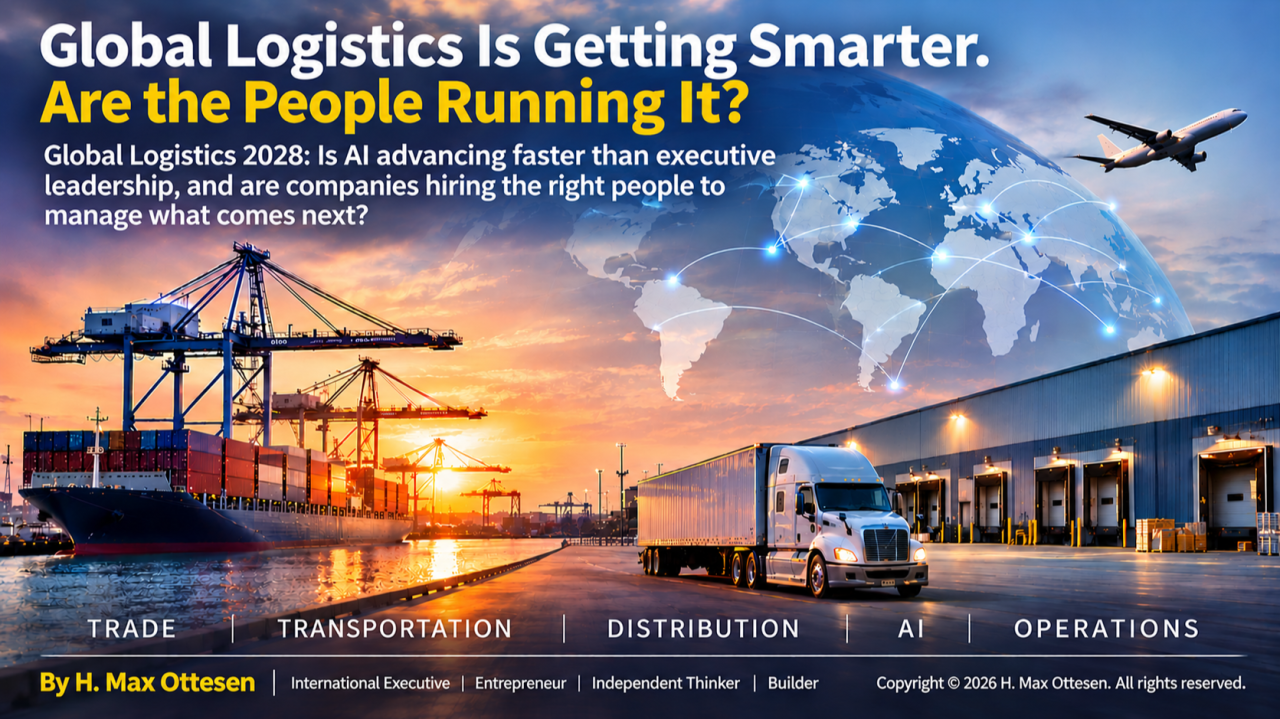
    Global Logistics 2028: Is AI advancing faster than executive leadership, and are companies hiring the right people to manage what comes next?

    By H. Max Ottesen

    Artificial intelligence is changing global logistics faster than many companies can reorganize the way they operate.

    Transportation planning, inventory management, warehouse operations and international supply chains are becoming more sophisticated. Companies are investing in systems that can analyze enormous amounts of information and recommend decisions in seconds.

    But I keep coming back to a more basic question.

    Are the executives running these businesses keeping up?

    I have owned companies, managed complex operations and worked across industries and international markets. That experience has made me enthusiastic about what technology can accomplish, but skeptical of the assumption that buying better technology automatically produces a better business.

    An AI system can identify an inefficient operation. It cannot guarantee that management will do anything about it.

    And with 2028 approaching, companies have less time than they may think to resolve that distinction.

    Global Trade Is Changing. The United States Cannot Ignore It.

    International supply chains have been tested repeatedly over the past decade.

    The pandemic exposed weaknesses in sourcing, inventory management and transportation capacity. Subsequent geopolitical disruptions forced businesses to reconsider routes, suppliers and operating costs.

    Now AI investment is influencing the goods being traded as well as the systems used to transport them.

    In October 2026, the World Trade Organization projected global merchandise trade volume growth of 3.9% for 2026 and 4.1% for 2027.

    The WTO also reported that AI-enabling goods, including semiconductors and servers, accounted for 47% of global merchandise trade growth during the first half of 2026.

    That is significant, but we should be careful about what it means.

    The figure does not indicate that AI increased logistics productivity by 47%. It reflects the contribution of AI-related goods to international trade growth.

    At the same time, UN Trade and Development reported that seaborne trade volume grew 2.2% in 2024 and projected growth of just 0.5% for 2025.

    Shipping distances have also increased as vessels have been rerouted around disruptions. UNCTAD reported a 5.9% increase in shipping ton-miles in 2024.

    Moving the same cargo over longer distances creates additional costs and demands more transportation capacity.

    For American manufacturers, retailers, distributors and transportation companies, these are practical operating problems.

    An international disruption can change delivery schedules, inventory requirements, transportation costs and customer commitments thousands of miles away.

    A business operating primarily in the United States can still depend heavily on decisions made across the global supply chain.

    By 2028, I expect the ability to respond quickly to these changes to matter at least as much as the ability to predict them.

    AI Adoption Is Increasing. Financial Results Are Another Matter.

    McKinsey's September 2026 research found that nearly 90% of surveyed shippers had adopted at least one transportation AI use case.

    That is substantial adoption.

    But Boston Consulting Group reported in March 2026 that only about one in ten logistics service providers in its survey had achieved measurable financial impact from AI.

    These studies cover different populations, so they should not be compared as though they measured the same companies.

    They do, however, highlight an important distinction.

    Using AI is not the same as making money from AI.

    A company can deploy sophisticated forecasting software without improving its purchasing decisions.

    It can introduce transportation optimization tools without reducing avoidable miles.

    It can install automated warehouse systems while leaving inefficient inventory practices untouched.

    The technology may be capable of improving performance. Whether it actually does so depends on how the organization uses it.

    I believe CEOs and boards should be asking more demanding questions about AI investments.

    What operating problem are we solving?

    What is the financial baseline?

    Who is responsible for changing the process?

    How will we measure whether the investment worked?

    And what happens if the results fall short?

    Those are ordinary management questions. AI does not make them less important.

    It makes them more important.

    The Problem Isn't Always Technology. Sometimes It's Management.

    Throughout my career, I have been involved in businesses where the greatest opportunities for improvement were not particularly mysterious.

    Operating costs needed closer examination. Information was fragmented. Responsibilities were unclear. Established procedures were followed because they had always been followed.

    In some cases, the necessary information already existed.

    The difficulty was getting people to act on it.

    I have also learned that operational improvement rarely comes from one dramatic decision. It usually requires a series of practical changes, consistent follow-through and management willing to challenge its own assumptions.

    AI can help identify patterns that would otherwise take considerable time to uncover.

    It can compare transportation alternatives, detect unusual maintenance trends, identify inventory imbalances and help managers respond to changing conditions.

    But identifying a problem is only the beginning.

    Someone must decide whether the recommendation makes sense, consider the consequences and take responsibility for the result.

    An AI system might recommend reducing inventory at a distribution center.

    That could improve working capital.

    It could also create service failures if the system does not adequately account for supplier reliability, customer commitments or unexpected demand.

    The decision cannot be evaluated in isolation.

    That is why I believe the real opportunity is to connect AI with financial judgment and a detailed understanding of how the business operates.

    The objective should not be to automate every decision.

    It should be to improve the quality, speed and consistency of decisions while preserving appropriate accountability.

    What Should Companies Accomplish by 2028?

    I would not attempt to predict an exact global logistics market value two years from now.

    The evidence does not justify that level of certainty.

    Instead, I would concentrate on what businesses can realistically improve between now and 2028.

    Transportation planning is an obvious starting point.

    Companies should be examining carrier selection, route efficiency, equipment utilization, empty miles and the cost of responding to disruptions.

    Warehouse operations offer another opportunity.

    Better forecasting, inventory positioning, labor planning and exception management can improve service while reducing unnecessary costs.

    Maintenance is equally important.

    AI-supported analysis can help identify equipment problems before they become expensive failures, provided the information is reliable and maintenance teams have the resources to respond.

    There is also a substantial opportunity in connecting decisions across departments.

    Purchasing decisions affect inventory. Inventory affects warehousing. Warehouse locations affect transportation. Transportation affects customer service and working capital.

    Too many businesses still manage these responsibilities as separate functions.

    AI may help connect them, but only if executives are willing to address the organizational boundaries that prevent coordination.

    By 2028, I would expect a serious AI investment program to demonstrate measurable progress in operating costs, service reliability, asset utilization or working capital.

    Not every investment will produce immediate returns. Some require infrastructure, training and process redesign before benefits become visible.

    That is reasonable.

    What is not reasonable is treating technology adoption itself as proof of business improvement.

    Are Companies Hiring the Right Executives for This Change?

    This is where the discussion becomes more uncomfortable.

    Businesses are investing in technology that changes how work is performed, how decisions are made and how performance is measured.

    But are they reconsidering what they need from the people running those operations?

    Executive recruitment often places considerable emphasis on experience within a particular industry.

    I understand why.

    A business operating under demanding safety or regulatory requirements needs leaders who appreciate those obligations. Technical knowledge and customer relationships can also be essential.

    Industry experience should not be dismissed.

    But neither should experience gained outside that industry.

    An executive who has managed complex operations, made substantial financial decisions, negotiated international business relationships and led organizational change may have capabilities that transfer well to another sector.

    The products may be different. The regulations may be different. The customers may be different.

    But many of the underlying management challenges remain familiar.

    How do we control costs without damaging service?

    How do we organize people and resources effectively?

    How do we evaluate investment decisions?

    How do we identify operational weaknesses and correct them?

    How do we integrate technology without losing control of the business?

    I believe companies should distinguish between industry knowledge that is genuinely essential and hiring preferences that simply reflect familiarity.

    That distinction becomes increasingly important when technology is changing the operating environment itself.

    An executive who knows an industry extremely well but resists necessary change may struggle.

    An executive with broader experience who understands financial accountability, operational discipline and organizational transformation may bring a different perspective.

    Neither background guarantees success.

    The question is whether recruitment processes are evaluating the capabilities that the business will actually need.

    AI Should Change Executive Expectations, Not Eliminate Executive Judgment.

    I do not believe the answer is to replace experienced executives with technology specialists.

    Nor do I believe companies should expect every COO or VP of Operations to become an AI engineer.

    The responsibilities are different.

    Technology specialists need to understand what systems can accomplish and how to implement them responsibly.

    Operations executives need to understand the business consequences.

    They must decide where investment makes sense, which processes require redesign, what risks are acceptable and how results will be measured.

    They must also understand the limitations of AI.

    Data can be incomplete. Recommendations can be wrong. Automated decisions can create safety, compliance, cybersecurity and customer-service problems.

    A system that works well under normal conditions may behave differently when suppliers fail, transportation networks are disrupted or unexpected demand changes operating priorities.

    These are reasons for stronger executive oversight, not weaker oversight.

    I believe the most effective leadership teams will combine industry knowledge, broad operating experience, financial discipline and technical expertise.

    That combination matters more than expecting one executive to possess every specialized skill.

    Why I've Reached This Conclusion

    My view comes from years of owning businesses, managing operations and making decisions where the financial and human consequences were real.

    I have seen how difficult it can be to change established practices.

    I have also seen the difference that clear priorities, accurate information and accountable management can make.

    That is why I am optimistic about AI but unwilling to confuse technological capability with business performance.

    By 2028, I expect more logistics companies to have AI embedded in everyday operations.

    What remains uncertain is how many will have changed their management practices sufficiently to benefit from it.

    Some businesses will improve because they connect technology to practical operating decisions.

    Others may discover that expensive systems cannot compensate for fragmented organizations, poor financial discipline or executives unwilling to challenge established assumptions.

    I also believe companies should reconsider how narrowly they define the experience required for senior operational leadership.

    Industry knowledge remains valuable. But the ability to manage complexity, evaluate financial consequences, lead people and adapt to changing conditions deserves equal attention.

    The next two years will not settle every question about AI.

    They may, however, reveal which companies are genuinely changing how they operate and which are simply purchasing new technology.

    And that leaves two questions I would put to CEOs, boards and executive recruiters.

    Are we changing our expectations of operational leadership quickly enough to keep pace with AI?

    And are we hiring executives based on the experience businesses needed yesterday, or the judgment and capabilities they will need tomorrow?

    SOURCES & EVIDENCE

    1. World Trade Organization. October 8, 2026. "AI boom and trade resilience to Middle East crisis lift outlook, but gains to be uneven." Supports the 2026–2027 merchandise trade forecasts and the contribution of AI-enabling goods to global trade growth. https://www.wto.org/english/news_e/news26_e/stat_08oct26_510_e.htm
    2. UN Trade and Development. September 24, 2025. "Review of Maritime Transport 2025: Staying the Course in Turbulent Waters." Supports the 2024 maritime trade figures, the 2025 outlook and shipping ton-mile growth. https://unctad.org/publication/review-maritime-transport-2025
    3. McKinsey & Company. September 8, 2026. "Creating Value from AI and Digital Capabilities in Logistics Operations." Supports the reported AI adoption rate among surveyed shippers and the importance of connecting AI to operating decisions. https://www.mckinsey.com/capabilities/operations/our-insights/creating-value-from-ai-and-digital-capabilities-in-logistics-operations
    4. Boston Consulting Group. March 27, 2026. "AI Is Already Moving the Logistics Industry Forward." Supports the reported financial-impact gap among surveyed logistics service providers and the barriers to broader AI implementation. https://www.bcg.com/publications/2026/ai-is-already-moving-the-logistics-industry-forward
    5. Boston Consulting Group. August 24, 2026. "AI Hasn't Fully Paid Off Yet in Logistics. But It Will." Supports the discussion of disconnected systems, implementation barriers, organizational capabilities and financial returns. https://www.bcg.com/publications/2026/why-ai-isnt-delivering-roi-logistics

    The 2028 outlook, executive recruitment arguments and management recommendations are my analysis and opinions. They are not presented as forecasts or conclusions established by the cited research.

    Copyright © 2026 H. Max Ottesen. All rights reserved.

    Original publication