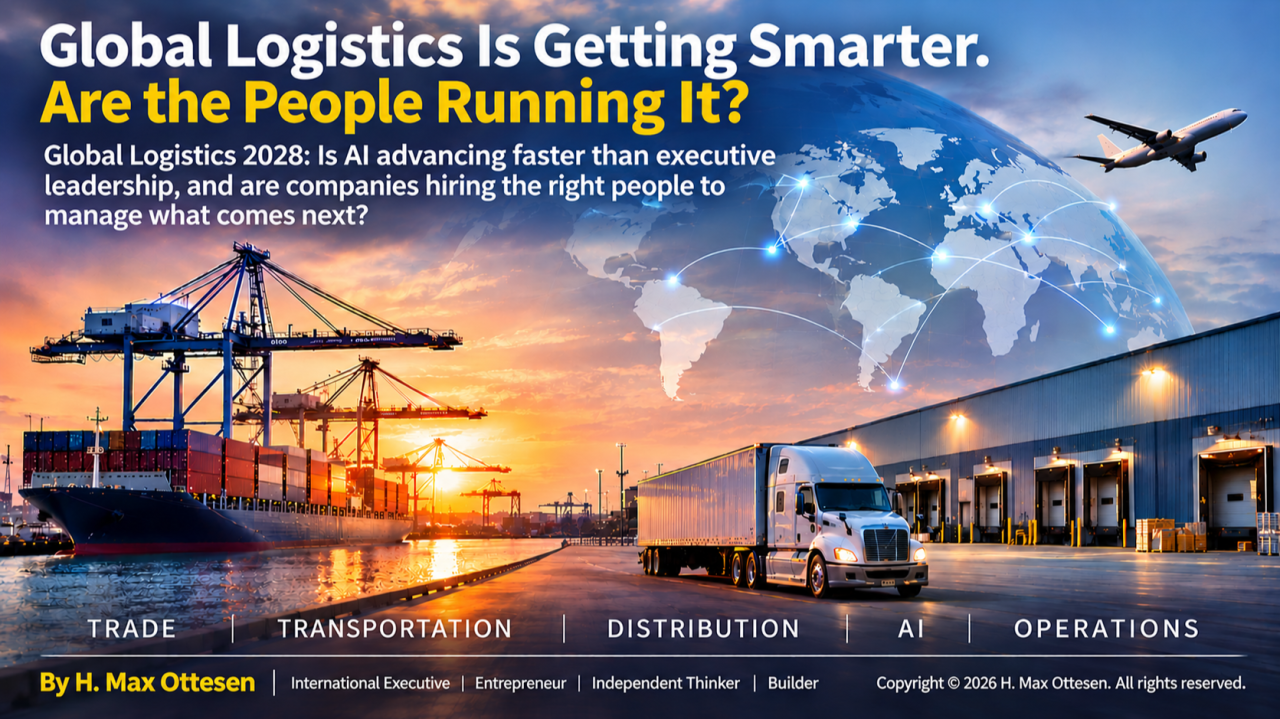
Global Logistics 2028: Is AI advancing faster than executive leadership, and are companies hiring the right people to manage what comes next?
By H. Max Ottesen
Artificial intelligence is changing global logistics faster than many companies can reorganize the way they operate.
Transportation planning, inventory management, warehouse operations and international supply chains are becoming more sophisticated. Companies are investing in systems that can analyze enormous amounts of information and recommend decisions in seconds.
But I keep coming back to a more basic question.
Are the executives running these businesses keeping up?
I have owned companies, managed complex operations and worked across industries and international markets. That experience has made me enthusiastic about what technology can accomplish, but skeptical of the assumption that buying better technology automatically produces a better business.
An AI system can identify an inefficient operation. It cannot guarantee that management will do anything about it.
And with 2028 approaching, companies have less time than they may think to resolve that distinction.
Global Trade Is Changing. The United States Cannot Ignore It.
International supply chains have been tested repeatedly over the past decade.
The pandemic exposed weaknesses in sourcing, inventory management and transportation capacity. Subsequent geopolitical disruptions forced businesses to reconsider routes, suppliers and operating costs.
Now AI investment is influencing the goods being traded as well as the systems used to transport them.
In October 2026, the World Trade Organization projected global merchandise trade volume growth of 3.9% for 2026 and 4.1% for 2027.
The WTO also reported that AI-enabling goods, including semiconductors and servers, accounted for 47% of global merchandise trade growth during the first half of 2026.
That is significant, but we should be careful about what it means.
The figure does not indicate that AI increased logistics productivity by 47%. It reflects the contribution of AI-related goods to international trade growth.
At the same time, UN Trade and Development reported that seaborne trade volume grew 2.2% in 2024 and projected growth of just 0.5% for 2025.
Shipping distances have also increased as vessels have been rerouted around disruptions. UNCTAD reported a 5.9% increase in shipping ton-miles in 2024.
Moving the same cargo over longer distances creates additional costs and demands more transportation capacity.
For American manufacturers, retailers, distributors and transportation companies, these are practical operating problems.
An international disruption can change delivery schedules, inventory requirements, transportation costs and customer commitments thousands of miles away.
A business operating primarily in the United States can still depend heavily on decisions made across the global supply chain.
By 2028, I expect the ability to respond quickly to these changes to matter at least as much as the ability to predict them.
AI Adoption Is Increasing. Financial Results Are Another Matter.
McKinsey's September 2026 research found that nearly 90% of surveyed shippers had adopted at least one transportation AI use case.
That is substantial adoption.
But Boston Consulting Group reported in March 2026 that only about one in ten logistics service providers in its survey had achieved measurable financial impact from AI.
These studies cover different populations, so they should not be compared as though they measured the same companies.
They do, however, highlight an important distinction.
Using AI is not the same as making money from AI.
A company can deploy sophisticated forecasting software without improving its purchasing decisions.
It can introduce transportation optimization tools without reducing avoidable miles.
It can install automated warehouse systems while leaving inefficient inventory practices untouched.
The technology may be capable of improving performance. Whether it actually does so depends on how the organization uses it.
I believe CEOs and boards should be asking more demanding questions about AI investments.
What operating problem are we solving?
What is the financial baseline?
Who is responsible for changing the process?
How will we measure whether the investment worked?
And what happens if the results fall short?
Those are ordinary management questions. AI does not make them less important.
It makes them more important.
The Problem Isn't Always Technology. Sometimes It's Management.
Throughout my career, I have been involved in businesses where the greatest opportunities for improvement were not particularly mysterious.
Operating costs needed closer examination. Information was fragmented. Responsibilities were unclear. Established procedures were followed because they had always been followed.
In some cases, the necessary information already existed.
The difficulty was getting people to act on it.
I have also learned that operational improvement rarely comes from one dramatic decision. It usually requires a series of practical changes, consistent follow-through and management willing to challenge its own assumptions.
AI can help identify patterns that would otherwise take considerable time to uncover.
It can compare transportation alternatives, detect unusual maintenance trends, identify inventory imbalances and help managers respond to changing conditions.
But identifying a problem is only the beginning.
Someone must decide whether the recommendation makes sense, consider the consequences and take responsibility for the result.
An AI system might recommend reducing inventory at a distribution center.
That could improve working capital.
It could also create service failures if the system does not adequately account for supplier reliability, customer commitments or unexpected demand.
The decision cannot be evaluated in isolation.
That is why I believe the real opportunity is to connect AI with financial judgment and a detailed understanding of how the business operates.
The objective should not be to automate every decision.
It should be to improve the quality, speed and consistency of decisions while preserving appropriate accountability.
What Should Companies Accomplish by 2028?
I would not attempt to predict an exact global logistics market value two years from now.
The evidence does not justify that level of certainty.
Instead, I would concentrate on what businesses can realistically improve between now and 2028.
Transportation planning is an obvious starting point.
Companies should be examining carrier selection, route efficiency, equipment utilization, empty miles and the cost of responding to disruptions.
Warehouse operations offer another opportunity.
Better forecasting, inventory positioning, labor planning and exception management can improve service while reducing unnecessary costs.
Maintenance is equally important.
AI-supported analysis can help identify equipment problems before they become expensive failures, provided the information is reliable and maintenance teams have the resources to respond.
There is also a substantial opportunity in connecting decisions across departments.
Purchasing decisions affect inventory. Inventory affects warehousing. Warehouse locations affect transportation. Transportation affects customer service and working capital.
Too many businesses still manage these responsibilities as separate functions.
AI may help connect them, but only if executives are willing to address the organizational boundaries that prevent coordination.
By 2028, I would expect a serious AI investment program to demonstrate measurable progress in operating costs, service reliability, asset utilization or working capital.
Not every investment will produce immediate returns. Some require infrastructure, training and process redesign before benefits become visible.
That is reasonable.
What is not reasonable is treating technology adoption itself as proof of business improvement.
Are Companies Hiring the Right Executives for This Change?
This is where the discussion becomes more uncomfortable.
Businesses are investing in technology that changes how work is performed, how decisions are made and how performance is measured.
But are they reconsidering what they need from the people running those operations?
Executive recruitment often places considerable emphasis on experience within a particular industry.
I understand why.
A business operating under demanding safety or regulatory requirements needs leaders who appreciate those obligations. Technical knowledge and customer relationships can also be essential.
Industry experience should not be dismissed.
But neither should experience gained outside that industry.
An executive who has managed complex operations, made substantial financial decisions, negotiated international business relationships and led organizational change may have capabilities that transfer well to another sector.
The products may be different. The regulations may be different. The customers may be different.
But many of the underlying management challenges remain familiar.
How do we control costs without damaging service?
How do we organize people and resources effectively?
How do we evaluate investment decisions?
How do we identify operational weaknesses and correct them?
How do we integrate technology without losing control of the business?
I believe companies should distinguish between industry knowledge that is genuinely essential and hiring preferences that simply reflect familiarity.
That distinction becomes increasingly important when technology is changing the operating environment itself.
An executive who knows an industry extremely well but resists necessary change may struggle.
An executive with broader experience who understands financial accountability, operational discipline and organizational transformation may bring a different perspective.
Neither background guarantees success.
The question is whether recruitment processes are evaluating the capabilities that the business will actually need.
AI Should Change Executive Expectations, Not Eliminate Executive Judgment.
I do not believe the answer is to replace experienced executives with technology specialists.
Nor do I believe companies should expect every COO or VP of Operations to become an AI engineer.
The responsibilities are different.
Technology specialists need to understand what systems can accomplish and how to implement them responsibly.
Operations executives need to understand the business consequences.
They must decide where investment makes sense, which processes require redesign, what risks are acceptable and how results will be measured.
They must also understand the limitations of AI.
Data can be incomplete. Recommendations can be wrong. Automated decisions can create safety, compliance, cybersecurity and customer-service problems.
A system that works well under normal conditions may behave differently when suppliers fail, transportation networks are disrupted or unexpected demand changes operating priorities.
These are reasons for stronger executive oversight, not weaker oversight.
I believe the most effective leadership teams will combine industry knowledge, broad operating experience, financial discipline and technical expertise.
That combination matters more than expecting one executive to possess every specialized skill.
Why I've Reached This Conclusion
My view comes from years of owning businesses, managing operations and making decisions where the financial and human consequences were real.
I have seen how difficult it can be to change established practices.
I have also seen the difference that clear priorities, accurate information and accountable management can make.
That is why I am optimistic about AI but unwilling to confuse technological capability with business performance.
By 2028, I expect more logistics companies to have AI embedded in everyday operations.
What remains uncertain is how many will have changed their management practices sufficiently to benefit from it.
Some businesses will improve because they connect technology to practical operating decisions.
Others may discover that expensive systems cannot compensate for fragmented organizations, poor financial discipline or executives unwilling to challenge established assumptions.
I also believe companies should reconsider how narrowly they define the experience required for senior operational leadership.
Industry knowledge remains valuable. But the ability to manage complexity, evaluate financial consequences, lead people and adapt to changing conditions deserves equal attention.
The next two years will not settle every question about AI.
They may, however, reveal which companies are genuinely changing how they operate and which are simply purchasing new technology.
And that leaves two questions I would put to CEOs, boards and executive recruiters.
Are we changing our expectations of operational leadership quickly enough to keep pace with AI?
And are we hiring executives based on the experience businesses needed yesterday, or the judgment and capabilities they will need tomorrow?
SOURCES & EVIDENCE
- World Trade Organization. October 8, 2026. "AI boom and trade resilience to Middle East crisis lift outlook, but gains to be uneven." Supports the 2026–2027 merchandise trade forecasts and the contribution of AI-enabling goods to global trade growth. https://www.wto.org/english/news_e/news26_e/stat_08oct26_510_e.htm
- UN Trade and Development. September 24, 2025. "Review of Maritime Transport 2025: Staying the Course in Turbulent Waters." Supports the 2024 maritime trade figures, the 2025 outlook and shipping ton-mile growth. https://unctad.org/publication/review-maritime-transport-2025
- McKinsey & Company. September 8, 2026. "Creating Value from AI and Digital Capabilities in Logistics Operations." Supports the reported AI adoption rate among surveyed shippers and the importance of connecting AI to operating decisions. https://www.mckinsey.com/capabilities/operations/our-insights/creating-value-from-ai-and-digital-capabilities-in-logistics-operations
- Boston Consulting Group. March 27, 2026. "AI Is Already Moving the Logistics Industry Forward." Supports the reported financial-impact gap among surveyed logistics service providers and the barriers to broader AI implementation. https://www.bcg.com/publications/2026/ai-is-already-moving-the-logistics-industry-forward
- Boston Consulting Group. August 24, 2026. "AI Hasn't Fully Paid Off Yet in Logistics. But It Will." Supports the discussion of disconnected systems, implementation barriers, organizational capabilities and financial returns. https://www.bcg.com/publications/2026/why-ai-isnt-delivering-roi-logistics
The 2028 outlook, executive recruitment arguments and management recommendations are my analysis and opinions. They are not presented as forecasts or conclusions established by the cited research.
Copyright © 2026 H. Max Ottesen. All rights reserved.